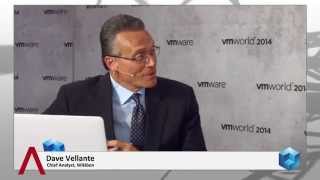
Dheeraj Pandey, Nutanix, at VMworld 2014 with John Furrier and Dave Vellante
@theCUBE
#vmworld2014
Dheeraj Pandey believes his company, Nutanix, Inc. CEO, is just beginning to blossom and will continue to expand. At this week’s VMworld 2014 conference, there’s been a buzz about Nutanix’s most recent financing round of $140 million, announced this morning. In conversation with Dave Vellante and John Furrier at SiliconANGLE’s roving news desk theCUBE, Pandey expounded on aspects of the recent Nutanix funding round, the reasons for his company’s success, and his predictions for the future of Nutanix.
Nutanix Funding: a pre-IPO
In this most recent round of funding, Pandey said that his business focused on building a relationship “with the best investors who buy into the IPO as well.” It was about the character of investors.
Calling Nutanix’s most recent round of funding a “pre-IPO,” Furrier wondered whether anybody sold their shares of Nutanix. Pandey replied that, in fact, no one had sold. “People believe in this company,” he said. Employees and stakeholders understand that while Nutanix is boxed into the same category as hyper-converge right now, it will break down the category barriers and continue to grow.
Read much more after the video.
The need for integration will sustain Nutanix performance
Now that Nutanix has received another massive round of funding, Furrier asked, how will they sustain their performance? Responding that their role in storage trends has largely to do with integration, Pandey explained “it’s about seamlessly integrating everything together.” If the trend is self service apps, he said, then “they need self-service ways to deal with performance issues.”
He cited the example of Docker, saying that it’s an excellent orchestration tool, but once everything is provision, “now what?” Nutanix can help with the “hand-holding” to aid practitioners in figuring out “why it’s running slow or what needs to move. There are a ton of analytics to be done.”
Once provisioning is done, Furrier pointed out, there still needs to be an enabler for the developer to ensure that “the infrastructure isn’t going to break.” Pandey agreed, saying that when apps are decoupled from infrastructure, “you still have to live with infrastructure. An app will not just run in a vacuum.” Docker, he said, is a great mechanism, but Nutanix will help put policies on top of it.
For Nutanix realationships, transparency are key
Nutanix is more transparent with its numbers than many other players in the tech world, if you ask Pandey. One of the reasons Nutanix chooses to be so transparent is because of it’s confidence in its products. “We’re very comfortable with Dell carrying an EVO RAIL platform and carrying an Nutanix,” said Pandey, going on to note his dedication to the market. “This is a marathon,” he said, and eventually the dust will settle and the top product will still be standing.
Nutanix is very open about its numbers with customers. It might not always be that way, he acknowledged, but right now, “We won’t let the lawyers run the company.” Pandey communicated that their customers love that amount of transparency because it communicates that Nutanix isn’t hiding anything: they’re proud of the company. Nutanix even openly addresses its weaknesses, and Pandey expressed that he thinks it makes them a better company.
As of July 31st, Pandey relayed, Nutanix has “800 customers. We’re adding 200 to 250 logos a quarter. And we have a lot of repeat customers.” In the first twelve months after their initial purchase, Pandey said that about 70 percent of their customers come back to buy two times more.
Forgot Password
Almost there!
We just sent you a verification email. Please verify your account to gain access to
VMworld 2014 | San Francisco. If you don’t think you received an email check your
spam folder.
In order to sign in, enter the email address you used to registered for the event. Once completed, you will receive an email with a verification link. Open this link to automatically sign into the site.
Register For VMworld 2014 | San Francisco
Please fill out the information below. You will recieve an email with a verification link confirming your registration. Click the link to automatically sign into the site.
You’re almost there!
We just sent you a verification email. Please click the verification button in the email. Once your email address is verified, you will have full access to all event content for VMworld 2014 | San Francisco.
I want my badge and interests to be visible to all attendees.
Checking this box will display your presense on the attendees list, view your profile and allow other attendees to contact you via 1-1 chat. Read the Privacy Policy. At any time, you can choose to disable this preference.
Select your Interests!
add
Upload your photo
Uploading..
OR
Connect via Twitter
Connect via Linkedin
EDIT PASSWORD
Share
Forgot Password
Almost there!
We just sent you a verification email. Please verify your account to gain access to
VMworld 2014 | San Francisco. If you don’t think you received an email check your
spam folder.
In order to sign in, enter the email address you used to registered for the event. Once completed, you will receive an email with a verification link. Open this link to automatically sign into the site.
Sign in to gain access to VMworld 2014 | San Francisco
Please sign in with LinkedIn to continue to VMworld 2014 | San Francisco. Signing in with LinkedIn ensures a professional environment.
Are you sure you want to remove access rights for this user?
Details
Manage Access
email address
Community Invitation
Dheeraj Pandey, Nutanix | VMworld 2014
Dheeraj Pandey, Nutanix, at VMworld 2014 with John Furrier and Dave Vellante
@theCUBE
#vmworld2014
Dheeraj Pandey believes his company, Nutanix, Inc. CEO, is just beginning to blossom and will continue to expand. At this week’s VMworld 2014 conference, there’s been a buzz about Nutanix’s most recent financing round of $140 million, announced this morning. In conversation with Dave Vellante and John Furrier at SiliconANGLE’s roving news desk theCUBE, Pandey expounded on aspects of the recent Nutanix funding round, the reasons for his company’s success, and his predictions for the future of Nutanix.
Nutanix Funding: a pre-IPO
In this most recent round of funding, Pandey said that his business focused on building a relationship “with the best investors who buy into the IPO as well.” It was about the character of investors.
Calling Nutanix’s most recent round of funding a “pre-IPO,” Furrier wondered whether anybody sold their shares of Nutanix. Pandey replied that, in fact, no one had sold. “People believe in this company,” he said. Employees and stakeholders understand that while Nutanix is boxed into the same category as hyper-converge right now, it will break down the category barriers and continue to grow.
Read much more after the video.
The need for integration will sustain Nutanix performance
Now that Nutanix has received another massive round of funding, Furrier asked, how will they sustain their performance? Responding that their role in storage trends has largely to do with integration, Pandey explained “it’s about seamlessly integrating everything together.” If the trend is self service apps, he said, then “they need self-service ways to deal with performance issues.”
He cited the example of Docker, saying that it’s an excellent orchestration tool, but once everything is provision, “now what?” Nutanix can help with the “hand-holding” to aid practitioners in figuring out “why it’s running slow or what needs to move. There are a ton of analytics to be done.”
Once provisioning is done, Furrier pointed out, there still needs to be an enabler for the developer to ensure that “the infrastructure isn’t going to break.” Pandey agreed, saying that when apps are decoupled from infrastructure, “you still have to live with infrastructure. An app will not just run in a vacuum.” Docker, he said, is a great mechanism, but Nutanix will help put policies on top of it.
For Nutanix realationships, transparency are key
Nutanix is more transparent with its numbers than many other players in the tech world, if you ask Pandey. One of the reasons Nutanix chooses to be so transparent is because of it’s confidence in its products. “We’re very comfortable with Dell carrying an EVO RAIL platform and carrying an Nutanix,” said Pandey, going on to note his dedication to the market. “This is a marathon,” he said, and eventually the dust will settle and the top product will still be standing.
Nutanix is very open about its numbers with customers. It might not always be that way, he acknowledged, but right now, “We won’t let the lawyers run the company.” Pandey communicated that their customers love that amount of transparency because it communicates that Nutanix isn’t hiding anything: they’re proud of the company. Nutanix even openly addresses its weaknesses, and Pandey expressed that he thinks it makes them a better company.
As of July 31st, Pandey relayed, Nutanix has “800 customers. We’re adding 200 to 250 logos a quarter. And we have a lot of repeat customers.” In the first twelve months after their initial purchase, Pandey said that about 70 percent of their customers come back to buy two times more.