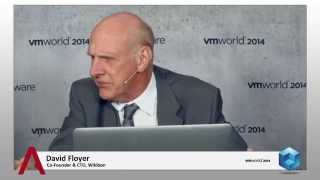
Sam Greenblatt, Dell, at VMworld 2014 with John Furrier and Dave Vellante
@theCUBE
#vmworld2014
With hyper converge, hybrid Cloud and end user computing bringing back infrastructure interest in a new way, it’s almost as if the 1980’s style of mainframe architecture has come back… with a twist, and without the mullet. Although a lot has changed in technology since that time, Dell Inc. VP & CTO of Engineered Solutions and Technology Sam Greenblatt, believes that functionalities have remained the same. In an interview for theCUBE at VMworld, he compared technology and architecture in the 1980’s to that of today.
Referencing the Ray Kurzwiel curve, Greenblatt stated that computing is actually going up by a factor of ten to six over period of time. However, the problem is that there aren’t a lot of new concepts. The mainframe was built hyper-converged, with a direct access storage device (DASD), CPU and networking. Although they may not have been in the same box, they were very closely coupled.
Today, the term hyper-converged is now referred to as integrated systems. Greenblatt stated that not everything can be hyper-converged. However, mentioning the recently announced EVO:RAIL product from VMware, Inc., he went on to say that it is possible to get a 2U form factor with four nodes in a box and actually get 100VMs on it. “Is that much different than the 80’s when we had those huge beasts? No. It’s scaled hardware,” Greenblatt added.
In terms of servers, Greenblatt believes that, although a lot has changed since the 1980’s, they will never go away. Back then, IBM, Corp. made its money selling type two cabling because no one thought it possible to get higher than 9600 because of things like shielding. Today, we can get up to 200 gigabits on Ethernet over copper. The industry is now noticing a disaggregation of the server. Greenblatt stated that there’s a need to get the server closer to the point of information. In the process, we’re going to get into a whole new style and a functional view of the architecture, where everything is interconnected on a high-speed, ubiquitous network. “So, the world changes, but it doesn’t change the functionality,” said Greenblatt.
Forgot Password
Almost there!
We just sent you a verification email. Please verify your account to gain access to
VMworld 2014 | San Francisco. If you don’t think you received an email check your
spam folder.
In order to sign in, enter the email address you used to registered for the event. Once completed, you will receive an email with a verification link. Open this link to automatically sign into the site.
Register For VMworld 2014 | San Francisco
Please fill out the information below. You will recieve an email with a verification link confirming your registration. Click the link to automatically sign into the site.
You’re almost there!
We just sent you a verification email. Please click the verification button in the email. Once your email address is verified, you will have full access to all event content for VMworld 2014 | San Francisco.
I want my badge and interests to be visible to all attendees.
Checking this box will display your presense on the attendees list, view your profile and allow other attendees to contact you via 1-1 chat. Read the Privacy Policy. At any time, you can choose to disable this preference.
Select your Interests!
add
Upload your photo
Uploading..
OR
Connect via Twitter
Connect via Linkedin
EDIT PASSWORD
Share
Forgot Password
Almost there!
We just sent you a verification email. Please verify your account to gain access to
VMworld 2014 | San Francisco. If you don’t think you received an email check your
spam folder.
In order to sign in, enter the email address you used to registered for the event. Once completed, you will receive an email with a verification link. Open this link to automatically sign into the site.
Sign in to gain access to VMworld 2014 | San Francisco
Please sign in with LinkedIn to continue to VMworld 2014 | San Francisco. Signing in with LinkedIn ensures a professional environment.
Are you sure you want to remove access rights for this user?
Details
Manage Access
email address
Community Invitation
Sam Greenblatt | VMworld 2014
Sam Greenblatt, Dell, at VMworld 2014 with John Furrier and Dave Vellante
@theCUBE
#vmworld2014
With hyper converge, hybrid Cloud and end user computing bringing back infrastructure interest in a new way, it’s almost as if the 1980’s style of mainframe architecture has come back… with a twist, and without the mullet. Although a lot has changed in technology since that time, Dell Inc. VP & CTO of Engineered Solutions and Technology Sam Greenblatt, believes that functionalities have remained the same. In an interview for theCUBE at VMworld, he compared technology and architecture in the 1980’s to that of today.
Referencing the Ray Kurzwiel curve, Greenblatt stated that computing is actually going up by a factor of ten to six over period of time. However, the problem is that there aren’t a lot of new concepts. The mainframe was built hyper-converged, with a direct access storage device (DASD), CPU and networking. Although they may not have been in the same box, they were very closely coupled.
Today, the term hyper-converged is now referred to as integrated systems. Greenblatt stated that not everything can be hyper-converged. However, mentioning the recently announced EVO:RAIL product from VMware, Inc., he went on to say that it is possible to get a 2U form factor with four nodes in a box and actually get 100VMs on it. “Is that much different than the 80’s when we had those huge beasts? No. It’s scaled hardware,” Greenblatt added.
In terms of servers, Greenblatt believes that, although a lot has changed since the 1980’s, they will never go away. Back then, IBM, Corp. made its money selling type two cabling because no one thought it possible to get higher than 9600 because of things like shielding. Today, we can get up to 200 gigabits on Ethernet over copper. The industry is now noticing a disaggregation of the server. Greenblatt stated that there’s a need to get the server closer to the point of information. In the process, we’re going to get into a whole new style and a functional view of the architecture, where everything is interconnected on a high-speed, ubiquitous network. “So, the world changes, but it doesn’t change the functionality,” said Greenblatt.