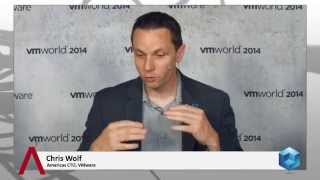
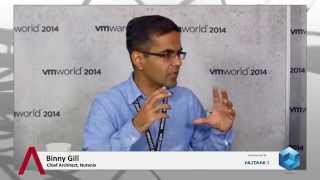
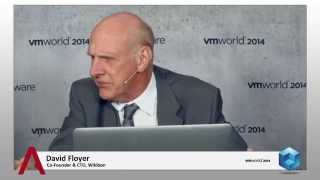
Craig McLuckie, Google, at VMworld 2014 with John Furrier and Dave Vellante
@theCUBE
#vmworld2014
If there were any doubts about the disruptive potential of container technology, they’ve been cast aside by the news that VMware Inc., is teaming up with Docker Inc., Google Inc., and Pivotal Software Inc., to integrate it with VMware’s virtualization software.
VMware announced the collaboration during CEO Pat Gelsinger’s keynote at VMworld 2014 yesterday. At first glance VMware and the Docker project seem to be at odds with each other, because Docker containers essentially remove the need for virtualization. But VMware begs to differ, saying there’s no reason why the two can’t co-exist with a container running inside a virtual machine.
Hence this new collaboration, which will allow developers and operations staff to use Docker with VMware’s vSphere hypervisor and its vCloud Air environment. VMware said it’s also teaming up with Docker on several open-source container projects on the Docker platform, and will make sure that all future Docker projects integrate well with its platform.
As for Google, VMware says it’s planning to “bring the pod based networking model to Open vSwitch enabling OpenStack and multi-cloud integration of Kubernetes.” Google explains that “providing machines for Kubernetes is not only necessary as a pool of raw cycles and bytes but also can provide a critical extra layer of security.”
Google argues that virtual machines represent “a strong security domain”. The point is that while containers might be fine for semi-trusted workloads, VMs offer a second layer of security for untrusted workloads. Indeed, Google explains that running containers inside VMs allows different Kubernetes clusters to co-exist on the same physical infrastructure within its data centers.
“The addition of VMWare’s technical expertise in cluster infrastructure will enable people begin to compute like Google, regardless of where they physically do that computation,” said Google product manager Craig Mcluckie.
As for Pivotal, Vmware plans to work with it to improve the libcontainer project, which is Docker’s reference implementation for containers. The plan is to add some features of VMware’s Warden project for managing isolated environments in Pivotal’s Cloud Foundry, to Docker.
Docker & VMs: The best of both worlds?
One school of thought claims Docker containers represent an existential threat to VMware and its virtualization business, and so this collaboration might seem like VMware is trying to protect itself from that. But Ben Golub, CEO of Docker Inc., was more diplomatic, saying it’s more about providing customers with a choice.
“No matter who the customer is, we want them to be able to deploy Docker in the environment that makes sense for them,” said Golub in a press conference.
One of Docker’s biggest advantages is it’s supposed to be more efficient than traditional virtualization, because there’s no need to run a separate operating system for each application. But Golub says this promise still holds true when running Docker atop of VMware, noting that when users first adopt containers they don’t have the overhead of a guest operating system.
“So instead of having a thousand applications running on a thousand different VMs, you can have a thousand different applications running in containers spread across a limited number of VMs,” he said. “As a result, you can get the best of both worlds.”
Appearing on theCUBE shortly after yesterday’s press conference, VMware’s Gelsinger elaborated a little on the company’s decision to embrace containers. Although the technology is still somewhat immature, it’s what customers want, and whatever its customers want, VMware will strive to deliver it.
“It’s still very early,” said Gelsinger. “In the hype cycle curve, we’re way up and we’ll probably go through the valley of despair. But there’s an emerging set using containers. If that’s how users want to deliver apps, we’re going to embrace and enable that as well.”
@Google
@Heptio
#Kubernetes
Forgot Password
Almost there!
We just sent you a verification email. Please verify your account to gain access to
VMworld 2014 | San Francisco. If you don’t think you received an email check your
spam folder.
In order to sign in, enter the email address you used to registered for the event. Once completed, you will receive an email with a verification link. Open this link to automatically sign into the site.
Register For VMworld 2014 | San Francisco
Please fill out the information below. You will recieve an email with a verification link confirming your registration. Click the link to automatically sign into the site.
You’re almost there!
We just sent you a verification email. Please click the verification button in the email. Once your email address is verified, you will have full access to all event content for VMworld 2014 | San Francisco.
I want my badge and interests to be visible to all attendees.
Checking this box will display your presense on the attendees list, view your profile and allow other attendees to contact you via 1-1 chat. Read the Privacy Policy. At any time, you can choose to disable this preference.
Select your Interests!
add
Upload your photo
Uploading..
OR
Connect via Twitter
Connect via Linkedin
EDIT PASSWORD
Share
Forgot Password
Almost there!
We just sent you a verification email. Please verify your account to gain access to
VMworld 2014 | San Francisco. If you don’t think you received an email check your
spam folder.
In order to sign in, enter the email address you used to registered for the event. Once completed, you will receive an email with a verification link. Open this link to automatically sign into the site.
Sign in to gain access to VMworld 2014 | San Francisco
Please sign in with LinkedIn to continue to VMworld 2014 | San Francisco. Signing in with LinkedIn ensures a professional environment.
Are you sure you want to remove access rights for this user?
Details
Manage Access
email address
Community Invitation
Craig McLuckie, Google | VMworld 2014
Craig McLuckie, Google, at VMworld 2014 with John Furrier and Dave Vellante
@theCUBE
#vmworld2014
If there were any doubts about the disruptive potential of container technology, they’ve been cast aside by the news that VMware Inc., is teaming up with Docker Inc., Google Inc., and Pivotal Software Inc., to integrate it with VMware’s virtualization software.
VMware announced the collaboration during CEO Pat Gelsinger’s keynote at VMworld 2014 yesterday. At first glance VMware and the Docker project seem to be at odds with each other, because Docker containers essentially remove the need for virtualization. But VMware begs to differ, saying there’s no reason why the two can’t co-exist with a container running inside a virtual machine.
Hence this new collaboration, which will allow developers and operations staff to use Docker with VMware’s vSphere hypervisor and its vCloud Air environment. VMware said it’s also teaming up with Docker on several open-source container projects on the Docker platform, and will make sure that all future Docker projects integrate well with its platform.
As for Google, VMware says it’s planning to “bring the pod based networking model to Open vSwitch enabling OpenStack and multi-cloud integration of Kubernetes.” Google explains that “providing machines for Kubernetes is not only necessary as a pool of raw cycles and bytes but also can provide a critical extra layer of security.”
Google argues that virtual machines represent “a strong security domain”. The point is that while containers might be fine for semi-trusted workloads, VMs offer a second layer of security for untrusted workloads. Indeed, Google explains that running containers inside VMs allows different Kubernetes clusters to co-exist on the same physical infrastructure within its data centers.
“The addition of VMWare’s technical expertise in cluster infrastructure will enable people begin to compute like Google, regardless of where they physically do that computation,” said Google product manager Craig Mcluckie.
As for Pivotal, Vmware plans to work with it to improve the libcontainer project, which is Docker’s reference implementation for containers. The plan is to add some features of VMware’s Warden project for managing isolated environments in Pivotal’s Cloud Foundry, to Docker.
Docker & VMs: The best of both worlds?
One school of thought claims Docker containers represent an existential threat to VMware and its virtualization business, and so this collaboration might seem like VMware is trying to protect itself from that. But Ben Golub, CEO of Docker Inc., was more diplomatic, saying it’s more about providing customers with a choice.
“No matter who the customer is, we want them to be able to deploy Docker in the environment that makes sense for them,” said Golub in a press conference.
One of Docker’s biggest advantages is it’s supposed to be more efficient than traditional virtualization, because there’s no need to run a separate operating system for each application. But Golub says this promise still holds true when running Docker atop of VMware, noting that when users first adopt containers they don’t have the overhead of a guest operating system.
“So instead of having a thousand applications running on a thousand different VMs, you can have a thousand different applications running in containers spread across a limited number of VMs,” he said. “As a result, you can get the best of both worlds.”
Appearing on theCUBE shortly after yesterday’s press conference, VMware’s Gelsinger elaborated a little on the company’s decision to embrace containers. Although the technology is still somewhat immature, it’s what customers want, and whatever its customers want, VMware will strive to deliver it.
“It’s still very early,” said Gelsinger. “In the hype cycle curve, we’re way up and we’ll probably go through the valley of despair. But there’s an emerging set using containers. If that’s how users want to deliver apps, we’re going to embrace and enable that as well.”
@Google
@Heptio
#Kubernetes