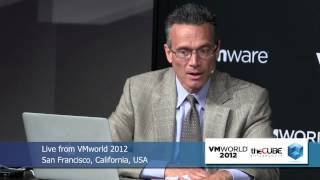
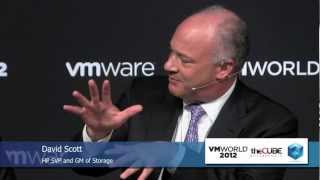
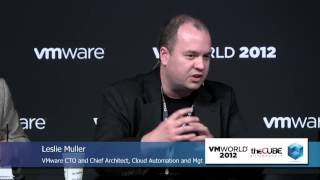
"The Software-Defined Data Center is partly about where value moves, mostly about where policy is controlled, but it's also about decoupling control planes from infrastructure," says EMC SVP Chad Sakac. "One thing that is not right in storage land is the control plane for storage is embedded in the storage target. So in storage language, this is about moving up to SDRS [VMware Storage DRS]."
The problem, Sakac explained in an interview webcast live from the Cube on the floor of VMworld 2012 over SiliconAngle.tv, is that managing VMware environments at scale requires managing thousands of LUNs or files at the storage level connecting to hundreds of VMs. Today that is accomplished by running the IO path for all those VMs through something called an "IO Demultiplexer", "a name only an engineer could love" regardless of the number of VMs.
The result is that whatever single policy is chosen for those LUNs is applied to all the VMs regardless of whether it fits. "If we want to move to the software-defined storage world, the storage infrastructure needs to enforce policy on a VM-by-VM basis. Instead of forcing all VMs to adapt to one policy, VMware at the policy layer would say, 'This is the policy I need for this VM, you figure it out. If you need to make a change internally to keep that policy coherent, do it!'"
The reason this is a major problem, and one that is occupying many of EMC's engineering cycles, is that large environments need three different kinds of storage architecture.
Basically, Sakac says, SMBs need a single "Swiss Army Knife" infrastructure that is simple and easy to consume and buy, because at their size a single system for all data needs -- small data, Big Data, structured, unstructured -- makes sense. This, he said, is why converged infrastructure, which eliminates a lot of the noise in the market and allows IT to implement a good-enough solution and move on to focus on more important business issues, is winning in that market today and will continue to win in the future.
However, large enterprises basically need three kinds of data infrastructure:
Transactional Systems, where non-volatile solid-state architectures become important and where companies are moving to all-flash models. This is why EMC purchased XtremeIO, which "we saw as the best technology out there."
Network-Attached Storage (NAS), which, he said, is the fastest growing category of storage infrastructure in the enterprise market. "Isolon [EMC's NAS technology] is growing faster than we can manage it," he said.
Analytics Storage capable to scale to handle unstructured Big Data.
Without a decoupled control plane that operates not just over EMC products but across heterogeneous hardware environments, and that is granular to the individual VM layer, policies designed for one of these use cases are being applied to VMs operating in others of these or other areas. The software-defined data center "really needs an open flow of storage" so that, for instance, data from the transactional systems can be used in big data market analytics.
VMware is driving much of this innovation with previews of new products that promise to continue revolutionizing the IT environment. In this period of huge technology transformation, "the biggest hazard is not getting eaten by somebody else but that you lose your mojo and willingness to cannibalize yourself and innovate," Sakac warns. Basically, it is hard for companies to attack their own cash cows by releasing new technologies that will cut into their own markets. But, the alternative, attempting to defend an established technology and market position, has proven to be a losing strategy in times of technology change. Therefore, it is important for companies like EMC to develop technologies that become the largest threats to their own most profitable products in order to move forward with the advance of the technology. Otherwise they will be left behind to wither.
Read the full article,
"Decoupling the Control Plane from Storage Key to Data Infrastructure"
by BERT LATAMORE, here:
http://servicesangle.com/blog/2012/08/29/decoupling-the-control-plane-from-storage-key-to-data-infrastructure/
Forgot Password
Almost there!
We just sent you a verification email. Please verify your account to gain access to
VMworld 2012 | San Francisco. If you don’t think you received an email check your
spam folder.
In order to sign in, enter the email address you used to registered for the event. Once completed, you will receive an email with a verification link. Open this link to automatically sign into the site.
Register For VMworld 2012 | San Francisco
Please fill out the information below. You will recieve an email with a verification link confirming your registration. Click the link to automatically sign into the site.
You’re almost there!
We just sent you a verification email. Please click the verification button in the email. Once your email address is verified, you will have full access to all event content for VMworld 2012 | San Francisco.
I want my badge and interests to be visible to all attendees.
Checking this box will display your presense on the attendees list, view your profile and allow other attendees to contact you via 1-1 chat. Read the Privacy Policy. At any time, you can choose to disable this preference.
Select your Interests!
add
Upload your photo
Uploading..
OR
Connect via Twitter
Connect via Linkedin
EDIT PASSWORD
Share
Forgot Password
Almost there!
We just sent you a verification email. Please verify your account to gain access to
VMworld 2012 | San Francisco. If you don’t think you received an email check your
spam folder.
In order to sign in, enter the email address you used to registered for the event. Once completed, you will receive an email with a verification link. Open this link to automatically sign into the site.
Sign in to gain access to VMworld 2012 | San Francisco
Please sign in with LinkedIn to continue to VMworld 2012 | San Francisco. Signing in with LinkedIn ensures a professional environment.
Are you sure you want to remove access rights for this user?
Details
Manage Access
email address
Community Invitation
Chad Sakac | VMworld 2012
"The Software-Defined Data Center is partly about where value moves, mostly about where policy is controlled, but it's also about decoupling control planes from infrastructure," says EMC SVP Chad Sakac. "One thing that is not right in storage land is the control plane for storage is embedded in the storage target. So in storage language, this is about moving up to SDRS [VMware Storage DRS]."
The problem, Sakac explained in an interview webcast live from the Cube on the floor of VMworld 2012 over SiliconAngle.tv, is that managing VMware environments at scale requires managing thousands of LUNs or files at the storage level connecting to hundreds of VMs. Today that is accomplished by running the IO path for all those VMs through something called an "IO Demultiplexer", "a name only an engineer could love" regardless of the number of VMs.
The result is that whatever single policy is chosen for those LUNs is applied to all the VMs regardless of whether it fits. "If we want to move to the software-defined storage world, the storage infrastructure needs to enforce policy on a VM-by-VM basis. Instead of forcing all VMs to adapt to one policy, VMware at the policy layer would say, 'This is the policy I need for this VM, you figure it out. If you need to make a change internally to keep that policy coherent, do it!'"
The reason this is a major problem, and one that is occupying many of EMC's engineering cycles, is that large environments need three different kinds of storage architecture.
Basically, Sakac says, SMBs need a single "Swiss Army Knife" infrastructure that is simple and easy to consume and buy, because at their size a single system for all data needs -- small data, Big Data, structured, unstructured -- makes sense. This, he said, is why converged infrastructure, which eliminates a lot of the noise in the market and allows IT to implement a good-enough solution and move on to focus on more important business issues, is winning in that market today and will continue to win in the future.
However, large enterprises basically need three kinds of data infrastructure:
Transactional Systems, where non-volatile solid-state architectures become important and where companies are moving to all-flash models. This is why EMC purchased XtremeIO, which "we saw as the best technology out there."
Network-Attached Storage (NAS), which, he said, is the fastest growing category of storage infrastructure in the enterprise market. "Isolon [EMC's NAS technology] is growing faster than we can manage it," he said.
Analytics Storage capable to scale to handle unstructured Big Data.
Without a decoupled control plane that operates not just over EMC products but across heterogeneous hardware environments, and that is granular to the individual VM layer, policies designed for one of these use cases are being applied to VMs operating in others of these or other areas. The software-defined data center "really needs an open flow of storage" so that, for instance, data from the transactional systems can be used in big data market analytics.
VMware is driving much of this innovation with previews of new products that promise to continue revolutionizing the IT environment. In this period of huge technology transformation, "the biggest hazard is not getting eaten by somebody else but that you lose your mojo and willingness to cannibalize yourself and innovate," Sakac warns. Basically, it is hard for companies to attack their own cash cows by releasing new technologies that will cut into their own markets. But, the alternative, attempting to defend an established technology and market position, has proven to be a losing strategy in times of technology change. Therefore, it is important for companies like EMC to develop technologies that become the largest threats to their own most profitable products in order to move forward with the advance of the technology. Otherwise they will be left behind to wither.
Read the full article,
"Decoupling the Control Plane from Storage Key to Data Infrastructure"
by BERT LATAMORE, here:
http://servicesangle.com/blog/2012/08/29/decoupling-the-control-plane-from-storage-key-to-data-infrastructure/