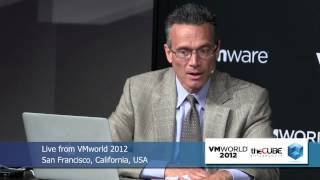
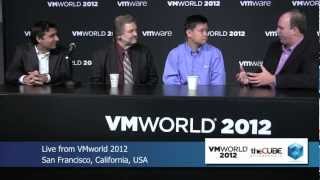
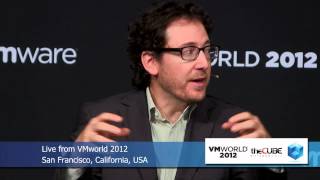
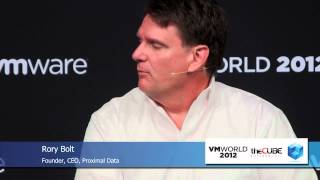
Despite the hype, software-defined networking (SDN) is not really that new, says Dom Delfino, senior director at network giant Cisco Systems. In fact, the basic concepts go back to the 1980s or earlier and TDM (time-division networking), ATM (Asynchronous Transfer Mode), and frame relay among other networking technologies, he told Wikibon Analyst Stuart Miniman in an interview webcast live from the Cube on the floor of VMworld 2012 over SiliconAngle.tv.
"While SDN is a new term, building software-defined networks is not a new thing," he said. "Fast forward to IP, MPLS, VPLS, VPNs, these are all forms of software-defined networks. So this evolution has been going on for a long time."
Today, virtualized environments have one or more hypervisors, VMs, host, and guest OS running on top of that network. "But what's most important is we can't break the operational environment. How do I troubleshoot what's happening on the virtual overlay network and separate that from the underlying physical network? Do I troubleshoot them separately, or do I need some integration there?" Cisco, he said, believes that integration is important and that the two layers need to be tied together.
That gets more complicated over time as the virtualized environments in data centers grow, and particularly, said Miniman, with the trend toward multi-hypervisor environments.
That, Delfino said, requires standards-based management. "We all need to play together in the industry." Cisco, he said, is basing its response on its Nexus 1000V network switch that is part of the VMware offering and, he said, will become part of Microsoft's Hyper-V architecture as well as that of other hypervisors. The 1000V provides control-plane centralization, which is important for managing virtualized environments and is the first step toward SDN. It allows physical network control to be linked to management of the higher levels layered on top of it, including the hypervisor itself.
Then adding the VX-LAN (Virtual Extensible LAN) provides the ability to build an overlay network that uses that control-plane environment. That, he says, approaches what VMware is doing with its new acquisition, Nicira, which provides virtualized LAN capability.
Cloud-Class Networks
"Our customers are concerned that they need to provide an enterprise-class or cloud-class, production-ready network, which is extremely comprehensive." That has to include scalability as the numbers of IP addresses on networks explodes, particularly with virtualization, which means table sizes on switches and routers need the capability to handle that. That has to be done in silicon, not software. And the foundations of strong network and data security have to be in silicon, not software. "So if the silicon's not talking to the software, and I can't do that pervasively across the network, I'm going to face major issues."
So the architecture has to have three important pieces -- software, hardware, and silicon. That is why Cisco works in all three layers. One criticism of Cisco has been that it maintains its own silicon foundry while the capabilities of merchant silicon has grown to cover many needs. Delfino's answer to that is Cisco does use merchant silicon in some products. But merchant silicon can never be cutting edge. "Innovation doesn't come in a mass form. It takes someone to develop it and then turn it over to the environment." Cisco has developed several network innovations that later have become industry standards, and today it continues to innovate at all levels, including silicon. The overlay network or SDN and network programmability are also parts of that architecture. "Part of the value of Cisco is that feature-rich control plane that has enabled customers to do all the things they have done so far. As we move to the next generation of SDNs you will see all three of these levels -- silicon, hardware, and software -- playing very relevant parts."
For instance, he says, as virtualized environments scale out, and increasing numbers of VMs and applications move across the network, latency becomes an important issue -- both port-to-port latency inside network switches but also latency across the entire data center fabric. Cisco is addressing this with 10GB Ethernet now and higher capacity switching products coming by the end of the year.
Programability is also important to support overall orchestration, provisioning, and self-service in cloud environments, whether they are public, private, or hybrid. Cisco is answering this with its Open Networking Environment that includes APIs and a developer kit to allow the orchestration and provisioning to interface with the network in a more granular and robust fashion.
Read the full article, "SDN Not Revolutionary, Part of an Evolution Going back to 1980s and ATM says Cisco's Delfino" by BERT LATAMORE, here:
http://servicesangle.com/blog/2012/08/30/utionary-part-of-an-evolution-going-back-to-1980s-and-atm-says-ciscos-delfino/
Forgot Password
Almost there!
We just sent you a verification email. Please verify your account to gain access to
VMworld 2012 | San Francisco. If you don’t think you received an email check your
spam folder.
In order to sign in, enter the email address you used to registered for the event. Once completed, you will receive an email with a verification link. Open this link to automatically sign into the site.
Register For VMworld 2012 | San Francisco
Please fill out the information below. You will recieve an email with a verification link confirming your registration. Click the link to automatically sign into the site.
You’re almost there!
We just sent you a verification email. Please click the verification button in the email. Once your email address is verified, you will have full access to all event content for VMworld 2012 | San Francisco.
I want my badge and interests to be visible to all attendees.
Checking this box will display your presense on the attendees list, view your profile and allow other attendees to contact you via 1-1 chat. Read the Privacy Policy. At any time, you can choose to disable this preference.
Select your Interests!
add
Upload your photo
Uploading..
OR
Connect via Twitter
Connect via Linkedin
EDIT PASSWORD
Share
Forgot Password
Almost there!
We just sent you a verification email. Please verify your account to gain access to
VMworld 2012 | San Francisco. If you don’t think you received an email check your
spam folder.
In order to sign in, enter the email address you used to registered for the event. Once completed, you will receive an email with a verification link. Open this link to automatically sign into the site.
Sign in to gain access to VMworld 2012 | San Francisco
Please sign in with LinkedIn to continue to VMworld 2012 | San Francisco. Signing in with LinkedIn ensures a professional environment.
Are you sure you want to remove access rights for this user?
Details
Manage Access
email address
Community Invitation
Dom Delfino | VMworld 2012
Despite the hype, software-defined networking (SDN) is not really that new, says Dom Delfino, senior director at network giant Cisco Systems. In fact, the basic concepts go back to the 1980s or earlier and TDM (time-division networking), ATM (Asynchronous Transfer Mode), and frame relay among other networking technologies, he told Wikibon Analyst Stuart Miniman in an interview webcast live from the Cube on the floor of VMworld 2012 over SiliconAngle.tv.
"While SDN is a new term, building software-defined networks is not a new thing," he said. "Fast forward to IP, MPLS, VPLS, VPNs, these are all forms of software-defined networks. So this evolution has been going on for a long time."
Today, virtualized environments have one or more hypervisors, VMs, host, and guest OS running on top of that network. "But what's most important is we can't break the operational environment. How do I troubleshoot what's happening on the virtual overlay network and separate that from the underlying physical network? Do I troubleshoot them separately, or do I need some integration there?" Cisco, he said, believes that integration is important and that the two layers need to be tied together.
That gets more complicated over time as the virtualized environments in data centers grow, and particularly, said Miniman, with the trend toward multi-hypervisor environments.
That, Delfino said, requires standards-based management. "We all need to play together in the industry." Cisco, he said, is basing its response on its Nexus 1000V network switch that is part of the VMware offering and, he said, will become part of Microsoft's Hyper-V architecture as well as that of other hypervisors. The 1000V provides control-plane centralization, which is important for managing virtualized environments and is the first step toward SDN. It allows physical network control to be linked to management of the higher levels layered on top of it, including the hypervisor itself.
Then adding the VX-LAN (Virtual Extensible LAN) provides the ability to build an overlay network that uses that control-plane environment. That, he says, approaches what VMware is doing with its new acquisition, Nicira, which provides virtualized LAN capability.
Cloud-Class Networks
"Our customers are concerned that they need to provide an enterprise-class or cloud-class, production-ready network, which is extremely comprehensive." That has to include scalability as the numbers of IP addresses on networks explodes, particularly with virtualization, which means table sizes on switches and routers need the capability to handle that. That has to be done in silicon, not software. And the foundations of strong network and data security have to be in silicon, not software. "So if the silicon's not talking to the software, and I can't do that pervasively across the network, I'm going to face major issues."
So the architecture has to have three important pieces -- software, hardware, and silicon. That is why Cisco works in all three layers. One criticism of Cisco has been that it maintains its own silicon foundry while the capabilities of merchant silicon has grown to cover many needs. Delfino's answer to that is Cisco does use merchant silicon in some products. But merchant silicon can never be cutting edge. "Innovation doesn't come in a mass form. It takes someone to develop it and then turn it over to the environment." Cisco has developed several network innovations that later have become industry standards, and today it continues to innovate at all levels, including silicon. The overlay network or SDN and network programmability are also parts of that architecture. "Part of the value of Cisco is that feature-rich control plane that has enabled customers to do all the things they have done so far. As we move to the next generation of SDNs you will see all three of these levels -- silicon, hardware, and software -- playing very relevant parts."
For instance, he says, as virtualized environments scale out, and increasing numbers of VMs and applications move across the network, latency becomes an important issue -- both port-to-port latency inside network switches but also latency across the entire data center fabric. Cisco is addressing this with 10GB Ethernet now and higher capacity switching products coming by the end of the year.
Programability is also important to support overall orchestration, provisioning, and self-service in cloud environments, whether they are public, private, or hybrid. Cisco is answering this with its Open Networking Environment that includes APIs and a developer kit to allow the orchestration and provisioning to interface with the network in a more granular and robust fashion.
Read the full article, "SDN Not Revolutionary, Part of an Evolution Going back to 1980s and ATM says Cisco's Delfino" by BERT LATAMORE, here:
http://servicesangle.com/blog/2012/08/30/utionary-part-of-an-evolution-going-back-to-1980s-and-atm-says-ciscos-delfino/