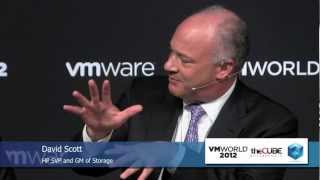
In their ongoing coverage of VMworld, John Furrier and Dave Vellante spoke with David Flynn, CEO of Fusion-IO. In its first year as a public company, Fusion-IO boasts an impressive earning’s report, 82% growth and acquisition of IO Turbine. In this conversation, Flynn discusses Fusion-IOs success and future innovations, the advantages of Fusion-IO architecture, Flash productivity increases and why competitor mimicry might actually be advantageous.
Recognizing Fusion-IO as “disruptors in the market,” Furrier asks about the next Fusion-IO disruption. According to Flynn, the release of Fusion-IO’s ION transforms select open systems servers into application data accelerators. In this way Fusion-IO is responding to the common problem clients were facing with networking capability from within local servers.
Flynn also comments on the interplay of cloud with flash, explaining that Fusin-IO technology allows for people to do more with their own infrastructure. Namely, customers can solve scaling problems that use to require you to take data off premise. Flynn adds, “It’s really about how quickly the organization can learn to take advantage of the performance levels.”
Furrier also inquires about new architectures in the data center. Flynn says, “Performance optimized storage arrays are now no longer necessary when flash in the server can do a much better job of supplying the performance.” Flynn references that there are multiple case studies on their website that further illustrate this point. Polaris uses Fusion-IO to accelerate their virtual server bar, decreasing the time for their customers to load their webpages from 5 seconds to under a second. There are also several examples of complex queries, such as analytics queries for large storehouse of data decreasing from days to hours. Flynn adds that Fusion-IO no longer requires a performance storage array, but allows customers to focus on a capacity problem. “With our architecture, its as if the data were in-memory because we’ve integrated flash as a new type of memory, as opposed to integrating it behind the storage controllers.”
Vellante suggests things start to get interesting when it comes to how these innovations deliver dramatically enhanced productivity “where you can actually support analytic and transactional inquiries in near real-time.” Flynn says we “want more information, more quickly, from multiple access points.” To illustrate how data services are enhancing productivity, Flynn cites a film production company called Prime Focus in the UK, which provides 3-D conversion for many major films. As the data does not take long to load into the system, artists triple productivity as they can edit 3 times the scenes in a day. Flynn says, “This does ultimately boil down to human productivity and that is what drives economic growth as well…get more work done per unit of human input.”
Vellante suggests, “To really get that productivity increase, people have to change the way they write applications.” Flynn says the world of big data is already changing because “to get scale, people are giving up on data management services.” He suggests with scale as the number 1 goal, people sacrifice data management services, transactional consistency and persistence altogether because of the business value that scale drives; “With Flash, you can offer those services in milliseconds, and instead of accessing those services as protocols on the far end of a network, you can access them as APIs.” According to Flynn, these services are significant because “this new generation of applications can offload that complexity that it used to take by having a platform underneath…because the media actually handles that for you. So, we’re talking about taking the data management services of the SAN and the persistence and transactional requirements at the app and converging them in the Flash infrastructure.”
Vellante notes that Pat Gelsinger of EMC has added Flash to the array and many others are making moves very similar to Fuion-IO. Vellante raises the question of whether copies in the tech market good or bad for Fusion-IO. Flynn believes the similar developments are beneficial. Flynn explains that Fusion-IO is agnostic to storage system and servers, which frees clients from the pressure to use a specific server or storage vendor.
Forgot Password
Almost there!
We just sent you a verification email. Please verify your account to gain access to
VMworld 2012 | San Francisco. If you don’t think you received an email check your
spam folder.
In order to sign in, enter the email address you used to registered for the event. Once completed, you will receive an email with a verification link. Open this link to automatically sign into the site.
Register For VMworld 2012 | San Francisco
Please fill out the information below. You will recieve an email with a verification link confirming your registration. Click the link to automatically sign into the site.
You’re almost there!
We just sent you a verification email. Please click the verification button in the email. Once your email address is verified, you will have full access to all event content for VMworld 2012 | San Francisco.
I want my badge and interests to be visible to all attendees.
Checking this box will display your presense on the attendees list, view your profile and allow other attendees to contact you via 1-1 chat. Read the Privacy Policy. At any time, you can choose to disable this preference.
Select your Interests!
add
Upload your photo
Uploading..
OR
Connect via Twitter
Connect via Linkedin
EDIT PASSWORD
Share
Forgot Password
Almost there!
We just sent you a verification email. Please verify your account to gain access to
VMworld 2012 | San Francisco. If you don’t think you received an email check your
spam folder.
In order to sign in, enter the email address you used to registered for the event. Once completed, you will receive an email with a verification link. Open this link to automatically sign into the site.
Sign in to gain access to VMworld 2012 | San Francisco
Please sign in with LinkedIn to continue to VMworld 2012 | San Francisco. Signing in with LinkedIn ensures a professional environment.
Are you sure you want to remove access rights for this user?
Details
Manage Access
email address
Community Invitation
David Flynn | VMworld 2012
In their ongoing coverage of VMworld, John Furrier and Dave Vellante spoke with David Flynn, CEO of Fusion-IO. In its first year as a public company, Fusion-IO boasts an impressive earning’s report, 82% growth and acquisition of IO Turbine. In this conversation, Flynn discusses Fusion-IOs success and future innovations, the advantages of Fusion-IO architecture, Flash productivity increases and why competitor mimicry might actually be advantageous.
Recognizing Fusion-IO as “disruptors in the market,” Furrier asks about the next Fusion-IO disruption. According to Flynn, the release of Fusion-IO’s ION transforms select open systems servers into application data accelerators. In this way Fusion-IO is responding to the common problem clients were facing with networking capability from within local servers.
Flynn also comments on the interplay of cloud with flash, explaining that Fusin-IO technology allows for people to do more with their own infrastructure. Namely, customers can solve scaling problems that use to require you to take data off premise. Flynn adds, “It’s really about how quickly the organization can learn to take advantage of the performance levels.”
Furrier also inquires about new architectures in the data center. Flynn says, “Performance optimized storage arrays are now no longer necessary when flash in the server can do a much better job of supplying the performance.” Flynn references that there are multiple case studies on their website that further illustrate this point. Polaris uses Fusion-IO to accelerate their virtual server bar, decreasing the time for their customers to load their webpages from 5 seconds to under a second. There are also several examples of complex queries, such as analytics queries for large storehouse of data decreasing from days to hours. Flynn adds that Fusion-IO no longer requires a performance storage array, but allows customers to focus on a capacity problem. “With our architecture, its as if the data were in-memory because we’ve integrated flash as a new type of memory, as opposed to integrating it behind the storage controllers.”
Vellante suggests things start to get interesting when it comes to how these innovations deliver dramatically enhanced productivity “where you can actually support analytic and transactional inquiries in near real-time.” Flynn says we “want more information, more quickly, from multiple access points.” To illustrate how data services are enhancing productivity, Flynn cites a film production company called Prime Focus in the UK, which provides 3-D conversion for many major films. As the data does not take long to load into the system, artists triple productivity as they can edit 3 times the scenes in a day. Flynn says, “This does ultimately boil down to human productivity and that is what drives economic growth as well…get more work done per unit of human input.”
Vellante suggests, “To really get that productivity increase, people have to change the way they write applications.” Flynn says the world of big data is already changing because “to get scale, people are giving up on data management services.” He suggests with scale as the number 1 goal, people sacrifice data management services, transactional consistency and persistence altogether because of the business value that scale drives; “With Flash, you can offer those services in milliseconds, and instead of accessing those services as protocols on the far end of a network, you can access them as APIs.” According to Flynn, these services are significant because “this new generation of applications can offload that complexity that it used to take by having a platform underneath…because the media actually handles that for you. So, we’re talking about taking the data management services of the SAN and the persistence and transactional requirements at the app and converging them in the Flash infrastructure.”
Vellante notes that Pat Gelsinger of EMC has added Flash to the array and many others are making moves very similar to Fuion-IO. Vellante raises the question of whether copies in the tech market good or bad for Fusion-IO. Flynn believes the similar developments are beneficial. Flynn explains that Fusion-IO is agnostic to storage system and servers, which frees clients from the pressure to use a specific server or storage vendor.