SiliconANGLE and Wikibon presented a segment on cloud realities from VMworld 2011, spotlighting George Reed, CIO of Seven Corners. Seven Corners is a specialty insurance company that provides travel, medical, emergency evacuation assistance, and a variety of insurance lines for various federal and state government agencies around the world. In a mere eight months, Seven Corners transitioned from a physical server environment to a privatized cloud, saving them $100K in revenue loss each month.
What does cloud mean to an organization like Seven Corners? According to Reed, it's "what we need, when we need, and in the correct configuration and method of delivery. It means not using more than I have to have until I need it."
Reed described the company's infrastructure transition as migrating from a full server room to three Cisco UCS racks running VMware's VSphere and using a Flex Pod from NetApp, which is allowing them to take their applications to the next level by writing a new application that consumes the cloud to provision itself so the customer has what they need instantaneously.
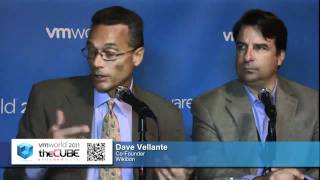
Dave Vellante, Co-Founder of Wikibon, asked how the concept of Flex Pod was more useful than silos. Reed maintained that having several silos was not conducive, especially when making changes that have to be accommodated in different places. He said, "We're living in a regulated industry, not just because it's insurance, but also because we have business with the government and have to be FISMA (Federal Information Security Management Act) compliant, so it's a lot easier to manage one array extremely well than to try to struggle with managing five or six different technology stacks simultaneously."
Many organizational changes were made in order for Seven Corners to make this transformation to their cloud reality. They started by stabilizing their in-house business management, project management, and system development lifecycle processes. Next, they quantified their problems, figured out what was hurting them, and identified solutions that could resolve the problems the fastest. Then they went out and found the right teaming partners in Cisco, NetApp and VMware and used a company called Netech for integration. Collaboration with these partners gave Seven Corners a customized solution, allowing them to merge the company's entire business into a single environment, only eight months after starting the project. When Vellante commented on how much risk they took, Reed simply stated, "Risk management doesn't mean it should be risk avoidance."
Reed enthusiastically shared revenue metrics from this venture. He said they calculated a real-life revenue loss of around $100K/month due to system outages and instability in the physical server-based environment and the amount of time to process a claim went down by 68%. The cost of the new infrastructure was approximately $400K, which paid for itself by mid-July, and the savings was rolled back into the IT budget, allowing them to triple the budget and increase the amount of projects. One such project will be creating a software system that will be self-provisioned from their cloud -- instead of nine people being involved in a sale, now only two people are needed.
As far as priorities and goals going forward, Reed envisions continuing to build infrastructure and applications to make innovative, creative imprints on the insurance world. The plan is to put in the storage and computing power which will allow them to make real-time portal generation available for their providers and members around the world. The members will have access to an online ID card, which the provider can scan, perform the service, submit the claim, and have it approved for payment real
-time.
Forgot Password
Almost there!
We just sent you a verification email. Please verify your account to gain access to
VMworld 2011 | Las Vegas. If you don’t think you received an email check your
spam folder.
In order to sign in, enter the email address you used to registered for the event. Once completed, you will receive an email with a verification link. Open this link to automatically sign into the site.
Register For VMworld 2011 | Las Vegas
Please fill out the information below. You will recieve an email with a verification link confirming your registration. Click the link to automatically sign into the site.
You’re almost there!
We just sent you a verification email. Please click the verification button in the email. Once your email address is verified, you will have full access to all event content for VMworld 2011 | Las Vegas.
I want my badge and interests to be visible to all attendees.
Checking this box will display your presense on the attendees list, view your profile and allow other attendees to contact you via 1-1 chat. Read the Privacy Policy. At any time, you can choose to disable this preference.
Select your Interests!
add
Upload your photo
Uploading..
OR
Connect via Twitter
Connect via Linkedin
EDIT PASSWORD
Share
Forgot Password
Almost there!
We just sent you a verification email. Please verify your account to gain access to
VMworld 2011 | Las Vegas. If you don’t think you received an email check your
spam folder.
In order to sign in, enter the email address you used to registered for the event. Once completed, you will receive an email with a verification link. Open this link to automatically sign into the site.
Sign in to gain access to VMworld 2011 | Las Vegas
Please sign in with LinkedIn to continue to VMworld 2011 | Las Vegas. Signing in with LinkedIn ensures a professional environment.
Are you sure you want to remove access rights for this user?
Details
Manage Access
email address
Community Invitation
George Reed, CIO of Seven Corners, Part 1 | VMworld 2011
SiliconANGLE and Wikibon presented a segment on cloud realities from VMworld 2011, spotlighting George Reed, CIO of Seven Corners. Seven Corners is a specialty insurance company that provides travel, medical, emergency evacuation assistance, and a variety of insurance lines for various federal and state government agencies around the world. In a mere eight months, Seven Corners transitioned from a physical server environment to a privatized cloud, saving them $100K in revenue loss each month.
What does cloud mean to an organization like Seven Corners? According to Reed, it's "what we need, when we need, and in the correct configuration and method of delivery. It means not using more than I have to have until I need it."
Reed described the company's infrastructure transition as migrating from a full server room to three Cisco UCS racks running VMware's VSphere and using a Flex Pod from NetApp, which is allowing them to take their applications to the next level by writing a new application that consumes the cloud to provision itself so the customer has what they need instantaneously.
Dave Vellante, Co-Founder of Wikibon, asked how the concept of Flex Pod was more useful than silos. Reed maintained that having several silos was not conducive, especially when making changes that have to be accommodated in different places. He said, "We're living in a regulated industry, not just because it's insurance, but also because we have business with the government and have to be FISMA (Federal Information Security Management Act) compliant, so it's a lot easier to manage one array extremely well than to try to struggle with managing five or six different technology stacks simultaneously."
Many organizational changes were made in order for Seven Corners to make this transformation to their cloud reality. They started by stabilizing their in-house business management, project management, and system development lifecycle processes. Next, they quantified their problems, figured out what was hurting them, and identified solutions that could resolve the problems the fastest. Then they went out and found the right teaming partners in Cisco, NetApp and VMware and used a company called Netech for integration. Collaboration with these partners gave Seven Corners a customized solution, allowing them to merge the company's entire business into a single environment, only eight months after starting the project. When Vellante commented on how much risk they took, Reed simply stated, "Risk management doesn't mean it should be risk avoidance."
Reed enthusiastically shared revenue metrics from this venture. He said they calculated a real-life revenue loss of around $100K/month due to system outages and instability in the physical server-based environment and the amount of time to process a claim went down by 68%. The cost of the new infrastructure was approximately $400K, which paid for itself by mid-July, and the savings was rolled back into the IT budget, allowing them to triple the budget and increase the amount of projects. One such project will be creating a software system that will be self-provisioned from their cloud -- instead of nine people being involved in a sale, now only two people are needed.
As far as priorities and goals going forward, Reed envisions continuing to build infrastructure and applications to make innovative, creative imprints on the insurance world. The plan is to put in the storage and computing power which will allow them to make real-time portal generation available for their providers and members around the world. The members will have access to an online ID card, which the provider can scan, perform the service, submit the claim, and have it approved for payment real
-time.