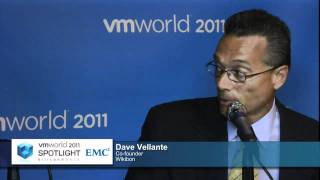
Rob Crawford, VP of Sales at QLogic stopped by the Cube to discuss QLogic's presence in the virtualization world with Dave Vellante, Co-Founder of Wikibon.
Crawford explained that QLogic collects data about their customers and users and have found that of virtual environments, 80% of them are using a shared storage, fibre channel environment. This enables further extensions of the VMware capabilities, such as high availability, so that failovers are seamless.
Vellante observed that companies will typically place mission critical applications on a fibre channel device. QLogic has a proven fibre channel stack, which is one of their key differentiators in the market. Crawford commented that building a bulletproof fibre channel stack takes time and only comes with usage cycles, with end user customers, and years of experience of "troubleshooting and proving" repeatedly.
Vellante asked where QLogic stands in the area of converged networking. Crawford responded that they are staying in front of the trend and actively participating in converged networking arena. He said, "It doesn't matter if you're using iSCSI storage, fibre channel storage, or FCOE as your protocol, you've got the ability to convert that traffic into a common network fabric. The obligation grows beyond fibre channel for us in terms of what we're bringing to the market."
When asked if customers are consolidating on a single pipe or a single technology, Crawford revealed that the requirement for flexibility stands out more than anything, as far as how customers want to design their infrastructure: some customers want to converge everything and simplify their network, while others want to migrate their networks over time.
Vellante brought up another potentially hot topic: InfiniBand, which is an architecture specification that defines a connection between processor nodes and high performance I/O nodes such as storage devices. Crawford called it a very compelling solution, noting that InfiniBand is being implemented in broader use cases. He said that there's a core low latency capability of InfiniBand that's applicable for a variety of markets, especially financial markets.
Crawford talked about VMflex capabilities as one of the big themes for QLogic, specifically partitioning of a NIC, which is unique to QLogic. Crawford said that one challenge of converged networking is converging I/O and that by offering NIC level partitioning, it does a number of helpful things, including using a shared I/O path, which allows dedicated I/O for specific applications, giving flexibility for configuring the network, as well as simplifying the number of slots, ports, and cables. This allows administrators to define how they want to manage their I/O path and where they want dedicated bandwidth to be available.
Finally, on the subject of how QLogic is handling rapidly growing networks without pushing their customers for additional sales, Crawford acknowledged that networks need fat pipes to get data moved around. He pointed out that an industry trend is consolidation in the storage space, and that some of the start-up companies that were disruptive are now part of bigger companies. He said, "So what you end up with is those large Tier1 OEMs have multiple storage protocols they're trying to support, they're building environments around that, and being able to operate between those different protocols on a common network is one of the bigger requirements we're seeing out there."
Forgot Password
Almost there!
We just sent you a verification email. Please verify your account to gain access to
VMworld 2011 | Las Vegas. If you don’t think you received an email check your
spam folder.
In order to sign in, enter the email address you used to registered for the event. Once completed, you will receive an email with a verification link. Open this link to automatically sign into the site.
Register For VMworld 2011 | Las Vegas
Please fill out the information below. You will recieve an email with a verification link confirming your registration. Click the link to automatically sign into the site.
You’re almost there!
We just sent you a verification email. Please click the verification button in the email. Once your email address is verified, you will have full access to all event content for VMworld 2011 | Las Vegas.
I want my badge and interests to be visible to all attendees.
Checking this box will display your presense on the attendees list, view your profile and allow other attendees to contact you via 1-1 chat. Read the Privacy Policy. At any time, you can choose to disable this preference.
Select your Interests!
add
Upload your photo
Uploading..
OR
Connect via Twitter
Connect via Linkedin
EDIT PASSWORD
Share
Forgot Password
Almost there!
We just sent you a verification email. Please verify your account to gain access to
VMworld 2011 | Las Vegas. If you don’t think you received an email check your
spam folder.
In order to sign in, enter the email address you used to registered for the event. Once completed, you will receive an email with a verification link. Open this link to automatically sign into the site.
Sign in to gain access to VMworld 2011 | Las Vegas
Please sign in with LinkedIn to continue to VMworld 2011 | Las Vegas. Signing in with LinkedIn ensures a professional environment.
Are you sure you want to remove access rights for this user?
Details
Manage Access
email address
Community Invitation
Rob Crawford, QLogic | VMworld 2011
Rob Crawford, VP of Sales at QLogic stopped by the Cube to discuss QLogic's presence in the virtualization world with Dave Vellante, Co-Founder of Wikibon.
Crawford explained that QLogic collects data about their customers and users and have found that of virtual environments, 80% of them are using a shared storage, fibre channel environment. This enables further extensions of the VMware capabilities, such as high availability, so that failovers are seamless.
Vellante observed that companies will typically place mission critical applications on a fibre channel device. QLogic has a proven fibre channel stack, which is one of their key differentiators in the market. Crawford commented that building a bulletproof fibre channel stack takes time and only comes with usage cycles, with end user customers, and years of experience of "troubleshooting and proving" repeatedly.
Vellante asked where QLogic stands in the area of converged networking. Crawford responded that they are staying in front of the trend and actively participating in converged networking arena. He said, "It doesn't matter if you're using iSCSI storage, fibre channel storage, or FCOE as your protocol, you've got the ability to convert that traffic into a common network fabric. The obligation grows beyond fibre channel for us in terms of what we're bringing to the market."
When asked if customers are consolidating on a single pipe or a single technology, Crawford revealed that the requirement for flexibility stands out more than anything, as far as how customers want to design their infrastructure: some customers want to converge everything and simplify their network, while others want to migrate their networks over time.
Vellante brought up another potentially hot topic: InfiniBand, which is an architecture specification that defines a connection between processor nodes and high performance I/O nodes such as storage devices. Crawford called it a very compelling solution, noting that InfiniBand is being implemented in broader use cases. He said that there's a core low latency capability of InfiniBand that's applicable for a variety of markets, especially financial markets.
Crawford talked about VMflex capabilities as one of the big themes for QLogic, specifically partitioning of a NIC, which is unique to QLogic. Crawford said that one challenge of converged networking is converging I/O and that by offering NIC level partitioning, it does a number of helpful things, including using a shared I/O path, which allows dedicated I/O for specific applications, giving flexibility for configuring the network, as well as simplifying the number of slots, ports, and cables. This allows administrators to define how they want to manage their I/O path and where they want dedicated bandwidth to be available.
Finally, on the subject of how QLogic is handling rapidly growing networks without pushing their customers for additional sales, Crawford acknowledged that networks need fat pipes to get data moved around. He pointed out that an industry trend is consolidation in the storage space, and that some of the start-up companies that were disruptive are now part of bigger companies. He said, "So what you end up with is those large Tier1 OEMs have multiple storage protocols they're trying to support, they're building environments around that, and being able to operate between those different protocols on a common network is one of the bigger requirements we're seeing out there."