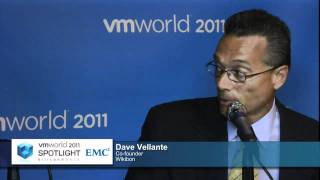
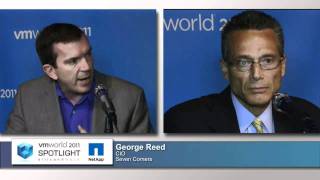
The demand for cloud storage is strong, and Nirvanix is leading the charge. SiliconANGLE Founder John Furrier and Wikibon Co-Founder Dave Vellante met with Paul Froutan, CTO of Nirvanix, at VMworld 2011 to discuss the cloud storage provider's plans to meet the demand.
Furrier kicked off the discussion by asking who the winners and losers are in cloud space, and what the key is that's differentiating the winners. Froutan responded that people are finally starting to realize "what is cloud and what isn't." He said, "You can't take a box that's been around for twenty years and . . . put a cloud label on it and sell it as cloud." However, he admitted there are some real cloud products out there, and predicted that the companies who have a real product will stay in the game, and the others will either disappear or go back to their traditional markets.
Vellante asked what the storage implications are of true cloud and machines at scale. Froutan emphasized that the most impactful thing is that the end user doesn't have to worry about anything. "That's what cloud is supposed to be -- the end user puts data in and forgets about it. It's all handled inside the cloud." He named things such as data replication, ensuring data integrity and availability, having multiple copies of the data -- all of these things and more are handled by the cloud.
Furrier asked what the plan is at Nirvanix on delivery and build-out with such high demand for cloud. Froutan said that Nirvanix is looking at all the important aspects of the cloud: incremental growth ability, the pay for what you use, having the replication to access and data integrity, and how to bring it to the customers more efficiently, faster and cheaper. He informed viewers that currently Nirvanix is the only company who can do a private, public and hybrid cloud in the real sense that they can bring the cloud to you. Froutan explained that clouds are not all the same. They all have different features, and what sets Nirvanix apart is that they have data consistency, they offer a hybrid cloud, and then they combine those features with enterprise level support.
Froutan described three quick tests on how to know if a product is "real cloud" or not, or "cloud washing" as Furrier called it. He said that if the exact same product has been around for twenty years, it's probably not cloud. If you have to buy a bunch of stuff upfront and set it up yourself, it's probably not cloud. Finally, if you don't have a global system object store, it's probably not a cloud.
Furrier questioned Froutan about OpenStack, whether they can deliver fast enough and about their viability as a competitor. Froutan agreed that OpenStack did a good job of open sourcing their product and getting the developer community involved. Although he believes OpenStack has a good product, he stated that there are specific features that Nirvanix has, such as the global object store consistency that will work better in an enterprise environment.
Forgot Password
Almost there!
We just sent you a verification email. Please verify your account to gain access to
VMworld 2011 | Las Vegas. If you don’t think you received an email check your
spam folder.
In order to sign in, enter the email address you used to registered for the event. Once completed, you will receive an email with a verification link. Open this link to automatically sign into the site.
Register For VMworld 2011 | Las Vegas
Please fill out the information below. You will recieve an email with a verification link confirming your registration. Click the link to automatically sign into the site.
You’re almost there!
We just sent you a verification email. Please click the verification button in the email. Once your email address is verified, you will have full access to all event content for VMworld 2011 | Las Vegas.
I want my badge and interests to be visible to all attendees.
Checking this box will display your presense on the attendees list, view your profile and allow other attendees to contact you via 1-1 chat. Read the Privacy Policy. At any time, you can choose to disable this preference.
Select your Interests!
add
Upload your photo
Uploading..
OR
Connect via Twitter
Connect via Linkedin
EDIT PASSWORD
Share
Forgot Password
Almost there!
We just sent you a verification email. Please verify your account to gain access to
VMworld 2011 | Las Vegas. If you don’t think you received an email check your
spam folder.
In order to sign in, enter the email address you used to registered for the event. Once completed, you will receive an email with a verification link. Open this link to automatically sign into the site.
Sign in to gain access to VMworld 2011 | Las Vegas
Please sign in with LinkedIn to continue to VMworld 2011 | Las Vegas. Signing in with LinkedIn ensures a professional environment.
Are you sure you want to remove access rights for this user?
Details
Manage Access
email address
Community Invitation
Paul Froutan, Nirvanix | VMworld 2011
The demand for cloud storage is strong, and Nirvanix is leading the charge. SiliconANGLE Founder John Furrier and Wikibon Co-Founder Dave Vellante met with Paul Froutan, CTO of Nirvanix, at VMworld 2011 to discuss the cloud storage provider's plans to meet the demand.
Furrier kicked off the discussion by asking who the winners and losers are in cloud space, and what the key is that's differentiating the winners. Froutan responded that people are finally starting to realize "what is cloud and what isn't." He said, "You can't take a box that's been around for twenty years and . . . put a cloud label on it and sell it as cloud." However, he admitted there are some real cloud products out there, and predicted that the companies who have a real product will stay in the game, and the others will either disappear or go back to their traditional markets.
Vellante asked what the storage implications are of true cloud and machines at scale. Froutan emphasized that the most impactful thing is that the end user doesn't have to worry about anything. "That's what cloud is supposed to be -- the end user puts data in and forgets about it. It's all handled inside the cloud." He named things such as data replication, ensuring data integrity and availability, having multiple copies of the data -- all of these things and more are handled by the cloud.
Furrier asked what the plan is at Nirvanix on delivery and build-out with such high demand for cloud. Froutan said that Nirvanix is looking at all the important aspects of the cloud: incremental growth ability, the pay for what you use, having the replication to access and data integrity, and how to bring it to the customers more efficiently, faster and cheaper. He informed viewers that currently Nirvanix is the only company who can do a private, public and hybrid cloud in the real sense that they can bring the cloud to you. Froutan explained that clouds are not all the same. They all have different features, and what sets Nirvanix apart is that they have data consistency, they offer a hybrid cloud, and then they combine those features with enterprise level support.
Froutan described three quick tests on how to know if a product is "real cloud" or not, or "cloud washing" as Furrier called it. He said that if the exact same product has been around for twenty years, it's probably not cloud. If you have to buy a bunch of stuff upfront and set it up yourself, it's probably not cloud. Finally, if you don't have a global system object store, it's probably not a cloud.
Furrier questioned Froutan about OpenStack, whether they can deliver fast enough and about their viability as a competitor. Froutan agreed that OpenStack did a good job of open sourcing their product and getting the developer community involved. Although he believes OpenStack has a good product, he stated that there are specific features that Nirvanix has, such as the global object store consistency that will work better in an enterprise environment.