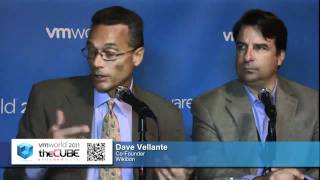
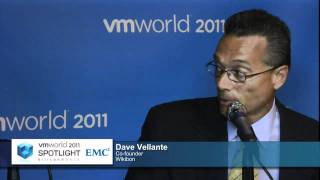
Amr Awadallah, Cloudera, and Richard McDougall, VMware at VMworld 2011 with John Furrier and Dave Vellante.
In theCube's Big Data panel spotlight at VMworld 2011, SiliconANGLE Founder John Furrier and Wikibon Co-Founder Dave Vellante were joined by Amr Awadallah, Co-Founder of Cloudera and Richard McDougall, CTO of Application Infrastructure at VMware.
Furrier kicked off the discussion by asking Awadallah from an entrepreneur's perspective, how VMware has changed over the years from a virtualization company to a pure-on cloud company. Awadallah observed that VMware has changed beyond the virtualization layer and has expanded into layers above that. He said he could see the growth with the acquisitions of Zimbra and SpringSource. He noted that traditionally, VMware has focused on storage for virtual machines, using storage area networks (SANs) and central storage. He predicted over the next few years that they will move to using storage on the servers themselves.
Furrier asked McDougall how VMware continues to roll out in the enterprise while dealing with Opensource frameworks and software development environments. McDougall responded that Opensource helps drive the eco-system, and that by containing core values that are needed, it is growing well, especially in the big data world. He said, "People want big data with strong isolation, with resource controls . . . a lot of the core values in the vSphere platform are really able to be exploited now for some of the needs around the big data platform."
Furrier asked Awadallah what enterprises really want in big data and how it relates to their cloud strategy and cloud possibilities. Awadallah replied that in many ways, both Hadoop and big data are about cloud. He stated, "Cloud is about having a resource that is scalable that can do your bidding . . . if you have lots of data that you want to have lots of flexibility and agility and scalability in terms of processing, that's exactly what Hadoop offers you."
Awadallah went on to list the major trends that are making Hadoop so hot today. The first one, he said, is behavioral. Organizations want to be more agile, more adaptive, and they don't want to be locked into one language to query their data or locked into a schema. Hadoop gives them that freedom. The other trends are commodity hardware with multiple cores and disks which allow customers to scale big data processing as never before.
Mcdougall agreed with Awadallah that Hadoop is growing like crazy. He indicated that customers want to implement Hadoop on their existing cloud infrastructure quickly, and so if they mix Hadoop with a cloud infrastructure, the result is "agile Hadoop" where they can deploy on demand Hadoop instances for analytics. McDougall predicted that the next big thing will be the change in how storage is provisioned, along with 5x or 10x reduction in cost per gigabyte for acquiring storage for big data.
Awadallah addressed the two main things that customers are asking for: 1) Scalability of people -- how can one system administrator manage 1000 or 10,000 nodes? He gave Cloudera Management Suite as a solution that attacks that problem. It allows one Hadoop sys admin to scale their capacity to manage hundreds or even thousands of nodes. 2) Integration with existing enterprise infrastructure. Customers want to ensure they can use Hadoop with what they have today. Cloudera has been working on integration with many industry partners such as Dell and MicroStrategy. They have also launched a partner exchange program that enables many partner eco-system players to start building their own system integrations.
Vellante commented that many of Cloudera's competitors are saying that Hadoop isn't enterprise-ready. Awadallah agreed that the maturity of Hadoop isn't quite there yet, but said that it is rapidly progressing, and he reminded viewers that Hadoop is only seven years old, as compared to VMware (15 years old) and basic technology (30-40 years old).
Vellante asked how VMware and Cloudera are working together. McDougall shared that they are doing performance testing of Hadoop on the VMware platform. Awadallah added that the integration of their technologies involve the WHIRR projects where the customer can easily deploy Hadoop on top of a vCloud solution.
Forgot Password
Almost there!
We just sent you a verification email. Please verify your account to gain access to
VMworld 2011 | Las Vegas. If you don’t think you received an email check your
spam folder.
In order to sign in, enter the email address you used to registered for the event. Once completed, you will receive an email with a verification link. Open this link to automatically sign into the site.
Register For VMworld 2011 | Las Vegas
Please fill out the information below. You will recieve an email with a verification link confirming your registration. Click the link to automatically sign into the site.
You’re almost there!
We just sent you a verification email. Please click the verification button in the email. Once your email address is verified, you will have full access to all event content for VMworld 2011 | Las Vegas.
I want my badge and interests to be visible to all attendees.
Checking this box will display your presense on the attendees list, view your profile and allow other attendees to contact you via 1-1 chat. Read the Privacy Policy. At any time, you can choose to disable this preference.
Select your Interests!
add
Upload your photo
Uploading..
OR
Connect via Twitter
Connect via Linkedin
EDIT PASSWORD
Share
Forgot Password
Almost there!
We just sent you a verification email. Please verify your account to gain access to
VMworld 2011 | Las Vegas. If you don’t think you received an email check your
spam folder.
In order to sign in, enter the email address you used to registered for the event. Once completed, you will receive an email with a verification link. Open this link to automatically sign into the site.
Sign in to gain access to VMworld 2011 | Las Vegas
Please sign in with LinkedIn to continue to VMworld 2011 | Las Vegas. Signing in with LinkedIn ensures a professional environment.
Are you sure you want to remove access rights for this user?
Details
Manage Access
email address
Community Invitation
Amr Awadallah, Cloudera and Richard McDougall, VMware | VMworld 2011
Amr Awadallah, Cloudera, and Richard McDougall, VMware at VMworld 2011 with John Furrier and Dave Vellante.
In theCube's Big Data panel spotlight at VMworld 2011, SiliconANGLE Founder John Furrier and Wikibon Co-Founder Dave Vellante were joined by Amr Awadallah, Co-Founder of Cloudera and Richard McDougall, CTO of Application Infrastructure at VMware.
Furrier kicked off the discussion by asking Awadallah from an entrepreneur's perspective, how VMware has changed over the years from a virtualization company to a pure-on cloud company. Awadallah observed that VMware has changed beyond the virtualization layer and has expanded into layers above that. He said he could see the growth with the acquisitions of Zimbra and SpringSource. He noted that traditionally, VMware has focused on storage for virtual machines, using storage area networks (SANs) and central storage. He predicted over the next few years that they will move to using storage on the servers themselves.
Furrier asked McDougall how VMware continues to roll out in the enterprise while dealing with Opensource frameworks and software development environments. McDougall responded that Opensource helps drive the eco-system, and that by containing core values that are needed, it is growing well, especially in the big data world. He said, "People want big data with strong isolation, with resource controls . . . a lot of the core values in the vSphere platform are really able to be exploited now for some of the needs around the big data platform."
Furrier asked Awadallah what enterprises really want in big data and how it relates to their cloud strategy and cloud possibilities. Awadallah replied that in many ways, both Hadoop and big data are about cloud. He stated, "Cloud is about having a resource that is scalable that can do your bidding . . . if you have lots of data that you want to have lots of flexibility and agility and scalability in terms of processing, that's exactly what Hadoop offers you."
Awadallah went on to list the major trends that are making Hadoop so hot today. The first one, he said, is behavioral. Organizations want to be more agile, more adaptive, and they don't want to be locked into one language to query their data or locked into a schema. Hadoop gives them that freedom. The other trends are commodity hardware with multiple cores and disks which allow customers to scale big data processing as never before.
Mcdougall agreed with Awadallah that Hadoop is growing like crazy. He indicated that customers want to implement Hadoop on their existing cloud infrastructure quickly, and so if they mix Hadoop with a cloud infrastructure, the result is "agile Hadoop" where they can deploy on demand Hadoop instances for analytics. McDougall predicted that the next big thing will be the change in how storage is provisioned, along with 5x or 10x reduction in cost per gigabyte for acquiring storage for big data.
Awadallah addressed the two main things that customers are asking for: 1) Scalability of people -- how can one system administrator manage 1000 or 10,000 nodes? He gave Cloudera Management Suite as a solution that attacks that problem. It allows one Hadoop sys admin to scale their capacity to manage hundreds or even thousands of nodes. 2) Integration with existing enterprise infrastructure. Customers want to ensure they can use Hadoop with what they have today. Cloudera has been working on integration with many industry partners such as Dell and MicroStrategy. They have also launched a partner exchange program that enables many partner eco-system players to start building their own system integrations.
Vellante commented that many of Cloudera's competitors are saying that Hadoop isn't enterprise-ready. Awadallah agreed that the maturity of Hadoop isn't quite there yet, but said that it is rapidly progressing, and he reminded viewers that Hadoop is only seven years old, as compared to VMware (15 years old) and basic technology (30-40 years old).
Vellante asked how VMware and Cloudera are working together. McDougall shared that they are doing performance testing of Hadoop on the VMware platform. Awadallah added that the integration of their technologies involve the WHIRR projects where the customer can easily deploy Hadoop on top of a vCloud solution.