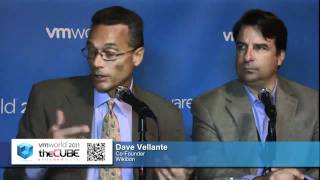
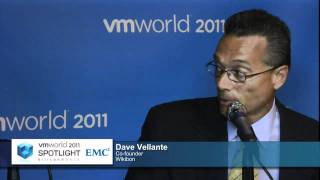
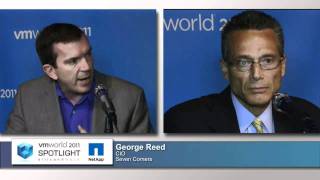
VCE offers Vblock, the world's first converged infrastructure for private cloud computing. Dave Vellante, Co-Founder of Wikibon, discussed VCE's strategies with Don Norbeck, CTO of VCE, at VMworld 2011.
Vellante noted how companies like HP, IBM and Oracle are using the integrated stack approach, while other companies such as Arista, Juniper and NetApp are taking the pure play approach. VCE seems to be taking the best of both worlds and putting it together. Norbeck explained that their technique is to look at common elements that companies already have deployed in their data center, figure out how they can fit better together, and wrap a systems approach around that. He said, "If you have that systems approach, you can gain better visibility into what happens on the switch . . . the server . . . the storage, and make sure you get that correlation on the physical and logical levels, not just on a monitoring management piece of software layered on top. If you get those correlations then you know that the port one, switch one is really associated with a much greater purpose . . . and you can do interesting policy-based things based on that."
Vellante summarized Vblock as a logical block of infrastructure designed to support applications across the portfolio horizontally. When asked why it's optimized for the cloud, Norbeck responded that cloud issues center around consistency of experience. VCE believes that gaining this consistency of experience is going to be the launching point for the future of hybrid or pervasive cloud as it emerges. He said to get this, the user needs greater visibility into the underlying infrastructure, which almost has to act like objects in the object-oriented programming world so that each time it's configured, it runs the same way and provides the same capacities. If the users have these infrastructure objects, then they have the ability to enable much more up on the application tier. The customer knows it's going to run the same way with the same
consistency of experience each time.
Vellante said that companies like Amazon have a successful cloud due to their homogeneous infrastructures and wondered if homogeneous infrastructure is the way to go. Norbeck countered that there could be a monogeneous, single set of infrastructure or they could have consistent primitives. Those primitives, or building blocks, would allow the user to maintain that consistency experience. Those individual building blocks are coming from VMware, Cisco and EMC. Norbeck said, "We understand what they do and how they fit together. Then we lasso around that a systems approach. We make sure we have the right elements in there appropriate to different workloads."
VCE's approach is that they are going for personalization, and not customization. He said that most IT organizations today run under a customized infrastructure or a cloud where one size fits all. VCE fits the middle ground where they have underlying components that allow them to give a homogeneous experience on the platform level but is built to be personalized for a particular workload.
Vellante asked what differences there are between VCE and their major competitors, such as HP, Oracle, and NetApp. Norbeck stated that VCE's strategy is ". . . to look at ways to leverage the best of breed underlying components that everyone in IT is familiar with, make them into a system that enables a lot of choice on the management tier, on the way that you achieve your policy objectives, but it's tuned and appropriate for applications."
Forgot Password
Almost there!
We just sent you a verification email. Please verify your account to gain access to
VMworld 2011 | Las Vegas. If you don’t think you received an email check your
spam folder.
In order to sign in, enter the email address you used to registered for the event. Once completed, you will receive an email with a verification link. Open this link to automatically sign into the site.
Register For VMworld 2011 | Las Vegas
Please fill out the information below. You will recieve an email with a verification link confirming your registration. Click the link to automatically sign into the site.
You’re almost there!
We just sent you a verification email. Please click the verification button in the email. Once your email address is verified, you will have full access to all event content for VMworld 2011 | Las Vegas.
I want my badge and interests to be visible to all attendees.
Checking this box will display your presense on the attendees list, view your profile and allow other attendees to contact you via 1-1 chat. Read the Privacy Policy. At any time, you can choose to disable this preference.
Select your Interests!
add
Upload your photo
Uploading..
OR
Connect via Twitter
Connect via Linkedin
EDIT PASSWORD
Share
Forgot Password
Almost there!
We just sent you a verification email. Please verify your account to gain access to
VMworld 2011 | Las Vegas. If you don’t think you received an email check your
spam folder.
In order to sign in, enter the email address you used to registered for the event. Once completed, you will receive an email with a verification link. Open this link to automatically sign into the site.
Sign in to gain access to VMworld 2011 | Las Vegas
Please sign in with LinkedIn to continue to VMworld 2011 | Las Vegas. Signing in with LinkedIn ensures a professional environment.
Are you sure you want to remove access rights for this user?
Details
Manage Access
email address
Community Invitation
Don Norbeck, VCE | VMworld 2011
VCE offers Vblock, the world's first converged infrastructure for private cloud computing. Dave Vellante, Co-Founder of Wikibon, discussed VCE's strategies with Don Norbeck, CTO of VCE, at VMworld 2011.
Vellante noted how companies like HP, IBM and Oracle are using the integrated stack approach, while other companies such as Arista, Juniper and NetApp are taking the pure play approach. VCE seems to be taking the best of both worlds and putting it together. Norbeck explained that their technique is to look at common elements that companies already have deployed in their data center, figure out how they can fit better together, and wrap a systems approach around that. He said, "If you have that systems approach, you can gain better visibility into what happens on the switch . . . the server . . . the storage, and make sure you get that correlation on the physical and logical levels, not just on a monitoring management piece of software layered on top. If you get those correlations then you know that the port one, switch one is really associated with a much greater purpose . . . and you can do interesting policy-based things based on that."
Vellante summarized Vblock as a logical block of infrastructure designed to support applications across the portfolio horizontally. When asked why it's optimized for the cloud, Norbeck responded that cloud issues center around consistency of experience. VCE believes that gaining this consistency of experience is going to be the launching point for the future of hybrid or pervasive cloud as it emerges. He said to get this, the user needs greater visibility into the underlying infrastructure, which almost has to act like objects in the object-oriented programming world so that each time it's configured, it runs the same way and provides the same capacities. If the users have these infrastructure objects, then they have the ability to enable much more up on the application tier. The customer knows it's going to run the same way with the same
consistency of experience each time.
Vellante said that companies like Amazon have a successful cloud due to their homogeneous infrastructures and wondered if homogeneous infrastructure is the way to go. Norbeck countered that there could be a monogeneous, single set of infrastructure or they could have consistent primitives. Those primitives, or building blocks, would allow the user to maintain that consistency experience. Those individual building blocks are coming from VMware, Cisco and EMC. Norbeck said, "We understand what they do and how they fit together. Then we lasso around that a systems approach. We make sure we have the right elements in there appropriate to different workloads."
VCE's approach is that they are going for personalization, and not customization. He said that most IT organizations today run under a customized infrastructure or a cloud where one size fits all. VCE fits the middle ground where they have underlying components that allow them to give a homogeneous experience on the platform level but is built to be personalized for a particular workload.
Vellante asked what differences there are between VCE and their major competitors, such as HP, Oracle, and NetApp. Norbeck stated that VCE's strategy is ". . . to look at ways to leverage the best of breed underlying components that everyone in IT is familiar with, make them into a system that enables a lot of choice on the management tier, on the way that you achieve your policy objectives, but it's tuned and appropriate for applications."