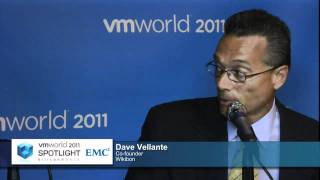
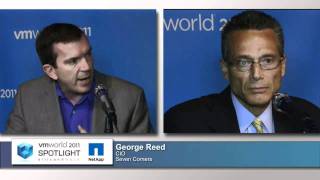
Cloud Foundry was a huge announcement by VMware, lifting platform as a service (PAAS) into the spotlight in the cloud industry. Jerry Chen, VP of Cloud and Application Services at VMware met with John Furrier, SiliconANGLE Founder, and Dave Vellante, Wikibon Co-Founder, at VMworld 2011 to discuss the latest developments with platform as a service.
Chen started out by discussing what the big change is in PAAS. He said, "I think cloud foundry hit a nerve with developers and customers because it really channeled a need in the market." He expanded on this by saying most PAAS offerings were either a single language, with access to limited technologies or were stuck on one cloud. VMware saw a need for a next generation PAAS or open platform service. Their vision was a platform that could use multiple languages and multiple frameworks, one that the customer could plug in their database or data services, and most importantly, run this PAAS engine in the private cloud or a public cloud, or even use VMware's Micro Cloud product on a laptop.
Chen remarked on another trend they're seeing, which is a need for symmetry between private and public clouds. He said customers want to replicate the same development environment in several locations. Applying that same philosophy at the app layer, Chen said, was revolutionary. Now customers can have the same app platform for cloud apps in multiple locations.
Vellante asked how fast Chen thought this vision would be adopted in the industry. Chen pointed out that everyone's talking about open PAAS and Cloud Foundry is already being adopted by other PAAS providers and ISVs (Independent Software Vendors). He said one of the reasons why they open-sourced Cloud Foundry was so that developers are not locked in to a specific method of development, and they also designed Cloud Foundry to help developers be productive, and not force them to change how they work. He believes the next phase will be the use of multi-cloud.
Furrier asked how Cloud Foundry fits into multi-cloud performance. Chen admitted that, "Multi-cloud is tricky . . . because it depends on your application." He used the example of next generation web apps. He said these apps will be to a browser, to a phone, tablet or mobile device, and they use a ton of data so the application needs to be scaled dynamically from cloud to cloud. With Cloud Foundry, he said it can be scaled up simply by adding more run-times. With multi-cloud, he said it's even easier for developers running Cloud Foundry to push their app from one cloud and re-deploy the same app to another cloud, thus providing multi-cloud portability.
Chen named developer awareness/adoption and eco-system as their two biggest goals. Chen said that they are actively tracking and monitoring the number of check-ins and improvements on both CloudFoundry.com and CloudFoundry.org, the OpenSource project. So far, there have been over a hundred OpenSource contributions, including languages such as Erlang, JRuby, and Python. In terms of eco-system, he said that they're on a good trajectory to getting Cloud Foundry adopted, especially with the recent announcements of companies such as AppFog, ActiveState, and Dell all starting to use Cloud Foundry as a PAAS container.
Chen went on to discuss some of the problems that actually create opportunity in the market today, mainly that customers who have saved money by virtualizing their infrastructure now have to turn around and spend that money to build new apps to add value to the business. The opportunity here is that if they spend more money to develop apps faster, they can be more competitive in the marketplace. He also commented on how fast PAAS is growing, the status of standards in the industry, his view on finding good talent, and how developers have transitioned over the past five years.
Forgot Password
Almost there!
We just sent you a verification email. Please verify your account to gain access to
VMworld 2011 | Las Vegas. If you don’t think you received an email check your
spam folder.
In order to sign in, enter the email address you used to registered for the event. Once completed, you will receive an email with a verification link. Open this link to automatically sign into the site.
Register For VMworld 2011 | Las Vegas
Please fill out the information below. You will recieve an email with a verification link confirming your registration. Click the link to automatically sign into the site.
You’re almost there!
We just sent you a verification email. Please click the verification button in the email. Once your email address is verified, you will have full access to all event content for VMworld 2011 | Las Vegas.
I want my badge and interests to be visible to all attendees.
Checking this box will display your presense on the attendees list, view your profile and allow other attendees to contact you via 1-1 chat. Read the Privacy Policy. At any time, you can choose to disable this preference.
Select your Interests!
add
Upload your photo
Uploading..
OR
Connect via Twitter
Connect via Linkedin
EDIT PASSWORD
Share
Forgot Password
Almost there!
We just sent you a verification email. Please verify your account to gain access to
VMworld 2011 | Las Vegas. If you don’t think you received an email check your
spam folder.
In order to sign in, enter the email address you used to registered for the event. Once completed, you will receive an email with a verification link. Open this link to automatically sign into the site.
Sign in to gain access to VMworld 2011 | Las Vegas
Please sign in with LinkedIn to continue to VMworld 2011 | Las Vegas. Signing in with LinkedIn ensures a professional environment.
Are you sure you want to remove access rights for this user?
Details
Manage Access
email address
Community Invitation
Jerry Chen, VMware | VMworld 2011
Cloud Foundry was a huge announcement by VMware, lifting platform as a service (PAAS) into the spotlight in the cloud industry. Jerry Chen, VP of Cloud and Application Services at VMware met with John Furrier, SiliconANGLE Founder, and Dave Vellante, Wikibon Co-Founder, at VMworld 2011 to discuss the latest developments with platform as a service.
Chen started out by discussing what the big change is in PAAS. He said, "I think cloud foundry hit a nerve with developers and customers because it really channeled a need in the market." He expanded on this by saying most PAAS offerings were either a single language, with access to limited technologies or were stuck on one cloud. VMware saw a need for a next generation PAAS or open platform service. Their vision was a platform that could use multiple languages and multiple frameworks, one that the customer could plug in their database or data services, and most importantly, run this PAAS engine in the private cloud or a public cloud, or even use VMware's Micro Cloud product on a laptop.
Chen remarked on another trend they're seeing, which is a need for symmetry between private and public clouds. He said customers want to replicate the same development environment in several locations. Applying that same philosophy at the app layer, Chen said, was revolutionary. Now customers can have the same app platform for cloud apps in multiple locations.
Vellante asked how fast Chen thought this vision would be adopted in the industry. Chen pointed out that everyone's talking about open PAAS and Cloud Foundry is already being adopted by other PAAS providers and ISVs (Independent Software Vendors). He said one of the reasons why they open-sourced Cloud Foundry was so that developers are not locked in to a specific method of development, and they also designed Cloud Foundry to help developers be productive, and not force them to change how they work. He believes the next phase will be the use of multi-cloud.
Furrier asked how Cloud Foundry fits into multi-cloud performance. Chen admitted that, "Multi-cloud is tricky . . . because it depends on your application." He used the example of next generation web apps. He said these apps will be to a browser, to a phone, tablet or mobile device, and they use a ton of data so the application needs to be scaled dynamically from cloud to cloud. With Cloud Foundry, he said it can be scaled up simply by adding more run-times. With multi-cloud, he said it's even easier for developers running Cloud Foundry to push their app from one cloud and re-deploy the same app to another cloud, thus providing multi-cloud portability.
Chen named developer awareness/adoption and eco-system as their two biggest goals. Chen said that they are actively tracking and monitoring the number of check-ins and improvements on both CloudFoundry.com and CloudFoundry.org, the OpenSource project. So far, there have been over a hundred OpenSource contributions, including languages such as Erlang, JRuby, and Python. In terms of eco-system, he said that they're on a good trajectory to getting Cloud Foundry adopted, especially with the recent announcements of companies such as AppFog, ActiveState, and Dell all starting to use Cloud Foundry as a PAAS container.
Chen went on to discuss some of the problems that actually create opportunity in the market today, mainly that customers who have saved money by virtualizing their infrastructure now have to turn around and spend that money to build new apps to add value to the business. The opportunity here is that if they spend more money to develop apps faster, they can be more competitive in the marketplace. He also commented on how fast PAAS is growing, the status of standards in the industry, his view on finding good talent, and how developers have transitioned over the past five years.