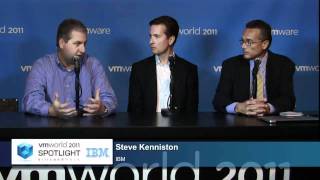
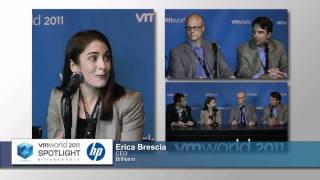
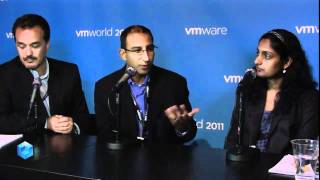
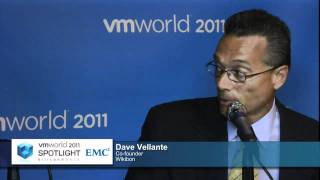
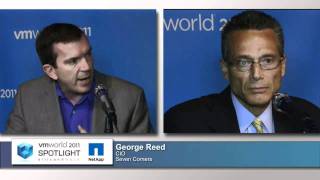
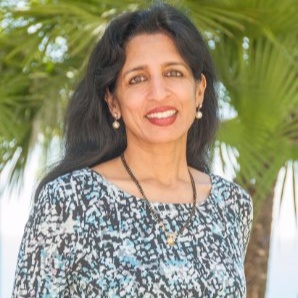
John Furrier, Founder of SiliconANGLE and Dave Vellante, Co-Founder of Wikibon sat down at VMworld 2011 with Jayshree Ulall, CEO of Artista Networks to find out what's going on at the network layer of cloud.
Ulall noted how the cloud has gone from being a hype term to real deployments. She explained how Artista was started with the sole intent of building cloud networking software, with different kinds of hardware layered on top. Today Arista has deployments all over the world, both in public and private clouds. She said not surprisingly, the private cloud took off first because people were looking to provide high performance transactions and solutions for very specific applications.
Ulall spoke about mobility, saying that the deployment of virtualization has especially been a challenge for mobility because of "VM sprawl" -- virtual machines running everywhere, independent of location. This has forced the networking vendors to be less static in their deployment of a network where everything is physically associated with a logical IP or MAC address. She addressed the announcement Steve (Herrod) made about VXLANs, saying it's an indicator of VMware and Arista partnering more closely on networking.
Furrier asked about the outdated WAN link, and Ulall agreed that it's a bottleneck. She said, "What Arista's done is put so much bandwidth into the LAN and data center that we've shifted the problem to the inner data center. Many companies have come up with proprietary tags and capabilities, and we see no reason for it. You can put in full fiber optic VWDM bandwidth and enable large-scale layer two, layer three topologies, enabling VXLAN at the edge so that now you can cross boundaries without proprietary networks and implement a full internet protocol rather than have multiple terminations and proprietary links in between."
Furrier asked Ulall what is meant by a flat network. She described it as "tuning your applications appropriately for the network rather than building a generic, multi-purpose enterprise network for multiple applications." She pointed out that it's for a very specific set of virtualization applications, high performance mission critical applications, and workloads that require scale of thousands of nodes. She said a flat network means they can provide unlimited capacity in a two layer, very simple network topology, (Arista's leaf and spine architecture), that gives the customer a scale of 10,000 nodes or even up to 100,000 nodes today.
Furrier wondered how application developers and network people are working together. Ulall responded that Arista introduced a feature called latency analyzer, which addresses the classic problem of an app developer saying the network is slow, and the network person saying it's an app problem. She reiterated that this Arista's key area -- tuning the network for the applications. The latency analyzer allows them to set watermarks and thresholds to say there's a problem that's coming before the congestion actually occurs. She emphasized that this kind of proactive troubleshooting is only possible if you tune the network with the application vendor.
Furrier asked her if she thought the traditional OSI seven-layer stack was still in place versus the model today. Ulall believes what's really emerging is a cloud stack, where you need best of breed in compute, storage, virtualization, as well as a new kind of network hypervisor. She said that the definition of a stack is less theoretical and more mission purpose to different applications.
Forgot Password
Almost there!
We just sent you a verification email. Please verify your account to gain access to
VMworld 2011 | Las Vegas. If you don’t think you received an email check your
spam folder.
In order to sign in, enter the email address you used to registered for the event. Once completed, you will receive an email with a verification link. Open this link to automatically sign into the site.
Register For VMworld 2011 | Las Vegas
Please fill out the information below. You will recieve an email with a verification link confirming your registration. Click the link to automatically sign into the site.
You’re almost there!
We just sent you a verification email. Please click the verification button in the email. Once your email address is verified, you will have full access to all event content for VMworld 2011 | Las Vegas.
I want my badge and interests to be visible to all attendees.
Checking this box will display your presense on the attendees list, view your profile and allow other attendees to contact you via 1-1 chat. Read the Privacy Policy. At any time, you can choose to disable this preference.
Select your Interests!
add
Upload your photo
Uploading..
OR
Connect via Twitter
Connect via Linkedin
EDIT PASSWORD
Share
Forgot Password
Almost there!
We just sent you a verification email. Please verify your account to gain access to
VMworld 2011 | Las Vegas. If you don’t think you received an email check your
spam folder.
In order to sign in, enter the email address you used to registered for the event. Once completed, you will receive an email with a verification link. Open this link to automatically sign into the site.
Sign in to gain access to VMworld 2011 | Las Vegas
Please sign in with LinkedIn to continue to VMworld 2011 | Las Vegas. Signing in with LinkedIn ensures a professional environment.
Are you sure you want to remove access rights for this user?
Details
Manage Access
email address
Community Invitation
Jayshree Ulall, Artista Networks | VMworld 2011
John Furrier, Founder of SiliconANGLE and Dave Vellante, Co-Founder of Wikibon sat down at VMworld 2011 with Jayshree Ulall, CEO of Artista Networks to find out what's going on at the network layer of cloud.
Ulall noted how the cloud has gone from being a hype term to real deployments. She explained how Artista was started with the sole intent of building cloud networking software, with different kinds of hardware layered on top. Today Arista has deployments all over the world, both in public and private clouds. She said not surprisingly, the private cloud took off first because people were looking to provide high performance transactions and solutions for very specific applications.
Ulall spoke about mobility, saying that the deployment of virtualization has especially been a challenge for mobility because of "VM sprawl" -- virtual machines running everywhere, independent of location. This has forced the networking vendors to be less static in their deployment of a network where everything is physically associated with a logical IP or MAC address. She addressed the announcement Steve (Herrod) made about VXLANs, saying it's an indicator of VMware and Arista partnering more closely on networking.
Furrier asked about the outdated WAN link, and Ulall agreed that it's a bottleneck. She said, "What Arista's done is put so much bandwidth into the LAN and data center that we've shifted the problem to the inner data center. Many companies have come up with proprietary tags and capabilities, and we see no reason for it. You can put in full fiber optic VWDM bandwidth and enable large-scale layer two, layer three topologies, enabling VXLAN at the edge so that now you can cross boundaries without proprietary networks and implement a full internet protocol rather than have multiple terminations and proprietary links in between."
Furrier asked Ulall what is meant by a flat network. She described it as "tuning your applications appropriately for the network rather than building a generic, multi-purpose enterprise network for multiple applications." She pointed out that it's for a very specific set of virtualization applications, high performance mission critical applications, and workloads that require scale of thousands of nodes. She said a flat network means they can provide unlimited capacity in a two layer, very simple network topology, (Arista's leaf and spine architecture), that gives the customer a scale of 10,000 nodes or even up to 100,000 nodes today.
Furrier wondered how application developers and network people are working together. Ulall responded that Arista introduced a feature called latency analyzer, which addresses the classic problem of an app developer saying the network is slow, and the network person saying it's an app problem. She reiterated that this Arista's key area -- tuning the network for the applications. The latency analyzer allows them to set watermarks and thresholds to say there's a problem that's coming before the congestion actually occurs. She emphasized that this kind of proactive troubleshooting is only possible if you tune the network with the application vendor.
Furrier asked her if she thought the traditional OSI seven-layer stack was still in place versus the model today. Ulall believes what's really emerging is a cloud stack, where you need best of breed in compute, storage, virtualization, as well as a new kind of network hypervisor. She said that the definition of a stack is less theoretical and more mission purpose to different applications.