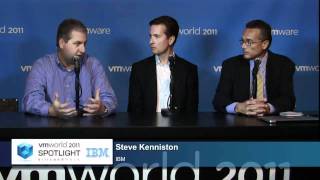
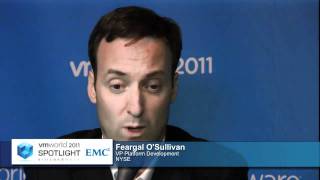
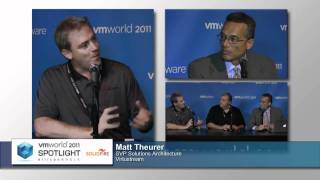
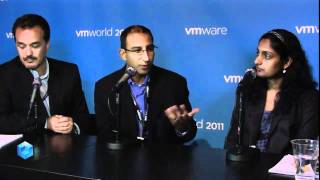
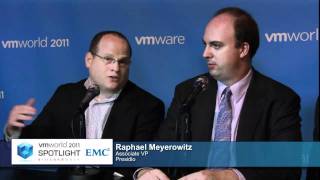
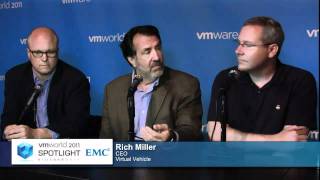
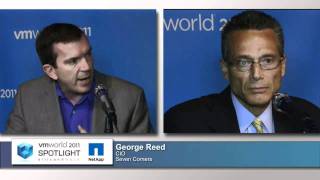
Alex Williams, Analyst with SiliconANGLE sat down in The Cube with George Reese, CTO of enStratus, Gary Orenstein of Fusion-io/Host of Cloud Computing and Derrick Harris who covers Cloud Computing and General Infrastructure for GigaOM to discuss developing stories at VMworld2011 in contrast with the rest of the market.
Harris notes the global expansion of VMware and that we are seeing new clouds popping up built on VMware. We are also seeing globally managed VMware clouds and it's entrance into the database world. VM appears to be growing each year. VMware's expansion into the storage arena is pointed out by Orenstein, "About a month or so, maybe a little bit more, they announced vSphere 5 with a slew of storage features. In fact, the vSphere Blog is in the midst of some eleven or twelve part series on all of the storage features. I think that we are going to see a lot more there."
Orenstein contrasts Amazon and VMware web services, "There's no option to run Amazon locally. You can't own your Amazon Cloud. I think if I'm looking around at some of the signage at VMworld one of the tag lines is [Your Cloud Own It]. So, I think VMware is making a very clear distinction that, that is not an option in most cases. You can't own it even if you wanted to." There needs to be a distinction between the companies that offer end users the ability to own the infrastructure and the software to build the cloud and the companies who don't. Harris doesn't believe the Amazon web service approach versus VMware approach will be a challenge.
According to Williams, data will continue to be the big story next year. More aps will be developed and the data story will continue into other realms beyond our mobile devices. Harris points out that VMware bought up many software applications startups in the past year which we will see the culmination of in the coming year.
Applications are here but it is early in the game. People are carrying around two devices and are still trying to figure out the efficiencies in their lifestyle. Orenstein adds, "When you start building applications, if you started today building an enterprise application, one of your primary requirements is, make sure I can use it on the phone or the iPad or some mobile device." The phone is the number one forefactor when designing collaboration software.
Reese states, "I think the thing that glues it all together, though, is that once you get away from the having two devices and it becomes a true bring-your-own-device world, then suddenly all corporate resources whether they're public cloud, private cloud or whatever have to be accessible anywhere anytime. That means the firewall has to start coming down."
In the technology progression across the marketplace, we are seeing incredible amounts of data with serious bottlenecks inside the enterprise. Virtualization is creating major storage issues for companies where performance becomes a problem. Orenstein responds that many have ways of optimizing storage for virtual machines, "Historically, when you've operated in a non-virtualized environment you had relatively good control over that path between the application and the data. But as you virtualize everything it gets far more complex and many people say that they don't feel comfortable virtualizing certain I/O intensive applications like databases because they get worried about performance or that they can only virtualize a limited amount of things because they get worried about performance. So flash memory and a variety of flash memory-based solutions are a great way to do that."
Forgot Password
Almost there!
We just sent you a verification email. Please verify your account to gain access to
VMworld 2011 | Las Vegas. If you don’t think you received an email check your
spam folder.
In order to sign in, enter the email address you used to registered for the event. Once completed, you will receive an email with a verification link. Open this link to automatically sign into the site.
Register For VMworld 2011 | Las Vegas
Please fill out the information below. You will recieve an email with a verification link confirming your registration. Click the link to automatically sign into the site.
You’re almost there!
We just sent you a verification email. Please click the verification button in the email. Once your email address is verified, you will have full access to all event content for VMworld 2011 | Las Vegas.
I want my badge and interests to be visible to all attendees.
Checking this box will display your presense on the attendees list, view your profile and allow other attendees to contact you via 1-1 chat. Read the Privacy Policy. At any time, you can choose to disable this preference.
Select your Interests!
add
Upload your photo
Uploading..
OR
Connect via Twitter
Connect via Linkedin
EDIT PASSWORD
Share
Forgot Password
Almost there!
We just sent you a verification email. Please verify your account to gain access to
VMworld 2011 | Las Vegas. If you don’t think you received an email check your
spam folder.
In order to sign in, enter the email address you used to registered for the event. Once completed, you will receive an email with a verification link. Open this link to automatically sign into the site.
Sign in to gain access to VMworld 2011 | Las Vegas
Please sign in with LinkedIn to continue to VMworld 2011 | Las Vegas. Signing in with LinkedIn ensures a professional environment.
Are you sure you want to remove access rights for this user?
Details
Manage Access
email address
Community Invitation
Blogger Panel - VMworld 2011 - theCUBE
Alex Williams, Analyst with SiliconANGLE sat down in The Cube with George Reese, CTO of enStratus, Gary Orenstein of Fusion-io/Host of Cloud Computing and Derrick Harris who covers Cloud Computing and General Infrastructure for GigaOM to discuss developing stories at VMworld2011 in contrast with the rest of the market.
Harris notes the global expansion of VMware and that we are seeing new clouds popping up built on VMware. We are also seeing globally managed VMware clouds and it's entrance into the database world. VM appears to be growing each year. VMware's expansion into the storage arena is pointed out by Orenstein, "About a month or so, maybe a little bit more, they announced vSphere 5 with a slew of storage features. In fact, the vSphere Blog is in the midst of some eleven or twelve part series on all of the storage features. I think that we are going to see a lot more there."
Orenstein contrasts Amazon and VMware web services, "There's no option to run Amazon locally. You can't own your Amazon Cloud. I think if I'm looking around at some of the signage at VMworld one of the tag lines is [Your Cloud Own It]. So, I think VMware is making a very clear distinction that, that is not an option in most cases. You can't own it even if you wanted to." There needs to be a distinction between the companies that offer end users the ability to own the infrastructure and the software to build the cloud and the companies who don't. Harris doesn't believe the Amazon web service approach versus VMware approach will be a challenge.
According to Williams, data will continue to be the big story next year. More aps will be developed and the data story will continue into other realms beyond our mobile devices. Harris points out that VMware bought up many software applications startups in the past year which we will see the culmination of in the coming year.
Applications are here but it is early in the game. People are carrying around two devices and are still trying to figure out the efficiencies in their lifestyle. Orenstein adds, "When you start building applications, if you started today building an enterprise application, one of your primary requirements is, make sure I can use it on the phone or the iPad or some mobile device." The phone is the number one forefactor when designing collaboration software.
Reese states, "I think the thing that glues it all together, though, is that once you get away from the having two devices and it becomes a true bring-your-own-device world, then suddenly all corporate resources whether they're public cloud, private cloud or whatever have to be accessible anywhere anytime. That means the firewall has to start coming down."
In the technology progression across the marketplace, we are seeing incredible amounts of data with serious bottlenecks inside the enterprise. Virtualization is creating major storage issues for companies where performance becomes a problem. Orenstein responds that many have ways of optimizing storage for virtual machines, "Historically, when you've operated in a non-virtualized environment you had relatively good control over that path between the application and the data. But as you virtualize everything it gets far more complex and many people say that they don't feel comfortable virtualizing certain I/O intensive applications like databases because they get worried about performance or that they can only virtualize a limited amount of things because they get worried about performance. So flash memory and a variety of flash memory-based solutions are a great way to do that."