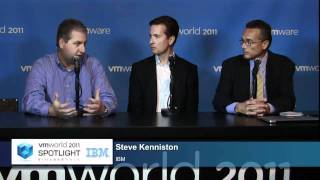
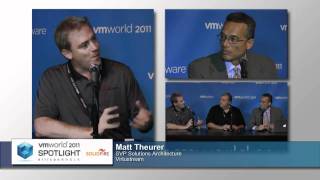
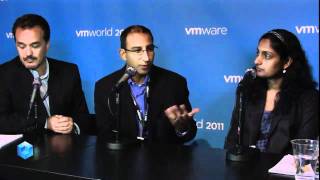
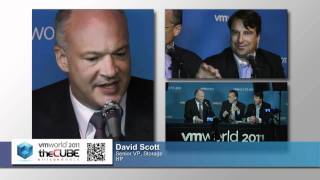
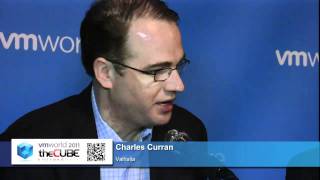
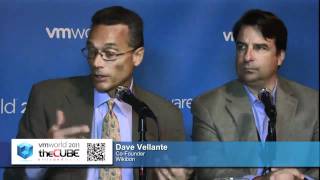
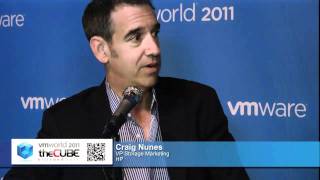
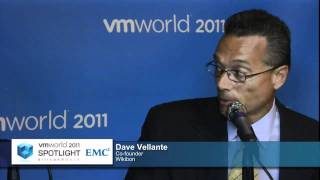
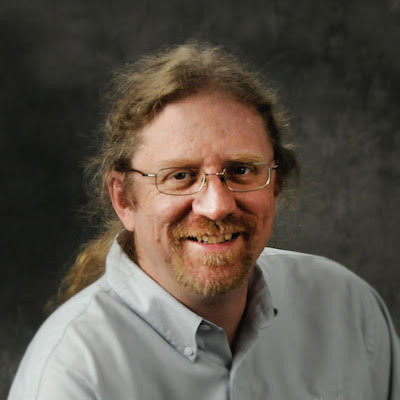
Brad Maltz, CTO of ICI, Drew Kramer, VP of IT Technical Operations at VMware and Jerome Wendt, President and Lead Analyist with DCIG joined Dave Vallante, Co-founder of Wikibon in The Cube at VMworld 2011, to spotlight VMware backup and recovery.
Vallente asks the panel for their perspectives regarding the state of backup, specifically VMware being blamed for so many storage problems, although it has stressed traditional backup. Maltz first notes, "Backups have always been one of the hardest pieces of IT to actually deal with. Virtualization does take that to the next level simply because the consolidation ratios people are driving into right now really are just making it exceedingly harder to get the IO out of the back end of the boxes." Backup technologies have modified how they work and are now leading the industry in how backups are functioning in virtualization.
VMware is making a lot of strides in storage and backup, specifically. Kramer, who runs a group called Technical Operations, which is responsible for the "care and feeding" of the R&D organization at VMware, states there is a share of challenges regarding backup of engineers' large amounts of data. Kramer explains the benefit of deduplication technology, "When you've got a lot of VM's sharing, essentially a common set of data across the operating system and also with the data that I'm storing for engineers, there's generally a lot of duplicative data in there."
Techniques and specifically leveraging of deduplication is discussed by Kramer, "The API's are great because they allow the vendor-specific products like the ones from EMC or NetApp, or anybody else for that matter to interact directly with the virtualization layers to optimize for those backup protocols. So that is important and the hooks that are in there are the one's that we leverage for the stuff that we do." Kramer is an IT Practitioner who works with VMware's products inside of VMware every day.
Wendt discusses the landscape of backup and recovery with three key points. Backup is being offloaded onto the storage array using more Snapshot and CDP type of technology. Backup should not be viewed traditionally due to time inefficiency. Wendt believes there is an emergence of VMware administrators with one group including a backup specialist who knows more about the process. Lastly, he sees more of a solution-oriented approach where people can use a "turn-key" appliance, one piece of hardware that will provide multiple ways to perform backups.
Backup is not currently considered a service inside of VMware. It is, however, being considered and pursued. Kramer points out the trend they are seeing internally, "You don't need to be a specialist in backup to get those backups up and running, or more importantly to do the restores...restores are actually the key."
New technologies are coming into play with recovery. Backup and recovery solutions should be the final piece of a restore. Maltz explains that the type of recovery one needs, including file-based, image-based or VM Decay level recovery should be taken into consideration, "When you get into an IT practice of a larger organization such as VMware or somebody of that size, you don't want everbody to be able to restore their own VM Decay files. That might be a little bit damaging because you never know what they're going to do, but file-based recovery is something that you probably do want almost everybody to have that level of control over." Knowing that one has good backups is extremely important from an IT perspective. Monitoring and testing backups on a regular basis is strongly recommended.
Monitoring and reporting can begin today. Maltz favors DPA (Data Protection Advisor) from EMC that gives a health check across different platforms. Kramer suggests, "I would even take that one step further. Reporting is good and necessary, but you actually have to go off and have the discipline of practicing the restores and making sure that the data has integrity and that you can do those restores. We tend to do those on, sort of, a quarterly basis with a drill we do around disaster recovery for that."
Looking forward in the next 24 months, Wendt expects to see faster recoveries, where 30 minutes or faster is going to become the new benchmark regardless of application size. Maltz considers Cloud to be the biggest potential disruptor, "Cloud is not just about technology. Cloud is about a modification of processes and policies and unfortunately backup and recovery is so rigid in how it functions, it might not be as elastic as Cloud's going to need it to be. So that's where you're going to see certain backup technologies that are going to have to modify themselves to really fit into the future Cloud model."
Forgot Password
Almost there!
We just sent you a verification email. Please verify your account to gain access to
VMworld 2011 | Las Vegas. If you don’t think you received an email check your
spam folder.
In order to sign in, enter the email address you used to registered for the event. Once completed, you will receive an email with a verification link. Open this link to automatically sign into the site.
Register For VMworld 2011 | Las Vegas
Please fill out the information below. You will recieve an email with a verification link confirming your registration. Click the link to automatically sign into the site.
You’re almost there!
We just sent you a verification email. Please click the verification button in the email. Once your email address is verified, you will have full access to all event content for VMworld 2011 | Las Vegas.
I want my badge and interests to be visible to all attendees.
Checking this box will display your presense on the attendees list, view your profile and allow other attendees to contact you via 1-1 chat. Read the Privacy Policy. At any time, you can choose to disable this preference.
Select your Interests!
add
Upload your photo
Uploading..
OR
Connect via Twitter
Connect via Linkedin
EDIT PASSWORD
Share
Forgot Password
Almost there!
We just sent you a verification email. Please verify your account to gain access to
VMworld 2011 | Las Vegas. If you don’t think you received an email check your
spam folder.
In order to sign in, enter the email address you used to registered for the event. Once completed, you will receive an email with a verification link. Open this link to automatically sign into the site.
Sign in to gain access to VMworld 2011 | Las Vegas
Please sign in with LinkedIn to continue to VMworld 2011 | Las Vegas. Signing in with LinkedIn ensures a professional environment.
Are you sure you want to remove access rights for this user?
Details
Manage Access
email address
Community Invitation
Backup and Recovery Spotlight Panel - VMworld 2011 - theCUBE
Brad Maltz, CTO of ICI, Drew Kramer, VP of IT Technical Operations at VMware and Jerome Wendt, President and Lead Analyist with DCIG joined Dave Vallante, Co-founder of Wikibon in The Cube at VMworld 2011, to spotlight VMware backup and recovery.
Vallente asks the panel for their perspectives regarding the state of backup, specifically VMware being blamed for so many storage problems, although it has stressed traditional backup. Maltz first notes, "Backups have always been one of the hardest pieces of IT to actually deal with. Virtualization does take that to the next level simply because the consolidation ratios people are driving into right now really are just making it exceedingly harder to get the IO out of the back end of the boxes." Backup technologies have modified how they work and are now leading the industry in how backups are functioning in virtualization.
VMware is making a lot of strides in storage and backup, specifically. Kramer, who runs a group called Technical Operations, which is responsible for the "care and feeding" of the R&D organization at VMware, states there is a share of challenges regarding backup of engineers' large amounts of data. Kramer explains the benefit of deduplication technology, "When you've got a lot of VM's sharing, essentially a common set of data across the operating system and also with the data that I'm storing for engineers, there's generally a lot of duplicative data in there."
Techniques and specifically leveraging of deduplication is discussed by Kramer, "The API's are great because they allow the vendor-specific products like the ones from EMC or NetApp, or anybody else for that matter to interact directly with the virtualization layers to optimize for those backup protocols. So that is important and the hooks that are in there are the one's that we leverage for the stuff that we do." Kramer is an IT Practitioner who works with VMware's products inside of VMware every day.
Wendt discusses the landscape of backup and recovery with three key points. Backup is being offloaded onto the storage array using more Snapshot and CDP type of technology. Backup should not be viewed traditionally due to time inefficiency. Wendt believes there is an emergence of VMware administrators with one group including a backup specialist who knows more about the process. Lastly, he sees more of a solution-oriented approach where people can use a "turn-key" appliance, one piece of hardware that will provide multiple ways to perform backups.
Backup is not currently considered a service inside of VMware. It is, however, being considered and pursued. Kramer points out the trend they are seeing internally, "You don't need to be a specialist in backup to get those backups up and running, or more importantly to do the restores...restores are actually the key."
New technologies are coming into play with recovery. Backup and recovery solutions should be the final piece of a restore. Maltz explains that the type of recovery one needs, including file-based, image-based or VM Decay level recovery should be taken into consideration, "When you get into an IT practice of a larger organization such as VMware or somebody of that size, you don't want everbody to be able to restore their own VM Decay files. That might be a little bit damaging because you never know what they're going to do, but file-based recovery is something that you probably do want almost everybody to have that level of control over." Knowing that one has good backups is extremely important from an IT perspective. Monitoring and testing backups on a regular basis is strongly recommended.
Monitoring and reporting can begin today. Maltz favors DPA (Data Protection Advisor) from EMC that gives a health check across different platforms. Kramer suggests, "I would even take that one step further. Reporting is good and necessary, but you actually have to go off and have the discipline of practicing the restores and making sure that the data has integrity and that you can do those restores. We tend to do those on, sort of, a quarterly basis with a drill we do around disaster recovery for that."
Looking forward in the next 24 months, Wendt expects to see faster recoveries, where 30 minutes or faster is going to become the new benchmark regardless of application size. Maltz considers Cloud to be the biggest potential disruptor, "Cloud is not just about technology. Cloud is about a modification of processes and policies and unfortunately backup and recovery is so rigid in how it functions, it might not be as elastic as Cloud's going to need it to be. So that's where you're going to see certain backup technologies that are going to have to modify themselves to really fit into the future Cloud model."