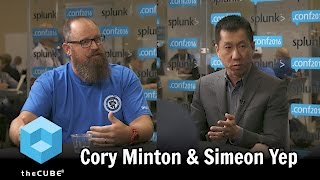
01. Ram Varadarajan, Acalvio, visits #theCUBE!. (00:19)
02. Background of Acalvio and the Splunk Relationship. (00:45)
03. Machine Learning and Security: Differentiating Acalvio. (02:31)
04. Unsupervised Machine Learning. (04:57)
05. Getting Wise to the Attackers' Methods. (07:45)
06. "Blending In" to Avoid Attackers. (09:04)
07. Perceiving the Patterns of Attackers. (10:24)
08. Algorithms and Keys. (11:28)
09. Tracing the Attacker's Path. (12:36)
10. New Tools for Unsupervised Attacks. (13:13)
11. Automation and Intelligence: Security Can Work. (13:57)
Track List created with http://www.vinjavideo.com.
--- ---
A motion detector for enterprise data: Building smarter security | #splunkconf16
by R. Danes | Sep 29, 2016
Anyone who uses a personal computer with a firewall knows that however secure that system may be, it’s not particularly smart. Yes it blocks threats, but it tends not to reveal much about them — and it sometimes blocks perfectly innocent applications. Likewise, businesses with very large assets at risk have traditionally had to make do with firewalls and all their imperfections. Now some vendors are stepping up their game and using data to develop brainier enterprise security systems.
Ram Varadarajan, founder, chairman and CEO of Acalvio Technologies, said the firewall is like the lock on a door — it can keep out intruders, but it doesn’t give much intelligence on them. He said his company has developed a tool called Deception that does more.
“Think of it as a motion detector for your enterprise,” he told John Furrier (@furrier) and John Walls (@JohnWalls21), cohosts of theCUBE, from the SiliconANGLE Media team, during Splunk.conf 2016.
Haystack, meet metal detector
“We want the anomaly to announce itself,” he said. Further, using Splunk data tools, the company can then glean information on the attacker.
“We actually go and mine for specific information without having to build an ocean of data,” Varadarajan said. “We just need to follow a thread.”
Forensic data science
The data-centric approach has another benefit over simply bolting the doors, so to speak, with a firewall, Varadarajan stated.
When an attacker touches a decoy, “we can actually trace the path the attacker took in order to reach the decoy,” he said, adding that feeding this information back into the system makes it smarter. “If you know the patterns of the attackers, you can set the decoys in clever ways.”
Forgot Password
Almost there!
We just sent you a verification email. Please verify your account to gain access to
Splunk.conf 2016 | Orlando. If you don’t think you received an email check your
spam folder.
In order to sign in, enter the email address you used to registered for the event. Once completed, you will receive an email with a verification link. Open this link to automatically sign into the site.
Register For Splunk.conf 2016 | Orlando
Please fill out the information below. You will recieve an email with a verification link confirming your registration. Click the link to automatically sign into the site.
You’re almost there!
We just sent you a verification email. Please click the verification button in the email. Once your email address is verified, you will have full access to all event content for Splunk.conf 2016 | Orlando.
I want my badge and interests to be visible to all attendees.
Checking this box will display your presense on the attendees list, view your profile and allow other attendees to contact you via 1-1 chat. Read the Privacy Policy. At any time, you can choose to disable this preference.
Select your Interests!
add
Upload your photo
Uploading..
OR
Connect via Twitter
Connect via Linkedin
EDIT PASSWORD
Share
Forgot Password
Almost there!
We just sent you a verification email. Please verify your account to gain access to
Splunk.conf 2016 | Orlando. If you don’t think you received an email check your
spam folder.
In order to sign in, enter the email address you used to registered for the event. Once completed, you will receive an email with a verification link. Open this link to automatically sign into the site.
Sign in to gain access to Splunk.conf 2016 | Orlando
Please sign in with LinkedIn to continue to Splunk.conf 2016 | Orlando. Signing in with LinkedIn ensures a professional environment.
Are you sure you want to remove access rights for this user?
Details
Manage Access
email address
Community Invitation
Ram Varadarajan | Splunk .conf2016
01. Ram Varadarajan, Acalvio, visits #theCUBE!. (00:19)
02. Background of Acalvio and the Splunk Relationship. (00:45)
03. Machine Learning and Security: Differentiating Acalvio. (02:31)
04. Unsupervised Machine Learning. (04:57)
05. Getting Wise to the Attackers' Methods. (07:45)
06. "Blending In" to Avoid Attackers. (09:04)
07. Perceiving the Patterns of Attackers. (10:24)
08. Algorithms and Keys. (11:28)
09. Tracing the Attacker's Path. (12:36)
10. New Tools for Unsupervised Attacks. (13:13)
11. Automation and Intelligence: Security Can Work. (13:57)
Track List created with http://www.vinjavideo.com.
--- ---
A motion detector for enterprise data: Building smarter security | #splunkconf16
by R. Danes | Sep 29, 2016
Anyone who uses a personal computer with a firewall knows that however secure that system may be, it’s not particularly smart. Yes it blocks threats, but it tends not to reveal much about them — and it sometimes blocks perfectly innocent applications. Likewise, businesses with very large assets at risk have traditionally had to make do with firewalls and all their imperfections. Now some vendors are stepping up their game and using data to develop brainier enterprise security systems.
Ram Varadarajan, founder, chairman and CEO of Acalvio Technologies, said the firewall is like the lock on a door — it can keep out intruders, but it doesn’t give much intelligence on them. He said his company has developed a tool called Deception that does more.
“Think of it as a motion detector for your enterprise,” he told John Furrier (@furrier) and John Walls (@JohnWalls21), cohosts of theCUBE, from the SiliconANGLE Media team, during Splunk.conf 2016.
Haystack, meet metal detector
“We want the anomaly to announce itself,” he said. Further, using Splunk data tools, the company can then glean information on the attacker.
“We actually go and mine for specific information without having to build an ocean of data,” Varadarajan said. “We just need to follow a thread.”
Forensic data science
The data-centric approach has another benefit over simply bolting the doors, so to speak, with a firewall, Varadarajan stated.
When an attacker touches a decoy, “we can actually trace the path the attacker took in order to reach the decoy,” he said, adding that feeding this information back into the system makes it smarter. “If you know the patterns of the attackers, you can set the decoys in clever ways.”