01. Andi Mann, Splunk, visits #theCUBE!. (00:19)
02. Jon Rooney, Splunk, visits #theCUBE!. (00:46)
03. The Growing Splunk Community. (02:12)
04. From Tool to Platform: The Splunk Progression. (02:60)
05. The New Face of IT and the Fabric of Businesss. (04:09)
06. The Breakdown of "Conventional Wisdom". (05:49)
07. Freeing People Up to Actually Add Value. (07:38)
08. How Splunk Differentiates from the Employee Perspective. (08:48)
09. Recent Changes in the Data EcoSystem. (10:18)
10. Takeaways from the Splunk 2016 Conference. (14:49)
Track List created with http://www.vinjavideo.com.
--- ---
The value of disruption and data analytics | #splunkconf16
by Gabriel Pesek | Oct 2, 2016
As the roles and sources of data continue to expand for so many companies, automation is increasingly becoming a necessity, not just to pull that data into storage, but for determining what sorts of questions should be asked in its analysis.
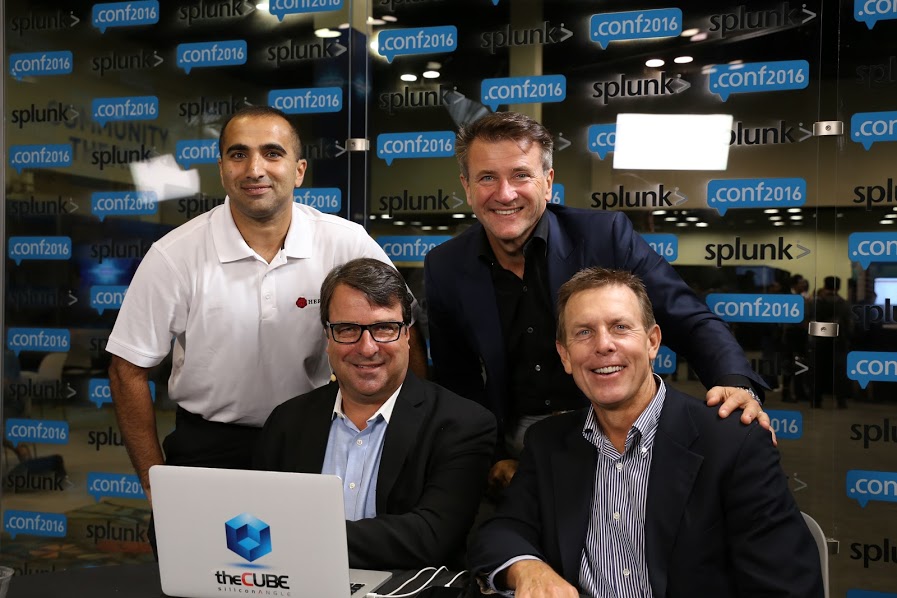
At the 2016 Splunk.conf event, Jon Rooney, senior director of Product Marketing at Splunk Inc., and Andi Mann, chief technology advocate at Splunk, joined John Walls (@JohnWalls21) and John Furrier (@furrier), cohosts of theCUBE, from the SiliconANGLE Media team, to talk about Splunk’s expanding interests and applications, as well as where they see things going from here.
Mingled energy
Both guests were enthusiastic about the conference, largely due to the engagement with customers it enabled.
“There’s a great vibe at this show,” Mann said. “I mean, it’s something I’ve just heard from this company is that customers are such a part of their life-blood, and they love to be here, love to be with each other, love to learn about stuff, they love to tell each other how good things are going. When they listen to the keynotes, you can really feel the buzz going. People are just really into what we do and the results we get, and that gives us a lot of energy.”
Growing from the base
Rooney and Mann also shared some insights into how Splunk was working to grow while holding onto its core principles.
“In hiring and growing, and how we treat our customers, we really try to not let go of the things from the early days,” Rooney said. “Going back about three to four years, we wanted to make sure that the fundamental things that Splunk did well – the data ingestion, the correlation, the visualization – we made sure that that was a platform, that was extensible, that was something that not only we could build on, but our partners could build on.”
RELATED: How do you get more from the path to cloud than a headache? | #VMworld
He continued: “And then over time, what we found the more we talked to customers, the more we heard about how they were using the product, we wanted to focus on ‘what are the pillars of the business?’. And that’s why we really doubled down on IT operations and security, to build out these solutions … that are hyped-focused on those users … but still take advantage of everything great with the platform.”
Disruptive synergy
Rooney explained: “Ultimately, if the big driver of this is businesses want to move faster, they want to do more and they want to learn faster, you can’t do that stuff manually. Infrastructure is good, it has to be software-driven, it has to be data-driven. … Ultimately, all the ditch-digging is done by the technology so that the people are freed up to actually add value.”
Rooney also shared information on some of the areas that are currently seeing the biggest growths of interest from customers and developers. “The paradigm for working with Splunk from the beginning was ‘get it all in one place and ask questions of it,’ he said. “And that’s still massively powerful, it’s still a powerful use-case for a lot of customers, but I think there’s a huge opportunity from the analytics side to say, ‘How about your data starts to tell you some things? How about your data proactively does some pattern recognition, does some predictive things, does some threshold analysis?’”
He continued: “And now, all of a sudden, you can expand the scope of the type of data you put in. Essentially, you’re gaining this scale that you wouldn’t normally have, because the software’s doing more of the work. It’s not just answering questions, it’s coming up with the questions for you.”
Forgot Password
Almost there!
We just sent you a verification email. Please verify your account to gain access to
Splunk.conf 2016 | Orlando. If you don’t think you received an email check your
spam folder.
In order to sign in, enter the email address you used to registered for the event. Once completed, you will receive an email with a verification link. Open this link to automatically sign into the site.
Register For Splunk.conf 2016 | Orlando
Please fill out the information below. You will recieve an email with a verification link confirming your registration. Click the link to automatically sign into the site.
You’re almost there!
We just sent you a verification email. Please click the verification button in the email. Once your email address is verified, you will have full access to all event content for Splunk.conf 2016 | Orlando.
I want my badge and interests to be visible to all attendees.
Checking this box will display your presense on the attendees list, view your profile and allow other attendees to contact you via 1-1 chat. Read the Privacy Policy. At any time, you can choose to disable this preference.
Select your Interests!
add
Upload your photo
Uploading..
OR
Connect via Twitter
Connect via Linkedin
EDIT PASSWORD
Share
Forgot Password
Almost there!
We just sent you a verification email. Please verify your account to gain access to
Splunk.conf 2016 | Orlando. If you don’t think you received an email check your
spam folder.
In order to sign in, enter the email address you used to registered for the event. Once completed, you will receive an email with a verification link. Open this link to automatically sign into the site.
Sign in to gain access to Splunk.conf 2016 | Orlando
Please sign in with LinkedIn to continue to Splunk.conf 2016 | Orlando. Signing in with LinkedIn ensures a professional environment.
Are you sure you want to remove access rights for this user?
Details
Manage Access
email address
Community Invitation
Jon Rooney & Andi Mann, Splunk | Splunk .conf2016
01. Andi Mann, Splunk, visits #theCUBE!. (00:19)
02. Jon Rooney, Splunk, visits #theCUBE!. (00:46)
03. The Growing Splunk Community. (02:12)
04. From Tool to Platform: The Splunk Progression. (02:60)
05. The New Face of IT and the Fabric of Businesss. (04:09)
06. The Breakdown of "Conventional Wisdom". (05:49)
07. Freeing People Up to Actually Add Value. (07:38)
08. How Splunk Differentiates from the Employee Perspective. (08:48)
09. Recent Changes in the Data EcoSystem. (10:18)
10. Takeaways from the Splunk 2016 Conference. (14:49)
Track List created with http://www.vinjavideo.com.
--- ---
The value of disruption and data analytics | #splunkconf16
by Gabriel Pesek | Oct 2, 2016
As the roles and sources of data continue to expand for so many companies, automation is increasingly becoming a necessity, not just to pull that data into storage, but for determining what sorts of questions should be asked in its analysis.
At the 2016 Splunk.conf event, Jon Rooney, senior director of Product Marketing at Splunk Inc., and Andi Mann, chief technology advocate at Splunk, joined John Walls (@JohnWalls21) and John Furrier (@furrier), cohosts of theCUBE, from the SiliconANGLE Media team, to talk about Splunk’s expanding interests and applications, as well as where they see things going from here.
Mingled energy
Both guests were enthusiastic about the conference, largely due to the engagement with customers it enabled.
“There’s a great vibe at this show,” Mann said. “I mean, it’s something I’ve just heard from this company is that customers are such a part of their life-blood, and they love to be here, love to be with each other, love to learn about stuff, they love to tell each other how good things are going. When they listen to the keynotes, you can really feel the buzz going. People are just really into what we do and the results we get, and that gives us a lot of energy.”
Growing from the base
Rooney and Mann also shared some insights into how Splunk was working to grow while holding onto its core principles.
“In hiring and growing, and how we treat our customers, we really try to not let go of the things from the early days,” Rooney said. “Going back about three to four years, we wanted to make sure that the fundamental things that Splunk did well – the data ingestion, the correlation, the visualization – we made sure that that was a platform, that was extensible, that was something that not only we could build on, but our partners could build on.”
RELATED: How do you get more from the path to cloud than a headache? | #VMworld
He continued: “And then over time, what we found the more we talked to customers, the more we heard about how they were using the product, we wanted to focus on ‘what are the pillars of the business?’. And that’s why we really doubled down on IT operations and security, to build out these solutions … that are hyped-focused on those users … but still take advantage of everything great with the platform.”
Disruptive synergy
Rooney explained: “Ultimately, if the big driver of this is businesses want to move faster, they want to do more and they want to learn faster, you can’t do that stuff manually. Infrastructure is good, it has to be software-driven, it has to be data-driven. … Ultimately, all the ditch-digging is done by the technology so that the people are freed up to actually add value.”
Rooney also shared information on some of the areas that are currently seeing the biggest growths of interest from customers and developers. “The paradigm for working with Splunk from the beginning was ‘get it all in one place and ask questions of it,’ he said. “And that’s still massively powerful, it’s still a powerful use-case for a lot of customers, but I think there’s a huge opportunity from the analytics side to say, ‘How about your data starts to tell you some things? How about your data proactively does some pattern recognition, does some predictive things, does some threshold analysis?’”
He continued: “And now, all of a sudden, you can expand the scope of the type of data you put in. Essentially, you’re gaining this scale that you wouldn’t normally have, because the software’s doing more of the work. It’s not just answering questions, it’s coming up with the questions for you.”