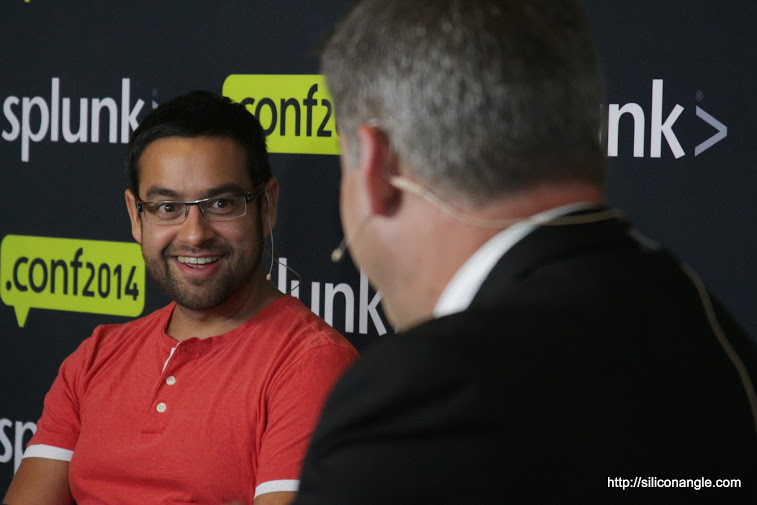
Adam Ind, IT Manager, Royal Flying Doctor Service, at Splunk.conf 2014 with Jeff Kelly and Jeff Frick
https://siliconangle.com/2014/10/10/real-time-data-for-royal-flying-doctors-is-crucial-for-the-non-profit-splunkconf/ @theCUBE @Splunk #theCUBE #Splunk #splunkconf #SiliconANGLE
Real-time data is crucial Royal Flying Doctors
The Royal Flying Doctor Service, an Australian nonprofit, uses dashboards from Splunk Inc. to support their day-to-day mission, providing medical care via airplane to remote communities throughout Australia.
The Royal Flying Doctor Service uses Splunk to index data from two main sources: flight trackers from Flight Explorer and temperature sensors from Corintech vaccine-bearing refrigerators and boxes.
Once indexed from the data aggregators, Splunk turns this information into dashboards that help medical personnel stay organized and maintain medicine within acceptable temperatures. The Royal Flying Doctor Service has been able to get real-time visibility of service patterns. Furthermore, Adam Ind, the Royal Flying Doctor Service IT Manager, explained that Splunk helps with day-to-day IT challenges in addition to niche needs like aircraft and vaccine temperature tracking. He said that the nonprofit also uses Splunk to easily and readily get information out to all the staff, or to achieve more granular communication control.
Beyond operational clarity, Ind called out that the Royal Flying Doctor Service uses Big Data to foster relationships with donors. For contributing $50, donors will receive a “patch of sky” — when a Royal Flying Doctor Service airplane flies through a particular geographic area monitored by Flight Explorer and Splunk, the donor will receive a notification. It’s a way to engage donors and raise awareness about services, said Ind.
The Royal Flying Doctor Service first encountered Splunk through a local partner. The “try before you buy” model was essential to the non profit, said Ind, because it needs “to maximize dollars from donors.” The chance to run a trial before buying, Ind noted, “convinced [him] that it definitely would provide value.”
Forgot Password
Almost there!
We just sent you a verification email. Please verify your account to gain access to
Splunk.conf 2014 | Las Vegas. If you don’t think you received an email check your
spam folder.
In order to sign in, enter the email address you used to registered for the event. Once completed, you will receive an email with a verification link. Open this link to automatically sign into the site.
Register For Splunk.conf 2014 | Las Vegas
Please fill out the information below. You will recieve an email with a verification link confirming your registration. Click the link to automatically sign into the site.
You’re almost there!
We just sent you a verification email. Please click the verification button in the email. Once your email address is verified, you will have full access to all event content for Splunk.conf 2014 | Las Vegas.
I want my badge and interests to be visible to all attendees.
Checking this box will display your presense on the attendees list, view your profile and allow other attendees to contact you via 1-1 chat. Read the Privacy Policy. At any time, you can choose to disable this preference.
Select your Interests!
add
Upload your photo
Uploading..
OR
Connect via Twitter
Connect via Linkedin
EDIT PASSWORD
Share
Forgot Password
Almost there!
We just sent you a verification email. Please verify your account to gain access to
Splunk.conf 2014 | Las Vegas. If you don’t think you received an email check your
spam folder.
In order to sign in, enter the email address you used to registered for the event. Once completed, you will receive an email with a verification link. Open this link to automatically sign into the site.
Sign in to gain access to Splunk.conf 2014 | Las Vegas
Please sign in with LinkedIn to continue to Splunk.conf 2014 | Las Vegas. Signing in with LinkedIn ensures a professional environment.
Are you sure you want to remove access rights for this user?
Details
Manage Access
email address
Community Invitation
Adam Ind, Royal Flying Doctor Service | Splunk .conf2014
Adam Ind, IT Manager, Royal Flying Doctor Service, at Splunk.conf 2014 with Jeff Kelly and Jeff Frick
https://siliconangle.com/2014/10/10/real-time-data-for-royal-flying-doctors-is-crucial-for-the-non-profit-splunkconf/ @theCUBE @Splunk #theCUBE #Splunk #splunkconf #SiliconANGLE
Real-time data is crucial Royal Flying Doctors
The Royal Flying Doctor Service, an Australian nonprofit, uses dashboards from Splunk Inc. to support their day-to-day mission, providing medical care via airplane to remote communities throughout Australia.
The Royal Flying Doctor Service uses Splunk to index data from two main sources: flight trackers from Flight Explorer and temperature sensors from Corintech vaccine-bearing refrigerators and boxes.
Once indexed from the data aggregators, Splunk turns this information into dashboards that help medical personnel stay organized and maintain medicine within acceptable temperatures. The Royal Flying Doctor Service has been able to get real-time visibility of service patterns. Furthermore, Adam Ind, the Royal Flying Doctor Service IT Manager, explained that Splunk helps with day-to-day IT challenges in addition to niche needs like aircraft and vaccine temperature tracking. He said that the nonprofit also uses Splunk to easily and readily get information out to all the staff, or to achieve more granular communication control.
Beyond operational clarity, Ind called out that the Royal Flying Doctor Service uses Big Data to foster relationships with donors. For contributing $50, donors will receive a “patch of sky” — when a Royal Flying Doctor Service airplane flies through a particular geographic area monitored by Flight Explorer and Splunk, the donor will receive a notification. It’s a way to engage donors and raise awareness about services, said Ind.
The Royal Flying Doctor Service first encountered Splunk through a local partner. The “try before you buy” model was essential to the non profit, said Ind, because it needs “to maximize dollars from donors.” The chance to run a trial before buying, Ind noted, “convinced [him] that it definitely would provide value.”