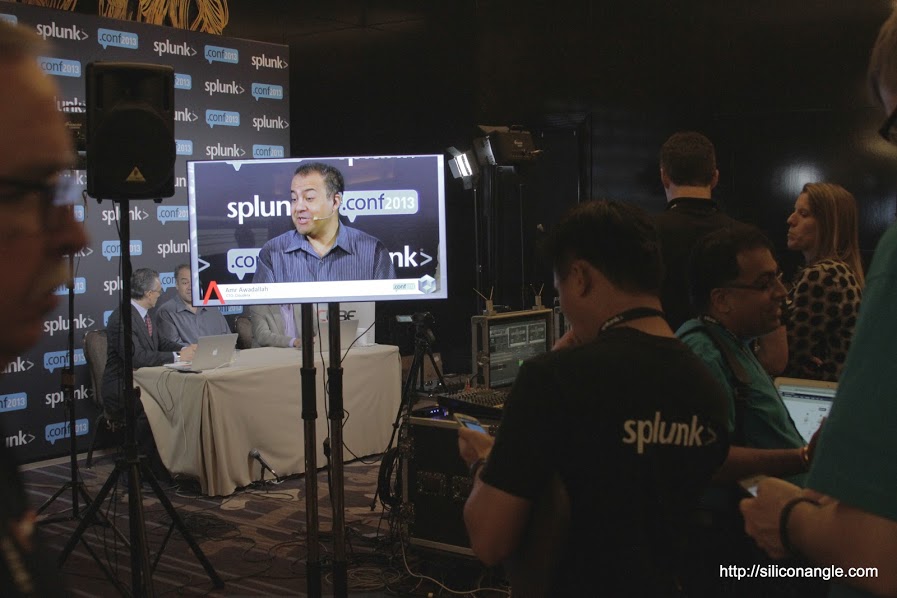
Mark Seward, Senior Director of Security and Compliance Marketing with Splunk, talked with John Furrier and Dave Vellante at Splunk.conf 2013 in Las Vegas, covering the data management platform and various security issues.
Furrier started the interview by pointing out that a lot of people are using Seward's product for security and compliance reasons, and asked the security angle for this conference.
"I've seen that liberating feeling coming over people. What is liberating is that they're able to answer questions with what is usually considered to be exhaust gas in the business -- the exhaust gas of data that comes out of the servers and applications," said Seward. "Splunk makes all data secure and relevant, and that makes it unique."
Asked what were some of the features of the product, Seward replied: "Splunk is trying to make data more accessible and more available to everyone."
What security people want
"For the most part, people are using the data reactively. The data is the definitive record of all the human-to-machine and machine-to-machine interaction you got inside of your business and inside your agency; it's the definitive record that you can put together in many ways the 5 W's of Journalism: Who What Where When and Why -- and that's what security people really want to get as well, and it's all inside of that data (either through data itself or through correlations amongst the data)."
Vellante wanted to debate a little more on the subject of data's security relevance, asking if "Splunk is making a safer environment from a National Security standpoint."
"It's not that I sleep better because my customers have Splunk, but I'd like to think that," smiled Seward. "When you take the supply chain for a nuclear reactor, what happens if there's nothing wrong inside that reactor, but the water supplier is having a problem? Water is needed to cool down the reactor and that's a potential threat to my being able to properly deal with the problem. I want to be able to take data from my ecosystems of suppliers, to be able to tell if I'm going to have a downstream or upstream problem or not. That's making us safer in that respect."
This is just one example of a '(if) you see these things (then) take this particular action' scenario. "We have customers implementing us in that manner all the time."
Taking the viewers through a series of case scenarios, Mark Seward managed to demonstrate successfully that "Splunk can act like the glue between a lot of different solutions that customers have on the security side." As for its versatility, "it can act either as a catalyst, or a platform, as Splunk has the ability to talk to other parts of the infrastructure and automate responses."
@thecube
#theCUBE #Splunk #SplunkConf #SiliconANGLE @Splunk
Forgot Password
Almost there!
We just sent you a verification email. Please verify your account to gain access to
Splunk.conf 2013. If you don’t think you received an email check your
spam folder.
In order to sign in, enter the email address you used to registered for the event. Once completed, you will receive an email with a verification link. Open this link to automatically sign into the site.
Register For Splunk.conf 2013
Please fill out the information below. You will recieve an email with a verification link confirming your registration. Click the link to automatically sign into the site.
You’re almost there!
We just sent you a verification email. Please click the verification button in the email. Once your email address is verified, you will have full access to all event content for Splunk.conf 2013.
I want my badge and interests to be visible to all attendees.
Checking this box will display your presense on the attendees list, view your profile and allow other attendees to contact you via 1-1 chat. Read the Privacy Policy. At any time, you can choose to disable this preference.
Select your Interests!
add
Upload your photo
Uploading..
OR
Connect via Twitter
Connect via Linkedin
EDIT PASSWORD
Share
Forgot Password
Almost there!
We just sent you a verification email. Please verify your account to gain access to
Splunk.conf 2013. If you don’t think you received an email check your
spam folder.
In order to sign in, enter the email address you used to registered for the event. Once completed, you will receive an email with a verification link. Open this link to automatically sign into the site.
Sign in to gain access to Splunk.conf 2013
Please sign in with LinkedIn to continue to Splunk.conf 2013. Signing in with LinkedIn ensures a professional environment.
Are you sure you want to remove access rights for this user?
Details
Manage Access
email address
Community Invitation
Mark Seward, Splunk | Splunk .conf2013
Mark Seward, Senior Director of Security and Compliance Marketing with Splunk, talked with John Furrier and Dave Vellante at Splunk.conf 2013 in Las Vegas, covering the data management platform and various security issues.
Furrier started the interview by pointing out that a lot of people are using Seward's product for security and compliance reasons, and asked the security angle for this conference.
"I've seen that liberating feeling coming over people. What is liberating is that they're able to answer questions with what is usually considered to be exhaust gas in the business -- the exhaust gas of data that comes out of the servers and applications," said Seward. "Splunk makes all data secure and relevant, and that makes it unique."
Asked what were some of the features of the product, Seward replied: "Splunk is trying to make data more accessible and more available to everyone."
What security people want
"For the most part, people are using the data reactively. The data is the definitive record of all the human-to-machine and machine-to-machine interaction you got inside of your business and inside your agency; it's the definitive record that you can put together in many ways the 5 W's of Journalism: Who What Where When and Why -- and that's what security people really want to get as well, and it's all inside of that data (either through data itself or through correlations amongst the data)."
Vellante wanted to debate a little more on the subject of data's security relevance, asking if "Splunk is making a safer environment from a National Security standpoint."
"It's not that I sleep better because my customers have Splunk, but I'd like to think that," smiled Seward. "When you take the supply chain for a nuclear reactor, what happens if there's nothing wrong inside that reactor, but the water supplier is having a problem? Water is needed to cool down the reactor and that's a potential threat to my being able to properly deal with the problem. I want to be able to take data from my ecosystems of suppliers, to be able to tell if I'm going to have a downstream or upstream problem or not. That's making us safer in that respect."
This is just one example of a '(if) you see these things (then) take this particular action' scenario. "We have customers implementing us in that manner all the time."
Taking the viewers through a series of case scenarios, Mark Seward managed to demonstrate successfully that "Splunk can act like the glue between a lot of different solutions that customers have on the security side." As for its versatility, "it can act either as a catalyst, or a platform, as Splunk has the ability to talk to other parts of the infrastructure and automate responses."
@thecube
#theCUBE #Splunk #SplunkConf #SiliconANGLE @Splunk