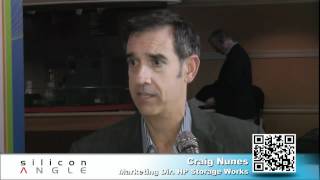
Gary Orenstein, writer at GigaOm, through leader and VP of Marketing at Fusion-io, explains the use cases and technology of the big wave of flash media. The discussion of flash was pervasive at SNW, and Gary explains the differentiation of Fusion-io's solution that moves storage closer to the data than array-based flash.
Flash memory is taking the data center world by storm and creating disruptive opportunities to challenge the status quo, overcoming the capacity challenges of RAM and the performance challenges of hard disks to enable innovative new architectures.
This article discusses several different real-world use cases for SQL Server, MySQL web scale, and performance scale up within a turnkey appliance.
A Highly Available, Shared-nothing Microsoft SQL Server Powerhouse
.
When flash is placed within the server, as close to the CPU as possible (i.e. natively on the PCI Express bus), the media's microsecond latencies enables databases to get the performance they need without having to go across the network to Tier 1 storage (via shared-nothing architectures).
But many organizations' High Availability (HA) requirements have kept them tied them to back-end storage, limiting them to less effective architectures that rely on hard disk arrays, unnecessary legacy storage protocols, and millisecond-latency network transfers.
Enterprise software developers have been quick to realize flash's potential and develop features to support HA without a SAN or NAS. A great example is Microsoft SQL Server 2012's AlwaysOn, which automates server-based replication and failover for many different environments.
Online gaming platform company, BetOnSoft, used flash memory with AlwaysOn and readable mirror to achieve the following benefits:
Eliminated maintenance job's impact on performance
10.8x faster Check DB jobs
9x faster backups
Support 10x more workload per server
Offloads reporting with Fusion Powered readable mirror
200-millisecond average replication speeds (including network overhead)
14-second failover
Notably, Microsoft is not the only Enterprise vendor in the space to offer
these kinds of features. Oracle's DataGuard provides similar server-based replication and failover—and flash memory eliminates performance slowdown for both.
Figure 1. BetOnSoft maintained HA and dramatically improved performance without a SAN
.
Web Scale Up, Not Out
.
MySQL (within a LAMP stack) is pervasive among web properties, such as eRetailers and social networking companies. The ability to simply add servers, implement memcache pools or RAM, etc., works very well in volatile environments that may have to scale quickly.
But as these companies begin to grow, performance per unit of scale out (servers) shrinks and operating costs grow. Flash memory solves this problem, maximizing the performance density of each server. It's low latency and short queue depths also make the entire system more resilient to traffic spikes.
Drecom, Japan's leading provider of social networking games for mobile devices, used flash memory to do just that. Drecom added flash memory to Master-Slave-Standby trios to achieve the following benefits:
20x lower I/O wait time
20x faster update queries
Eliminated service interruptions to end-users, even under heavy traffic
Growth headroom to support expanding product line
4:1 server consolidation
Increase replication speeds to enhance reliability
Figure 2. Drecom consolidated MySQL scale out database footprint 4:1.
.
Scaling Up Performance without RAM
.
An interesting use of flash memory that is increasingly pervasive is as RAM replacement. Flash is much more affordable on a per GB basis than RAM and organizations can now place multiple terabytes of flash in servers. This makes it possible to fit even large data sets entirely into a high-performance (and even persistent) memory tier.
SevOne, a provider of turnkey enterprise network monitoring appliances put this capability to good use, enabling its customers to continue using a single appliance to achieve the following benefits:
Real-time monitoring of millions of elements
Dramatically faster real-time current and historical reporting over billions of baseline data points
"The [flash memory] performed like the data was in RAM. After testing them at our most challenging customer site, we decided to make them standard in two of our top-tier appliances," says Tanya Shea, SVP of Operations, SevOne. Improved data protection by caching to non-volatile flash rather than RAM.
Summary
.
Flash memory (as opposed to flash storage, which is essentially a fast disk) offers exceptionally low-latencies to maximize end application throughput. Its high performance overcome the scale-out weakness of hard disk arrays, while its performance density often makes it a great fit to replace RAM. The examples described are just a sample of the many ways this flexible new media is changing data centers around the world.
Forgot Password
Almost there!
We just sent you a verification email. Please verify your account to gain access to
Computerworld SNIA SNW Spring 2011 | Santa Clara. If you don’t think you received an email check your
spam folder.
Sign in to Computerworld SNIA SNW Spring 2011 | Santa Clara.
In order to sign in, enter the email address you used to registered for the event. Once completed, you will receive an email with a verification link. Open this link to automatically sign into the site.
Register For Computerworld SNIA SNW Spring 2011 | Santa Clara
Please fill out the information below. You will recieve an email with a verification link confirming your registration. Click the link to automatically sign into the site.
You’re almost there!
We just sent you a verification email. Please click the verification button in the email. Once your email address is verified, you will have full access to all event content for Computerworld SNIA SNW Spring 2011 | Santa Clara.
I want my badge and interests to be visible to all attendees.
Checking this box will display your presense on the attendees list, view your profile and allow other attendees to contact you via 1-1 chat. Read the Privacy Policy. At any time, you can choose to disable this preference.
Select your Interests!
add
Upload your photo
Uploading..
OR
Connect via Twitter
Connect via Linkedin
EDIT PASSWORD
Share
Forgot Password
Almost there!
We just sent you a verification email. Please verify your account to gain access to
Computerworld SNIA SNW Spring 2011 | Santa Clara. If you don’t think you received an email check your
spam folder.
Sign in to Computerworld SNIA SNW Spring 2011 | Santa Clara.
In order to sign in, enter the email address you used to registered for the event. Once completed, you will receive an email with a verification link. Open this link to automatically sign into the site.
Sign in to gain access to Computerworld SNIA SNW Spring 2011 | Santa Clara
Please sign in with LinkedIn to continue to Computerworld SNIA SNW Spring 2011 | Santa Clara. Signing in with LinkedIn ensures a professional environment.
Are you sure you want to remove access rights for this user?
Details
Manage Access
email address
Community Invitation
Gary Orenstein, writer at GigaOm - SNW 2011 - theCUBE
Gary Orenstein, writer at GigaOm, through leader and VP of Marketing at Fusion-io, explains the use cases and technology of the big wave of flash media. The discussion of flash was pervasive at SNW, and Gary explains the differentiation of Fusion-io's solution that moves storage closer to the data than array-based flash.
Flash memory is taking the data center world by storm and creating disruptive opportunities to challenge the status quo, overcoming the capacity challenges of RAM and the performance challenges of hard disks to enable innovative new architectures.
This article discusses several different real-world use cases for SQL Server, MySQL web scale, and performance scale up within a turnkey appliance.
A Highly Available, Shared-nothing Microsoft SQL Server Powerhouse
.
When flash is placed within the server, as close to the CPU as possible (i.e. natively on the PCI Express bus), the media's microsecond latencies enables databases to get the performance they need without having to go across the network to Tier 1 storage (via shared-nothing architectures).
But many organizations' High Availability (HA) requirements have kept them tied them to back-end storage, limiting them to less effective architectures that rely on hard disk arrays, unnecessary legacy storage protocols, and millisecond-latency network transfers.
Enterprise software developers have been quick to realize flash's potential and develop features to support HA without a SAN or NAS. A great example is Microsoft SQL Server 2012's AlwaysOn, which automates server-based replication and failover for many different environments.
Online gaming platform company, BetOnSoft, used flash memory with AlwaysOn and readable mirror to achieve the following benefits:
Eliminated maintenance job's impact on performance
10.8x faster Check DB jobs
9x faster backups
Support 10x more workload per server
Offloads reporting with Fusion Powered readable mirror
200-millisecond average replication speeds (including network overhead)
14-second failover
Notably, Microsoft is not the only Enterprise vendor in the space to offer
these kinds of features. Oracle's DataGuard provides similar server-based replication and failover—and flash memory eliminates performance slowdown for both.
Figure 1. BetOnSoft maintained HA and dramatically improved performance without a SAN
.
Web Scale Up, Not Out
.
MySQL (within a LAMP stack) is pervasive among web properties, such as eRetailers and social networking companies. The ability to simply add servers, implement memcache pools or RAM, etc., works very well in volatile environments that may have to scale quickly.
But as these companies begin to grow, performance per unit of scale out (servers) shrinks and operating costs grow. Flash memory solves this problem, maximizing the performance density of each server. It's low latency and short queue depths also make the entire system more resilient to traffic spikes.
Drecom, Japan's leading provider of social networking games for mobile devices, used flash memory to do just that. Drecom added flash memory to Master-Slave-Standby trios to achieve the following benefits:
20x lower I/O wait time
20x faster update queries
Eliminated service interruptions to end-users, even under heavy traffic
Growth headroom to support expanding product line
4:1 server consolidation
Increase replication speeds to enhance reliability
Figure 2. Drecom consolidated MySQL scale out database footprint 4:1.
.
Scaling Up Performance without RAM
.
An interesting use of flash memory that is increasingly pervasive is as RAM replacement. Flash is much more affordable on a per GB basis than RAM and organizations can now place multiple terabytes of flash in servers. This makes it possible to fit even large data sets entirely into a high-performance (and even persistent) memory tier.
SevOne, a provider of turnkey enterprise network monitoring appliances put this capability to good use, enabling its customers to continue using a single appliance to achieve the following benefits:
Real-time monitoring of millions of elements
Dramatically faster real-time current and historical reporting over billions of baseline data points
"The [flash memory] performed like the data was in RAM. After testing them at our most challenging customer site, we decided to make them standard in two of our top-tier appliances," says Tanya Shea, SVP of Operations, SevOne. Improved data protection by caching to non-volatile flash rather than RAM.
Summary
.
Flash memory (as opposed to flash storage, which is essentially a fast disk) offers exceptionally low-latencies to maximize end application throughput. Its high performance overcome the scale-out weakness of hard disk arrays, while its performance density often makes it a great fit to replace RAM. The examples described are just a sample of the many ways this flexible new media is changing data centers around the world.