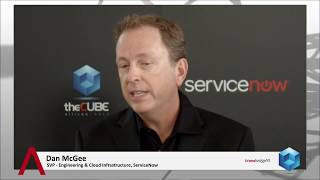
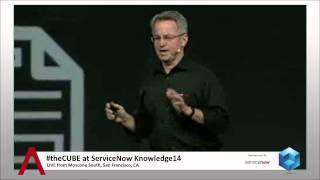
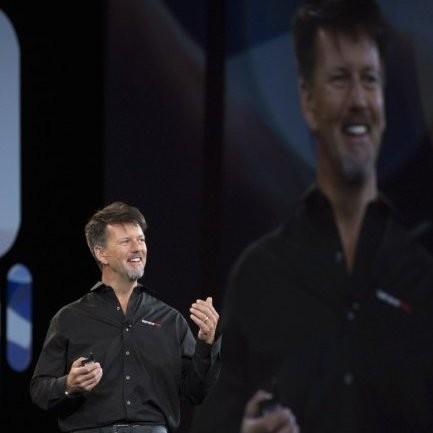
01. Dave Wright - CSO of ServiceNow - Visits theCUBE!. (00:30)
02. What Was The Reaction To ServiceNow From The Analysts?. (00:51)
03. Summarizing The ServiceNow Strategy. (02:55)
04. How Does ServiceNow Interact With CIOs?. (04:48)
05. Is It Feasible For IT Heads To Become Business Heads?. (05:55)
06. Are CIO's Still Coming Up Through IT Departments?. (07:12)
07. How Does ServiceNow Walk Between The Trends of The Could & Big Data?. (08:01)
08. Dealing With Companies Who Are In "Reactive Budget" Mode. (09:45)
09. It's Not Just How The Work Is Done But How The People Do The Work. (11:04)
10. The Emergence Of The Chief Data Officer. (13:11)
11. Long Term Strategy. (15:36)
--- ---
Dave Wright, ServiceNow, at ServiceNow Knowledge 2014 with Dave Vellante and Jeff Frick
@thecube #theCUBE #ServiceNow #Know14 #SiliconANGLE
Dave Wright, the CSO at ServiceNow, discussed service orientation and new trends in IT service management with theCUBE co-hosts Dave Vellante and Jeff Frick in a live interview at the ServiceNow Knowledge14 conference.
“Everyone in the world is a provider of service. Technically someone needs to require that service,” Wright explained. Even in day to day life, the acquisition of new products and services comes down to wanting something you don’t have, wanting something you want to chance, or something you want to know.
Commenting on the role of the CSO, Wright said that for ServiceNow, the company initially focused on the IT service management (ITSM) side of the business. “We got to a point where we want to wrap our hands around it,” he explained., going on to note that there are still ways to expand that approach, to implement the strategy of “managing IT according to business demands.”
Asked how his interaction with CIOs and senior IT leadership impacts their strategy, Wright said “this is the first company where you can talk to a CIO and there’s an ‘a-ha’ moment.”
A lot of the conversations are around orchestrating all the services relationships in the entire company. CIOs already have the knowhow of doing ITSM, which is the most complex to manage.
Commenting on the feasibility of a senior IT leader becoming more of a business leader, Wright said there were two types of CIOs: the proactive and the reactive ones. A proactive CIO perspective is, “‘This is the business problem, how are you going to solve it?’ They are asking the right questions,” Wright explained. They demand management to explain their business challenges, to help them get there.
“It can be an evolutionary process, you just have to question the way you do what you do,” he added. “I know some CIOs that are a lot more business focused. It’s this understanding of what IT can do for a business. Some of these guys are now becoming go to guys for the CEOs of the company.”
These circumstances generate a chance for the CIO to get a seat at the top management table.
Asked what was holding CIOs back form transforming their companies, Wright said that it’s “not really having the confidence to propose this as a solution to the business.” CIOs are in a position where they can get kicked if they don’t propose an effective solution.
Commenting on how the younger, “entitlement generation” shapes IT, Wright said the demographic comprises “people who think ‘I just get it’, it’s on demand IT from a media perspective.”
Wright shared this scenario: If they want a song, they will just go and get it now and listen to it, they do not care where it is stored. “As they are going to work, people want to work in the same way they work at home,” he explained, noting the importance of visualization tools like virtual task boards, which “allow them to monitor as many streams of data as they can possibly have.”
Speaking on the big trends that are disrupting IT, cloud, mobile, social, Big Data and the emergence of the Chief Data Officer, Vellante asked if the CIOs will be adapting.
“I don’t think people have fully wrapped their mind around that,” Wright said. “I wouldn’t want a CDO to work for me,” he added, commenting on a CIO’s perspective. “I think there will be a more prevalent position in data, and I think the big driver for it is that now everything is running externally,” and you have trillions of events happening daily, he concluded. Private cloud providers will have to clearly demonstrate how your app runs and how it’s performing in order to succeed.
Forgot Password
Almost there!
We just sent you a verification email. Please verify your account to gain access to
ServiceNow Knowledge 2014. If you don’t think you received an email check your
spam folder.
In order to sign in, enter the email address you used to registered for the event. Once completed, you will receive an email with a verification link. Open this link to automatically sign into the site.
Register For ServiceNow Knowledge 2014
Please fill out the information below. You will recieve an email with a verification link confirming your registration. Click the link to automatically sign into the site.
You’re almost there!
We just sent you a verification email. Please click the verification button in the email. Once your email address is verified, you will have full access to all event content for ServiceNow Knowledge 2014.
I want my badge and interests to be visible to all attendees.
Checking this box will display your presense on the attendees list, view your profile and allow other attendees to contact you via 1-1 chat. Read the Privacy Policy. At any time, you can choose to disable this preference.
Select your Interests!
add
Upload your photo
Uploading..
OR
Connect via Twitter
Connect via Linkedin
EDIT PASSWORD
Share
Forgot Password
Almost there!
We just sent you a verification email. Please verify your account to gain access to
ServiceNow Knowledge 2014. If you don’t think you received an email check your
spam folder.
In order to sign in, enter the email address you used to registered for the event. Once completed, you will receive an email with a verification link. Open this link to automatically sign into the site.
Sign in to gain access to ServiceNow Knowledge 2014
Please sign in with LinkedIn to continue to ServiceNow Knowledge 2014. Signing in with LinkedIn ensures a professional environment.
Are you sure you want to remove access rights for this user?
Details
Manage Access
email address
Community Invitation
Dave Wright, ServiceNow | ServiceNow Knowledge14
01. Dave Wright - CSO of ServiceNow - Visits theCUBE!. (00:30)
02. What Was The Reaction To ServiceNow From The Analysts?. (00:51)
03. Summarizing The ServiceNow Strategy. (02:55)
04. How Does ServiceNow Interact With CIOs?. (04:48)
05. Is It Feasible For IT Heads To Become Business Heads?. (05:55)
06. Are CIO's Still Coming Up Through IT Departments?. (07:12)
07. How Does ServiceNow Walk Between The Trends of The Could & Big Data?. (08:01)
08. Dealing With Companies Who Are In "Reactive Budget" Mode. (09:45)
09. It's Not Just How The Work Is Done But How The People Do The Work. (11:04)
10. The Emergence Of The Chief Data Officer. (13:11)
11. Long Term Strategy. (15:36)
--- ---
Dave Wright, ServiceNow, at ServiceNow Knowledge 2014 with Dave Vellante and Jeff Frick
@thecube #theCUBE #ServiceNow #Know14 #SiliconANGLE
Dave Wright, the CSO at ServiceNow, discussed service orientation and new trends in IT service management with theCUBE co-hosts Dave Vellante and Jeff Frick in a live interview at the ServiceNow Knowledge14 conference.
“Everyone in the world is a provider of service. Technically someone needs to require that service,” Wright explained. Even in day to day life, the acquisition of new products and services comes down to wanting something you don’t have, wanting something you want to chance, or something you want to know.
Commenting on the role of the CSO, Wright said that for ServiceNow, the company initially focused on the IT service management (ITSM) side of the business. “We got to a point where we want to wrap our hands around it,” he explained., going on to note that there are still ways to expand that approach, to implement the strategy of “managing IT according to business demands.”
Asked how his interaction with CIOs and senior IT leadership impacts their strategy, Wright said “this is the first company where you can talk to a CIO and there’s an ‘a-ha’ moment.”
A lot of the conversations are around orchestrating all the services relationships in the entire company. CIOs already have the knowhow of doing ITSM, which is the most complex to manage.
Commenting on the feasibility of a senior IT leader becoming more of a business leader, Wright said there were two types of CIOs: the proactive and the reactive ones. A proactive CIO perspective is, “‘This is the business problem, how are you going to solve it?’ They are asking the right questions,” Wright explained. They demand management to explain their business challenges, to help them get there.
“It can be an evolutionary process, you just have to question the way you do what you do,” he added. “I know some CIOs that are a lot more business focused. It’s this understanding of what IT can do for a business. Some of these guys are now becoming go to guys for the CEOs of the company.”
These circumstances generate a chance for the CIO to get a seat at the top management table.
Asked what was holding CIOs back form transforming their companies, Wright said that it’s “not really having the confidence to propose this as a solution to the business.” CIOs are in a position where they can get kicked if they don’t propose an effective solution.
Commenting on how the younger, “entitlement generation” shapes IT, Wright said the demographic comprises “people who think ‘I just get it’, it’s on demand IT from a media perspective.”
Wright shared this scenario: If they want a song, they will just go and get it now and listen to it, they do not care where it is stored. “As they are going to work, people want to work in the same way they work at home,” he explained, noting the importance of visualization tools like virtual task boards, which “allow them to monitor as many streams of data as they can possibly have.”
Speaking on the big trends that are disrupting IT, cloud, mobile, social, Big Data and the emergence of the Chief Data Officer, Vellante asked if the CIOs will be adapting.
“I don’t think people have fully wrapped their mind around that,” Wright said. “I wouldn’t want a CDO to work for me,” he added, commenting on a CIO’s perspective. “I think there will be a more prevalent position in data, and I think the big driver for it is that now everything is running externally,” and you have trillions of events happening daily, he concluded. Private cloud providers will have to clearly demonstrate how your app runs and how it’s performing in order to succeed.