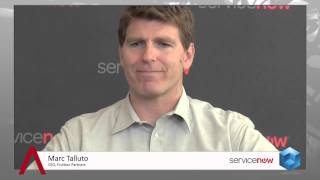
Frank Slootmman, CEO, ServiceNow at ServiceNow Knowledge13 with theCUBE's Dave Vellante and Jeff Frick
The irony is that IT, who's job is to transform the enterprise with automation, has the least management sophistication in the enterprise," says Frank Slootman, CEO of ServiceNow, a company dedicated to bringing proven management automation to IT.
Large enterprise IT shops typically run their multibillion dollar budgets on spreadsheets. Every process is manual, requests and complaints arrive as e-mails and IMs, people are on the phone all day. As a result, nobody really knows what's going on, the CIO has no visibility into the overall processes he is supposed to be managing, requests get lost or forgotten, no one can identify problems with the process much less fix them to improve efficiencies. "It is astounding to me that corporate America — Coca-Cola, the New York Stock Exchange, Eli Lilly, etc. — have completely fragmented, sprawling IT environments. An executive at Citi told me, 'We're a global bank, but we don't have a global IT organization.
As a result, Slootman told Wikibon Cofounder David Vellante in theCUBE from the ServiceNow Knowledge 2013 conference in Las Vegas, instead of driving the business, the ITO is being driven by it. The goal of ServiceNow is to get the ITO out of reactive mode and free it to innovate and create the revolutionary opportunities that are the promise of the new technologies
"We're trying to turn the tables here," Slootman said. "The whole history of IT has been one big end around." Client-server, for instance, was IT finally incorporating the desktop systems that business units and individuals had brought into enterprises a decade before despite IT non-participation at best and active resistance at worst. Cloud services came into the organization before IT realized they were there, brought in often by heads of sales or other business unit leaders to solve problems that internal IT was not tackling. "The CIOs aren't running anything. They are being run by it. This lack of ability to drive things is unacceptable to those businesses."
The tools of this major change are workflow and associated management automation technologies and, of course, the streamlined business processes they mandate. "The impact of moving from e-mail & Excel to a record workflow system on organizational efficiency is tremendous," Slootman said.
The result in a sentence is that CIOs and ITOs move from constant reactionary mode, constantly putting out fires and working full time just to keep the lights on, to focusing on defining the structure and manner of delivery of IT services. It makes it possible for IT to restructure into true services and, through providing the platform and tools to support common, defined processes, supports those services.
It gives them the hard, up-to-date data on what is happening and how productivity and efficiency are improving okay single, central pane-of-glass, whereas previously that data, if it existed at all, was fragmented in multiple spreadsheets scattered through the organization, preventing meaningful central management.
So far ServiceNow has penetrated a mere 14 percent of its core target market of the Fortune 2000 customers. The street actually sees that as a positive, Slootman says. It means that as large and fast growing as it now is, ServiceNow has plenty of headroom for further growth.
"IT has reams of people on their staffs," he says. "Large financial institutions have tons of people on their IT staffs because the processes require so many touch points." Every time someone writes an e-mail that person should be thinking, 'Could I be filling out a process request form instead.' All those touch points need to be automated, and that is what ServiceNow does.
"You had better have a good reason every time you touch a process," he says, "because every time you do, you go from the speed of light to the speed of a dirt road."
@ServiceNow #ServiceNow @SiliconANGLE theCUBE #theCUBE @theCUBE
Forgot Password
Almost there!
We just sent you a verification email. Please verify your account to gain access to
ServiceNow Knowledge 2013. If you don’t think you received an email check your
spam folder.
In order to sign in, enter the email address you used to registered for the event. Once completed, you will receive an email with a verification link. Open this link to automatically sign into the site.
Register For ServiceNow Knowledge 2013
Please fill out the information below. You will recieve an email with a verification link confirming your registration. Click the link to automatically sign into the site.
You’re almost there!
We just sent you a verification email. Please click the verification button in the email. Once your email address is verified, you will have full access to all event content for ServiceNow Knowledge 2013.
I want my badge and interests to be visible to all attendees.
Checking this box will display your presense on the attendees list, view your profile and allow other attendees to contact you via 1-1 chat. Read the Privacy Policy. At any time, you can choose to disable this preference.
Select your Interests!
add
Upload your photo
Uploading..
OR
Connect via Twitter
Connect via Linkedin
EDIT PASSWORD
Share
Forgot Password
Almost there!
We just sent you a verification email. Please verify your account to gain access to
ServiceNow Knowledge 2013. If you don’t think you received an email check your
spam folder.
In order to sign in, enter the email address you used to registered for the event. Once completed, you will receive an email with a verification link. Open this link to automatically sign into the site.
Sign in to gain access to ServiceNow Knowledge 2013
Please sign in with LinkedIn to continue to ServiceNow Knowledge 2013. Signing in with LinkedIn ensures a professional environment.
Are you sure you want to remove access rights for this user?
Details
Manage Access
email address
Community Invitation
Frank Slootman, ServiceNow | ServiceNow Knowledge13
Frank Slootmman, CEO, ServiceNow at ServiceNow Knowledge13 with theCUBE's Dave Vellante and Jeff Frick
The irony is that IT, who's job is to transform the enterprise with automation, has the least management sophistication in the enterprise," says Frank Slootman, CEO of ServiceNow, a company dedicated to bringing proven management automation to IT.
Large enterprise IT shops typically run their multibillion dollar budgets on spreadsheets. Every process is manual, requests and complaints arrive as e-mails and IMs, people are on the phone all day. As a result, nobody really knows what's going on, the CIO has no visibility into the overall processes he is supposed to be managing, requests get lost or forgotten, no one can identify problems with the process much less fix them to improve efficiencies. "It is astounding to me that corporate America — Coca-Cola, the New York Stock Exchange, Eli Lilly, etc. — have completely fragmented, sprawling IT environments. An executive at Citi told me, 'We're a global bank, but we don't have a global IT organization.
As a result, Slootman told Wikibon Cofounder David Vellante in theCUBE from the ServiceNow Knowledge 2013 conference in Las Vegas, instead of driving the business, the ITO is being driven by it. The goal of ServiceNow is to get the ITO out of reactive mode and free it to innovate and create the revolutionary opportunities that are the promise of the new technologies
"We're trying to turn the tables here," Slootman said. "The whole history of IT has been one big end around." Client-server, for instance, was IT finally incorporating the desktop systems that business units and individuals had brought into enterprises a decade before despite IT non-participation at best and active resistance at worst. Cloud services came into the organization before IT realized they were there, brought in often by heads of sales or other business unit leaders to solve problems that internal IT was not tackling. "The CIOs aren't running anything. They are being run by it. This lack of ability to drive things is unacceptable to those businesses."
The tools of this major change are workflow and associated management automation technologies and, of course, the streamlined business processes they mandate. "The impact of moving from e-mail & Excel to a record workflow system on organizational efficiency is tremendous," Slootman said.
The result in a sentence is that CIOs and ITOs move from constant reactionary mode, constantly putting out fires and working full time just to keep the lights on, to focusing on defining the structure and manner of delivery of IT services. It makes it possible for IT to restructure into true services and, through providing the platform and tools to support common, defined processes, supports those services.
It gives them the hard, up-to-date data on what is happening and how productivity and efficiency are improving okay single, central pane-of-glass, whereas previously that data, if it existed at all, was fragmented in multiple spreadsheets scattered through the organization, preventing meaningful central management.
So far ServiceNow has penetrated a mere 14 percent of its core target market of the Fortune 2000 customers. The street actually sees that as a positive, Slootman says. It means that as large and fast growing as it now is, ServiceNow has plenty of headroom for further growth.
"IT has reams of people on their staffs," he says. "Large financial institutions have tons of people on their IT staffs because the processes require so many touch points." Every time someone writes an e-mail that person should be thinking, 'Could I be filling out a process request form instead.' All those touch points need to be automated, and that is what ServiceNow does.
"You had better have a good reason every time you touch a process," he says, "because every time you do, you go from the speed of light to the speed of a dirt road."
@ServiceNow #ServiceNow @SiliconANGLE theCUBE #theCUBE @theCUBE