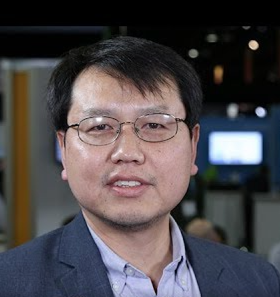
Jim Wu, Director of Customer Experience, Falcon Computing talks with Jeff Frick at Super Computing 2017
#theCUBE #SC17 #FalconComputing #SuperComputing #SiliconANGLE #Intel
https://siliconangle.com/2017/12/04/startup-creates-new-tools-let-fpga-programmers-fly-sc17/
Startup creates new tools to let FPGA programmers fly
Intel Corp.’s field programmable gate array acceleration stack offers tremendous potential for developers to deploy applications and workloads at maximum performance. But there can be issues when software programmers try to build applications for hardware platforms, including the time it takes. One startup company is creating new tools to make the job easier.
“To develop FPGA accelerators is very challenging; it’s very time-consuming and labor-intensive for [programmers]. Our goal is to liberate them,” said Jim Wu (pictured), director of consumer experience at Falcon Computing Solutions Inc.
Wu visited theCUBE, SiliconANGLE Media’s mobile livestreaming studio, and spoke with host Jeff Frick (@JeffFrick) during the Supercomputing event in Denver, Colorado. They discussed the company’s principal compiler product, its integration in the data center and cloud environments, and plans for general release. (* Disclosure below.)
Push-button FPGA programming
Falcon Computing has developed automated compilation tools that focus on streamlining FPGA-based acceleration. Its principal product is Merlin, a compiler that provides push-button C/C++ language programming to optimize FPGA implementation and work in a fully integrated fashion with Intel’s own development tools.
“It’s a pure C/C++ flow that enables software programmers to design FPGA accelerators without any knowledge of FPGA,” Wu said. “We want to put the tool in the hands of all software programmers.”
The integration of FPGAs with Intel’s Xeon CPU has created opportunities for significant performance and power efficiency in developing applications for highly computational fields, such as machine learning, genomics and major big data projects. Falcon Computing is making the product available in a 14-day trial for use in the enterprise data center or in the cloud, and general availability is planned for the first quarter of 2018.
The company already has agreements with Amazon Web Services Inc. and Alibaba Cloud. “We are working to bring the tool to other public cloud providers as well,” Wu said. “Any space where FPGA can play well, we want to be there.”
Watch the complete video interview below, and be sure to check out more of SiliconANGLE’s and theCUBE’s coverage of the Supercomputing 2017 conference. (* Disclosure: TheCUBE is a paid media partner for the Super Computing 2017 conference. Neither Intel, the event sponsor, nor other sponsors have editorial control over content on theCUBE or SiliconANGLE.)
Forgot Password
Almost there!
We just sent you a verification email. Please verify your account to gain access to
Super Computing Conference 2017. If you don’t think you received an email check your
spam folder.
In order to sign in, enter the email address you used to registered for the event. Once completed, you will receive an email with a verification link. Open this link to automatically sign into the site.
Register For Super Computing Conference 2017
Please fill out the information below. You will recieve an email with a verification link confirming your registration. Click the link to automatically sign into the site.
You’re almost there!
We just sent you a verification email. Please click the verification button in the email. Once your email address is verified, you will have full access to all event content for Super Computing Conference 2017.
I want my badge and interests to be visible to all attendees.
Checking this box will display your presense on the attendees list, view your profile and allow other attendees to contact you via 1-1 chat. Read the Privacy Policy. At any time, you can choose to disable this preference.
Select your Interests!
add
Upload your photo
Uploading..
OR
Connect via Twitter
Connect via Linkedin
EDIT PASSWORD
Share
Forgot Password
Almost there!
We just sent you a verification email. Please verify your account to gain access to
Super Computing Conference 2017. If you don’t think you received an email check your
spam folder.
In order to sign in, enter the email address you used to registered for the event. Once completed, you will receive an email with a verification link. Open this link to automatically sign into the site.
Sign in to gain access to Super Computing Conference 2017
Please sign in with LinkedIn to continue to Super Computing Conference 2017. Signing in with LinkedIn ensures a professional environment.
Are you sure you want to remove access rights for this user?
Details
Manage Access
email address
Community Invitation
Jim Wu, Falcon Computing | Super Computing 2017
Jim Wu, Director of Customer Experience, Falcon Computing talks with Jeff Frick at Super Computing 2017
#theCUBE #SC17 #FalconComputing #SuperComputing #SiliconANGLE #Intel
https://siliconangle.com/2017/12/04/startup-creates-new-tools-let-fpga-programmers-fly-sc17/
Startup creates new tools to let FPGA programmers fly
Intel Corp.’s field programmable gate array acceleration stack offers tremendous potential for developers to deploy applications and workloads at maximum performance. But there can be issues when software programmers try to build applications for hardware platforms, including the time it takes. One startup company is creating new tools to make the job easier.
“To develop FPGA accelerators is very challenging; it’s very time-consuming and labor-intensive for [programmers]. Our goal is to liberate them,” said Jim Wu (pictured), director of consumer experience at Falcon Computing Solutions Inc.
Wu visited theCUBE, SiliconANGLE Media’s mobile livestreaming studio, and spoke with host Jeff Frick (@JeffFrick) during the Supercomputing event in Denver, Colorado. They discussed the company’s principal compiler product, its integration in the data center and cloud environments, and plans for general release. (* Disclosure below.)
Push-button FPGA programming
Falcon Computing has developed automated compilation tools that focus on streamlining FPGA-based acceleration. Its principal product is Merlin, a compiler that provides push-button C/C++ language programming to optimize FPGA implementation and work in a fully integrated fashion with Intel’s own development tools.
“It’s a pure C/C++ flow that enables software programmers to design FPGA accelerators without any knowledge of FPGA,” Wu said. “We want to put the tool in the hands of all software programmers.”
The integration of FPGAs with Intel’s Xeon CPU has created opportunities for significant performance and power efficiency in developing applications for highly computational fields, such as machine learning, genomics and major big data projects. Falcon Computing is making the product available in a 14-day trial for use in the enterprise data center or in the cloud, and general availability is planned for the first quarter of 2018.
The company already has agreements with Amazon Web Services Inc. and Alibaba Cloud. “We are working to bring the tool to other public cloud providers as well,” Wu said. “Any space where FPGA can play well, we want to be there.”
Watch the complete video interview below, and be sure to check out more of SiliconANGLE’s and theCUBE’s coverage of the Supercomputing 2017 conference. (* Disclosure: TheCUBE is a paid media partner for the Super Computing 2017 conference. Neither Intel, the event sponsor, nor other sponsors have editorial control over content on theCUBE or SiliconANGLE.)