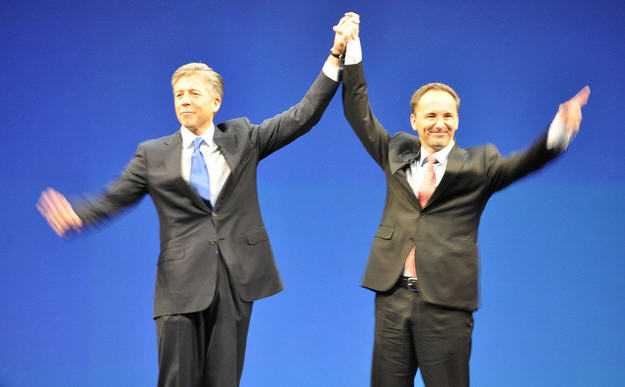
Doc D'Errico (EMC) with John Furrier and Dave Vellante at SAP Sapphire 2011.
Far from being a threat to EMC’s storage business, SAP’s HANA In-Memory Appliance is good for storage, says EMC VP and General Manager of the EMC Advanced Technology Group Don D’Errico in an interview on SiliconAngle.tv live from SAPphire 2011. And while to an extent the proto-architecture it represents competes with the direction of EMC’s Project Lightning vision, they will probably co-exist in a future that will see at least two and possibly more multi-tiered architectures evolve to meet different needs, he told Wikibon Co-Founder and .Chief Analyst David Vellante and SiliconAngle Founder John Furrier.
Both approaches are trying to accomplish the same thing – to move critical data closer to the compute resource to speed up data access, to create what is being called “fast data”. And each will find applications where it is most appropriate. HANA moves the most critical data into the server to make it instantly available for processing. It will be appropriate for applications that need fast access to a small amount of data. Project Lightning is built on a storage-centric model, moving the processing as close as possible to the data storage. This is closer to the Hadoop model for processing very large amounts of structured and unstructured “big data”.
He envisions a future with multiple architectures. The top tier of the storage pyramid might be DRAM, in the server, providing the fastest possible data access for small amounts of vital data. The second tier, also built into the server, might be persistent flash memory such as that supplied by Fusion-IO, for larger but still fairly small amounts of important data. But these are both too expensive to replace the disk farms that will still be needed to hold most data. “We are never going to put the world’s data into memory,” Vallente said.
Most data, and in particular the fast-growing amounts of unstructured big data, will go onto a third physical tier of traditional storage, either aggregated in one location or distributed in multiple locations across the network, depending on several considerations including whether the amount of data is too large to move across the network. And in cases where very large amounts of data need to be analyzed, the architecture will be reversed, with the application coming to the data.
The important thing to remember in all of this, D’Errico says, is “storage is not spinning rust. It is software. EMC’s strategy is to distribute information more widely to get it closer to where it will be consumed. But it is also to aggregate information when that is the best option. It is not an either-or choice.”
Is the Network Ready?
The network this architecture will run on is another issue, he admitted. Today the network is not ready, but he said EMC is working with two partners – dominant network vendor Cisco and very high-speed network specialist Ciena – on different parts of that problem. And EMC’s VPLEX and vMotion products are playing a role.
Recently, he said, Ciena did a demonstration in which it ported a working 40 Mbyte I/O application across a lake on one of its networks while the application continued to function. Using a bare Ethernet network the port, while successful, took nine minutes. When Ciena added EMC’s VPLEX, the same port took less than one minute, in part because VPLEX was able to reallocate extra bandwidth dynamically to the port.
Technologies like HANA and Project Lighting “are a recognition that processing and information must move closer to the user in some cases the provide the speed that business needs today and in the future,” D’Errico said. “Solid state storage is small but growing, and most of all, the world is changing.”
Forgot Password
Almost there!
We just sent you a verification email. Please verify your account to gain access to
SAP SAPPHIRE NOW 2011 | Orlando. If you don’t think you received an email check your
spam folder.
In order to sign in, enter the email address you used to registered for the event. Once completed, you will receive an email with a verification link. Open this link to automatically sign into the site.
Register For SAP SAPPHIRE NOW 2011 | Orlando
Please fill out the information below. You will recieve an email with a verification link confirming your registration. Click the link to automatically sign into the site.
You’re almost there!
We just sent you a verification email. Please click the verification button in the email. Once your email address is verified, you will have full access to all event content for SAP SAPPHIRE NOW 2011 | Orlando.
I want my badge and interests to be visible to all attendees.
Checking this box will display your presense on the attendees list, view your profile and allow other attendees to contact you via 1-1 chat. Read the Privacy Policy. At any time, you can choose to disable this preference.
Select your Interests!
add
Upload your photo
Uploading..
OR
Connect via Twitter
Connect via Linkedin
EDIT PASSWORD
Share
Forgot Password
Almost there!
We just sent you a verification email. Please verify your account to gain access to
SAP SAPPHIRE NOW 2011 | Orlando. If you don’t think you received an email check your
spam folder.
In order to sign in, enter the email address you used to registered for the event. Once completed, you will receive an email with a verification link. Open this link to automatically sign into the site.
Sign in to gain access to SAP SAPPHIRE NOW 2011 | Orlando
Please sign in with LinkedIn to continue to SAP SAPPHIRE NOW 2011 | Orlando. Signing in with LinkedIn ensures a professional environment.
Are you sure you want to remove access rights for this user?
Details
Manage Access
email address
Community Invitation
Doc D'Errico - SAP Sapphire 2011 - theCUBE
Doc D'Errico (EMC) with John Furrier and Dave Vellante at SAP Sapphire 2011.
Far from being a threat to EMC’s storage business, SAP’s HANA In-Memory Appliance is good for storage, says EMC VP and General Manager of the EMC Advanced Technology Group Don D’Errico in an interview on SiliconAngle.tv live from SAPphire 2011. And while to an extent the proto-architecture it represents competes with the direction of EMC’s Project Lightning vision, they will probably co-exist in a future that will see at least two and possibly more multi-tiered architectures evolve to meet different needs, he told Wikibon Co-Founder and .Chief Analyst David Vellante and SiliconAngle Founder John Furrier.
Both approaches are trying to accomplish the same thing – to move critical data closer to the compute resource to speed up data access, to create what is being called “fast data”. And each will find applications where it is most appropriate. HANA moves the most critical data into the server to make it instantly available for processing. It will be appropriate for applications that need fast access to a small amount of data. Project Lightning is built on a storage-centric model, moving the processing as close as possible to the data storage. This is closer to the Hadoop model for processing very large amounts of structured and unstructured “big data”.
He envisions a future with multiple architectures. The top tier of the storage pyramid might be DRAM, in the server, providing the fastest possible data access for small amounts of vital data. The second tier, also built into the server, might be persistent flash memory such as that supplied by Fusion-IO, for larger but still fairly small amounts of important data. But these are both too expensive to replace the disk farms that will still be needed to hold most data. “We are never going to put the world’s data into memory,” Vallente said.
Most data, and in particular the fast-growing amounts of unstructured big data, will go onto a third physical tier of traditional storage, either aggregated in one location or distributed in multiple locations across the network, depending on several considerations including whether the amount of data is too large to move across the network. And in cases where very large amounts of data need to be analyzed, the architecture will be reversed, with the application coming to the data.
The important thing to remember in all of this, D’Errico says, is “storage is not spinning rust. It is software. EMC’s strategy is to distribute information more widely to get it closer to where it will be consumed. But it is also to aggregate information when that is the best option. It is not an either-or choice.”
Is the Network Ready?
The network this architecture will run on is another issue, he admitted. Today the network is not ready, but he said EMC is working with two partners – dominant network vendor Cisco and very high-speed network specialist Ciena – on different parts of that problem. And EMC’s VPLEX and vMotion products are playing a role.
Recently, he said, Ciena did a demonstration in which it ported a working 40 Mbyte I/O application across a lake on one of its networks while the application continued to function. Using a bare Ethernet network the port, while successful, took nine minutes. When Ciena added EMC’s VPLEX, the same port took less than one minute, in part because VPLEX was able to reallocate extra bandwidth dynamically to the port.
Technologies like HANA and Project Lighting “are a recognition that processing and information must move closer to the user in some cases the provide the speed that business needs today and in the future,” D’Errico said. “Solid state storage is small but growing, and most of all, the world is changing.”