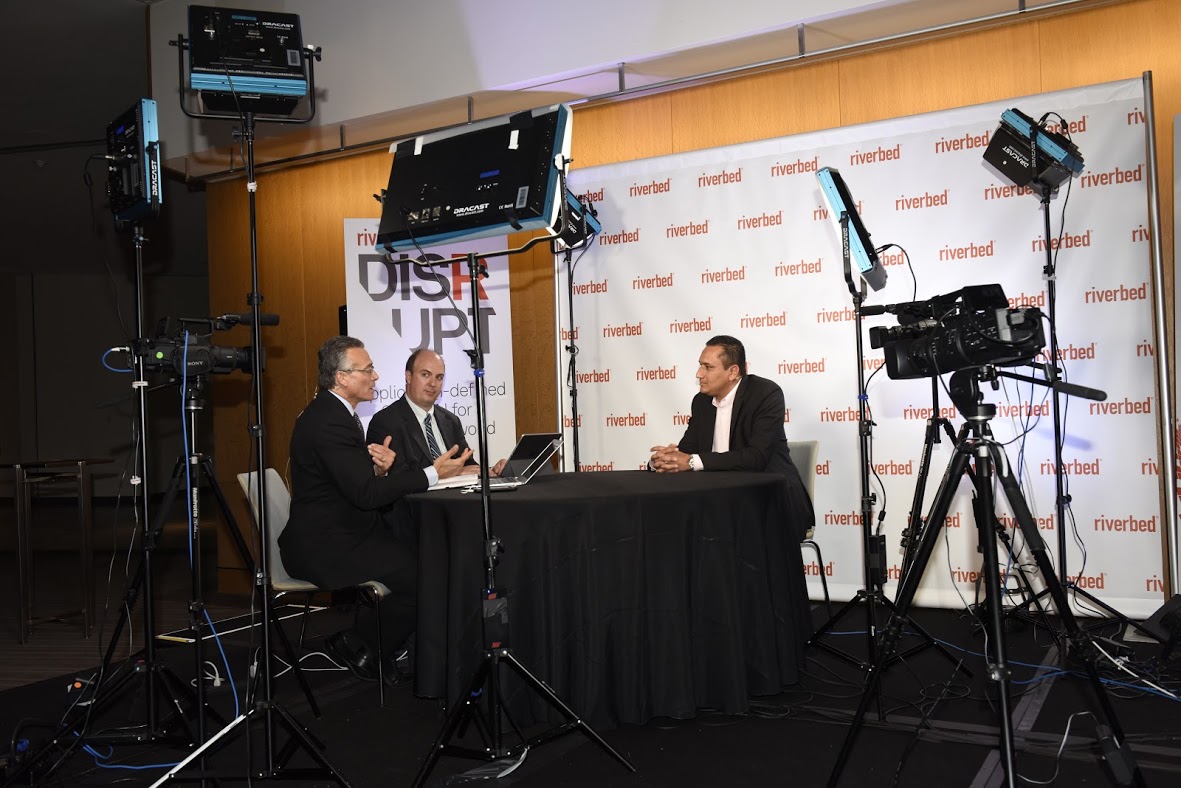
01. Angelo Comazzetto, Riverbed, Visits #theCUBE!. (00:20)
02. What's Happening In The World Of Cloud. (00:30)
03. How Do You Turn Buzzwords Into Actually Developing A Product. (01:20)
04. Talk About The Transformation Of The Cloud. (02:40)
05. Talk About The Demo You Showed This Morning. (03:58)
06. How Much Of People Being Afraid Of Automation Is Real. (04:49)
07. Tell Us ABout The Application Library Of The Demo You Did. (05:50)
08. What Are People Doing With The Extra Time For Network Admins. (07:14)
Track List created with http://www.vinjavideo.com.
--- ---
Should companies learn to let go and trust the cloud? | #Riverbed by Bev Terrell | Sep 13, 2016
One of the greatest challenges of cloud technology is how companies can smoothly move their servers and applications, and how they then connect their customers and employees. Riverbed Technology, Inc.’s line of software-defined WAN (SD-WAN) products use a Virtual Private Network (VPN), providing visibility across the entire organization.
Angelo Comazzetto, technical director of Cloud at Riverbed Technology, joined Dave Vellante (@dvellante) and Stu Miniman (@stu), cohosts of theCUBE, from the SiliconANGLE Media team, during the Riverbed Disrupt conference, held at the Conrad Hotel in New York City, to discuss the evolving corporate uses of cloud technology.
How do companies see the cloud?
“They [companies] shouldn’t actually have to become cloud experts to connect to the cloud,” said Comazzetto. He explained that one of the best things about cloud technology is that it takes on the heavy tasks of application and server management, leaving companies free to focus on their core businesses.
Potential fear of automation
Comazzetto pointed out that while the future is filled with products such as Tesla cars that automatically drive us around, there is definitely a “fear of letting go,” an apprehension of allowing even proven technology to take over processes that companies are used to running themselves.
In some ways, it’s easier to redesign for the cloud rather than to port over existing technologies that have, over time, become bloated and difficult to use, according to Comazzetto. “Things you run in the cloud, for example, work orders applications … bringing the cloud down, [and will] accelerate [those applications],” explained Comazzetto. These increased speeds and efficiencies will help users to see the cloud as a benefit, rather than as a burden.
Forgot Password
Almost there!
We just sent you a verification email. Please verify your account to gain access to
Riverbed Disrupt 2016 | New York. If you don’t think you received an email check your
spam folder.
In order to sign in, enter the email address you used to registered for the event. Once completed, you will receive an email with a verification link. Open this link to automatically sign into the site.
Register For Riverbed Disrupt 2016 | New York
Please fill out the information below. You will recieve an email with a verification link confirming your registration. Click the link to automatically sign into the site.
You’re almost there!
We just sent you a verification email. Please click the verification button in the email. Once your email address is verified, you will have full access to all event content for Riverbed Disrupt 2016 | New York.
I want my badge and interests to be visible to all attendees.
Checking this box will display your presense on the attendees list, view your profile and allow other attendees to contact you via 1-1 chat. Read the Privacy Policy. At any time, you can choose to disable this preference.
Select your Interests!
add
Upload your photo
Uploading..
OR
Connect via Twitter
Connect via Linkedin
EDIT PASSWORD
Share
Forgot Password
Almost there!
We just sent you a verification email. Please verify your account to gain access to
Riverbed Disrupt 2016 | New York. If you don’t think you received an email check your
spam folder.
In order to sign in, enter the email address you used to registered for the event. Once completed, you will receive an email with a verification link. Open this link to automatically sign into the site.
Sign in to gain access to Riverbed Disrupt 2016 | New York
Please sign in with LinkedIn to continue to Riverbed Disrupt 2016 | New York. Signing in with LinkedIn ensures a professional environment.
01. Angelo Comazzetto, Riverbed, Visits #theCUBE!. (00:20)
02. What's Happening In The World Of Cloud. (00:30)
03. How Do You Turn Buzzwords Into Actually Developing A Product. (01:20)
04. Talk About The Transformation Of The Cloud. (02:40)
05. Talk About The Demo You Showed This Morning. (03:58)
06. How Much Of People Being Afraid Of Automation Is Real. (04:49)
07. Tell Us ABout The Application Library Of The Demo You Did. (05:50)
08. What Are People Doing With The Extra Time For Network Admins. (07:14)
Track List created with http://www.vinjavideo.com.
--- ---
Should companies learn to let go and trust the cloud? | #Riverbed by Bev Terrell | Sep 13, 2016
One of the greatest challenges of cloud technology is how companies can smoothly move their servers and applications, and how they then connect their customers and employees. Riverbed Technology, Inc.’s line of software-defined WAN (SD-WAN) products use a Virtual Private Network (VPN), providing visibility across the entire organization.
Angelo Comazzetto, technical director of Cloud at Riverbed Technology, joined Dave Vellante (@dvellante) and Stu Miniman (@stu), cohosts of theCUBE, from the SiliconANGLE Media team, during the Riverbed Disrupt conference, held at the Conrad Hotel in New York City, to discuss the evolving corporate uses of cloud technology.
How do companies see the cloud?
“They [companies] shouldn’t actually have to become cloud experts to connect to the cloud,” said Comazzetto. He explained that one of the best things about cloud technology is that it takes on the heavy tasks of application and server management, leaving companies free to focus on their core businesses.
Potential fear of automation
Comazzetto pointed out that while the future is filled with products such as Tesla cars that automatically drive us around, there is definitely a “fear of letting go,” an apprehension of allowing even proven technology to take over processes that companies are used to running themselves.
In some ways, it’s easier to redesign for the cloud rather than to port over existing technologies that have, over time, become bloated and difficult to use, according to Comazzetto. “Things you run in the cloud, for example, work orders applications … bringing the cloud down, [and will] accelerate [those applications],” explained Comazzetto. These increased speeds and efficiencies will help users to see the cloud as a benefit, rather than as a burden.