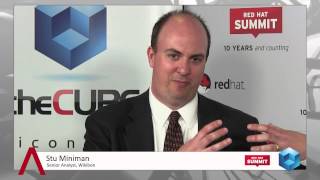
Sam Greenblatt, Dell, at Red Hat Summit 2014 with John Furrier and Stu Miniman
@thecube
#RHSummit
The open source revolution is spilling over to the cloud as more and more incumbent data center vendors rally behind OpenStack in response to Amazon’s growing enterprise gains. Sam Greenblatt, the vice president of technology and architecture and CTO for Dell’s core Enterprise Solutions Group, returned to theCUBE at the recently concluded Red Hat Summit to give us an update on his company’s role in driving this industry-wide shift.
The conference saw the announcement of several milestones in a landmark partnership between Red Hat and Dell, originally signed last December, centering on the joint development of hybrid cloud products based on open source software. These so-called “co-engineered solutions” serve different purposes but utilize the same underlying technologies, combining Dell hardware with the Linux distributor’s flagship platform, its OpenShift platform-as-a-service stack, OpenStack and the Docker container engine. The goal of the collaboration is to abstract away infrastructure and allow customers to focus entirely on application logic, an objective that Dell is also been pursuing independently.
Greenblatt tells theCUBE hosts John Furrier and Stu Miniman that his company is currently working to provide integration for the Swift object and Cinder block store components of OpenStack throughout its EqualLogic and Compellent portfolios, as well as support for the Ceph unified storage backend. The effort aims to enable the high level of scalability required by Dell’s biggest customers, he says, a large number of whom are in the financial services sector.
On the network side, the company sells top-of-rack switches loaded with a software-defined networking platform from an emerging startup called Cumulus and counts itself as a bronze sponsor of the OpenDaylight project, a collaborative effort led by The Linux Foundation to develop a set of common standards for SDN. Dell also participates in Juniper’s OpenContrail initiative, Greenblatt points out, although to a lesser extent.
Lastly, the vendor is developing tools that simplify the management of OpenStack environments. Its arguably most important contribution is the Crowbar deployment and operations tool, but it’s far from being the only one. Dell has released several reference architectures and a rules engine for the project, Greenblatt details, and also published a number of enhancements to the Nova compute component and the complementary open source Puppet Razor hardware provisioning tool.
Sizing up the competition
.
While Dell is taking the open source road to the software-defined data center, some of its rivals are choosing to go it alone. One of the biggest threats facing the company is EMC’s ViPR, a storage abstraction platform that Greenblatt sees as the vendor’s attempt to unify its six primary product lines under a single management layer. It has potential, he admits, but insists that his company does it better.
“We believe that how you should do it is the way we’re doing it with EqualLogic and Compellent,” the executive elaborates. “We’re merging the stacks into what we call next-gen, and we’re gonna keep alive both products but working on a single stack. ViPR is an abstraction layer above it and what we find with abstraction layers is, when you’re dealing with storage, you gotta build a software hypervisor that’s able to work with the hardware much more efficiently.”
Containers
Although certainly a critical component, storage abstraction is but one aspect of the software-defined vision. Greenblatt believes that Linux containers, which provide a lightweight alternative to traditional virtualization, are emerging as an equally important piece of the puzzle.
“We think that containers are going to be the next form of virtualization. Will it replace it? Absolutely not. You’re not gonna see SAP virtualize into a container. But what you will see is applications that you want to put into a PC, into a mobile device, into the Internet of Things,” he says. Bringing the technology into the enterprise mainstream is one of the primary goals of Dell’s partnership with Red Hat.
Forgot Password
Almost there!
We just sent you a verification email. Please verify your account to gain access to
Red Hat Summit 2014 | San Francisco. If you don’t think you received an email check your
spam folder.
In order to sign in, enter the email address you used to registered for the event. Once completed, you will receive an email with a verification link. Open this link to automatically sign into the site.
Register For Red Hat Summit 2014 | San Francisco
Please fill out the information below. You will recieve an email with a verification link confirming your registration. Click the link to automatically sign into the site.
You’re almost there!
We just sent you a verification email. Please click the verification button in the email. Once your email address is verified, you will have full access to all event content for Red Hat Summit 2014 | San Francisco.
I want my badge and interests to be visible to all attendees.
Checking this box will display your presense on the attendees list, view your profile and allow other attendees to contact you via 1-1 chat. Read the Privacy Policy. At any time, you can choose to disable this preference.
Select your Interests!
add
Upload your photo
Uploading..
OR
Connect via Twitter
Connect via Linkedin
EDIT PASSWORD
Share
Forgot Password
Almost there!
We just sent you a verification email. Please verify your account to gain access to
Red Hat Summit 2014 | San Francisco. If you don’t think you received an email check your
spam folder.
In order to sign in, enter the email address you used to registered for the event. Once completed, you will receive an email with a verification link. Open this link to automatically sign into the site.
Sign in to gain access to Red Hat Summit 2014 | San Francisco
Please sign in with LinkedIn to continue to Red Hat Summit 2014 | San Francisco. Signing in with LinkedIn ensures a professional environment.
Are you sure you want to remove access rights for this user?
Details
Manage Access
email address
Community Invitation
Sam Greenblatt - Red Hat Summit 2014 - TheCUBE
Sam Greenblatt, Dell, at Red Hat Summit 2014 with John Furrier and Stu Miniman
@thecube
#RHSummit
The open source revolution is spilling over to the cloud as more and more incumbent data center vendors rally behind OpenStack in response to Amazon’s growing enterprise gains. Sam Greenblatt, the vice president of technology and architecture and CTO for Dell’s core Enterprise Solutions Group, returned to theCUBE at the recently concluded Red Hat Summit to give us an update on his company’s role in driving this industry-wide shift.
The conference saw the announcement of several milestones in a landmark partnership between Red Hat and Dell, originally signed last December, centering on the joint development of hybrid cloud products based on open source software. These so-called “co-engineered solutions” serve different purposes but utilize the same underlying technologies, combining Dell hardware with the Linux distributor’s flagship platform, its OpenShift platform-as-a-service stack, OpenStack and the Docker container engine. The goal of the collaboration is to abstract away infrastructure and allow customers to focus entirely on application logic, an objective that Dell is also been pursuing independently.
Greenblatt tells theCUBE hosts John Furrier and Stu Miniman that his company is currently working to provide integration for the Swift object and Cinder block store components of OpenStack throughout its EqualLogic and Compellent portfolios, as well as support for the Ceph unified storage backend. The effort aims to enable the high level of scalability required by Dell’s biggest customers, he says, a large number of whom are in the financial services sector.
On the network side, the company sells top-of-rack switches loaded with a software-defined networking platform from an emerging startup called Cumulus and counts itself as a bronze sponsor of the OpenDaylight project, a collaborative effort led by The Linux Foundation to develop a set of common standards for SDN. Dell also participates in Juniper’s OpenContrail initiative, Greenblatt points out, although to a lesser extent.
Lastly, the vendor is developing tools that simplify the management of OpenStack environments. Its arguably most important contribution is the Crowbar deployment and operations tool, but it’s far from being the only one. Dell has released several reference architectures and a rules engine for the project, Greenblatt details, and also published a number of enhancements to the Nova compute component and the complementary open source Puppet Razor hardware provisioning tool.
Sizing up the competition
.
While Dell is taking the open source road to the software-defined data center, some of its rivals are choosing to go it alone. One of the biggest threats facing the company is EMC’s ViPR, a storage abstraction platform that Greenblatt sees as the vendor’s attempt to unify its six primary product lines under a single management layer. It has potential, he admits, but insists that his company does it better.
“We believe that how you should do it is the way we’re doing it with EqualLogic and Compellent,” the executive elaborates. “We’re merging the stacks into what we call next-gen, and we’re gonna keep alive both products but working on a single stack. ViPR is an abstraction layer above it and what we find with abstraction layers is, when you’re dealing with storage, you gotta build a software hypervisor that’s able to work with the hardware much more efficiently.”
Containers
Although certainly a critical component, storage abstraction is but one aspect of the software-defined vision. Greenblatt believes that Linux containers, which provide a lightweight alternative to traditional virtualization, are emerging as an equally important piece of the puzzle.
“We think that containers are going to be the next form of virtualization. Will it replace it? Absolutely not. You’re not gonna see SAP virtualize into a container. But what you will see is applications that you want to put into a PC, into a mobile device, into the Internet of Things,” he says. Bringing the technology into the enterprise mainstream is one of the primary goals of Dell’s partnership with Red Hat.