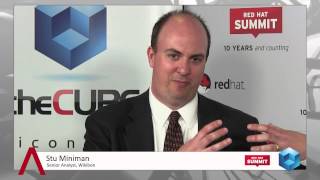
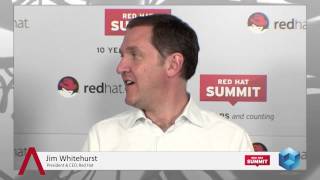
Jim Totton, Red Hat, at Red Hat Summit 2014 with John Furrier and Stu Miniman
@thecube
#RHSummit
This year's 10th anniversary of the Red Hat Summit has yielded some interesting and important insights into the continued acceptance and growth of open source for the Enterprise. Jim Totton, the Vice President and General Manager for Platform with Red Hat, joined John Furrier and Stu Miniman on SiliconANGLE's theCUBE to discuss the focus of his division, highlight current strategic partnerships and share some interesting news about RHEL 7, which was, until today, only available in Beta.
The concept of 'platform wars' led today's conversation. Furrier felt an explanation around the context of platform would be an important way to understand just what bloggers and press meant when they bandied about that phrase.
It would be important to start with a definition of platform because, according to Totton, too many people have too many ideas of what exactly that means. "Red Hat defines platform as the Red Hat Enterprise Linux system," he began. And within the RHEL, Red Hat directs their conversations around four key areas: physical deployments, traditional virtualization, private cloud built on OpenStack, and public cloud.
"Here at Summit, these four environments cover what our customers are running in their own operations," Totton said. He went on to say the most important task for RHEL is to always light up hardware. "We work closely at an engineering level to make sure we are lighting up the hardware and putting technology up the stack."
Another equally important task of RHEL is to be the platform everything is going to sit on. "We want platform to be rock solid and stable," he stated. "Lifecycle comes in here. We offer a 10-year lifecycle." As the pace of innovation and technology in open source accelerates it was the guaranteed lengthy lifecycle of RHEL that next came into discussion.
Red Hat has been maintaining a release schedule for major new RHEL platforms every 2 to 3 years. Many technologies now reaching maturity were still in their infancy when RHEL 6 released in Beta in November, 2010. For Enterprise customers, an assurance of easy and seamless migration with minimal to no downtime would have to be given.
Making the announcement during his interview on theCUBE, Totton heralded the wide-release of the RHEL 7 Release Candidate coming next week. "We've had over 10,000 downloads of RHEL 7. General interest has been great and we have received great feedback," he said. One important new feature will certainly put the Enterprise at ease and it has to do with exactly what was discussed above. Red Hat has provided real-time VM migration from their previous release to the new RHEL 7 with no downtime and no VM modification. While RHEL 6's lifecycle is guaranteed to 2020, adopters of that platform will not be left behind as technology marches on at an ever quickening pace.
While RHEL and the impending release of version 7 next week is the primary priority for Red Hat Miniman brought up Red Hat's recent partnership with Cent OS and asked Totton to break through what appears to be a conflict between the two operating systems.
"We have enjoyed a great partnership over many years," Totton explained. "Cent OS has provided a great on-ramp in the industry and we wanted to bring the partnership even closer together." As Totton further explained, innovation on the development side in open source today is occurring above the OS. "The community needs a great OS as a foundation to build those innovations out. Cent OS works well for that," he stated. "That being said, RHEL is always for our end customer. RHEL is great for Enterprise. Cent OS is suited for the development community."
The future of Red Hat was discussed just as the interview was wrapping up. "What's around the corner," asked Furrier. Before addressing the question, Totton assured that any forward movement in the company was going to be strongly rooted in the lessons learned in the previous 12 years spent developing their RHEL product. "We are focused now on a complete portfolio solution and no longer being the Linux company," he explained. "We will focus on providing a consumable platform for the enterprise."
Forgot Password
Almost there!
We just sent you a verification email. Please verify your account to gain access to
Red Hat Summit 2014 | San Francisco. If you don’t think you received an email check your
spam folder.
In order to sign in, enter the email address you used to registered for the event. Once completed, you will receive an email with a verification link. Open this link to automatically sign into the site.
Register For Red Hat Summit 2014 | San Francisco
Please fill out the information below. You will recieve an email with a verification link confirming your registration. Click the link to automatically sign into the site.
You’re almost there!
We just sent you a verification email. Please click the verification button in the email. Once your email address is verified, you will have full access to all event content for Red Hat Summit 2014 | San Francisco.
I want my badge and interests to be visible to all attendees.
Checking this box will display your presense on the attendees list, view your profile and allow other attendees to contact you via 1-1 chat. Read the Privacy Policy. At any time, you can choose to disable this preference.
Select your Interests!
add
Upload your photo
Uploading..
OR
Connect via Twitter
Connect via Linkedin
EDIT PASSWORD
Share
Forgot Password
Almost there!
We just sent you a verification email. Please verify your account to gain access to
Red Hat Summit 2014 | San Francisco. If you don’t think you received an email check your
spam folder.
In order to sign in, enter the email address you used to registered for the event. Once completed, you will receive an email with a verification link. Open this link to automatically sign into the site.
Sign in to gain access to Red Hat Summit 2014 | San Francisco
Please sign in with LinkedIn to continue to Red Hat Summit 2014 | San Francisco. Signing in with LinkedIn ensures a professional environment.
Are you sure you want to remove access rights for this user?
Details
Manage Access
email address
Community Invitation
Jim Totton - Red Hat Summit 2014 - TheCUBE
Jim Totton, Red Hat, at Red Hat Summit 2014 with John Furrier and Stu Miniman
@thecube
#RHSummit
This year's 10th anniversary of the Red Hat Summit has yielded some interesting and important insights into the continued acceptance and growth of open source for the Enterprise. Jim Totton, the Vice President and General Manager for Platform with Red Hat, joined John Furrier and Stu Miniman on SiliconANGLE's theCUBE to discuss the focus of his division, highlight current strategic partnerships and share some interesting news about RHEL 7, which was, until today, only available in Beta.
The concept of 'platform wars' led today's conversation. Furrier felt an explanation around the context of platform would be an important way to understand just what bloggers and press meant when they bandied about that phrase.
It would be important to start with a definition of platform because, according to Totton, too many people have too many ideas of what exactly that means. "Red Hat defines platform as the Red Hat Enterprise Linux system," he began. And within the RHEL, Red Hat directs their conversations around four key areas: physical deployments, traditional virtualization, private cloud built on OpenStack, and public cloud.
"Here at Summit, these four environments cover what our customers are running in their own operations," Totton said. He went on to say the most important task for RHEL is to always light up hardware. "We work closely at an engineering level to make sure we are lighting up the hardware and putting technology up the stack."
Another equally important task of RHEL is to be the platform everything is going to sit on. "We want platform to be rock solid and stable," he stated. "Lifecycle comes in here. We offer a 10-year lifecycle." As the pace of innovation and technology in open source accelerates it was the guaranteed lengthy lifecycle of RHEL that next came into discussion.
Red Hat has been maintaining a release schedule for major new RHEL platforms every 2 to 3 years. Many technologies now reaching maturity were still in their infancy when RHEL 6 released in Beta in November, 2010. For Enterprise customers, an assurance of easy and seamless migration with minimal to no downtime would have to be given.
Making the announcement during his interview on theCUBE, Totton heralded the wide-release of the RHEL 7 Release Candidate coming next week. "We've had over 10,000 downloads of RHEL 7. General interest has been great and we have received great feedback," he said. One important new feature will certainly put the Enterprise at ease and it has to do with exactly what was discussed above. Red Hat has provided real-time VM migration from their previous release to the new RHEL 7 with no downtime and no VM modification. While RHEL 6's lifecycle is guaranteed to 2020, adopters of that platform will not be left behind as technology marches on at an ever quickening pace.
While RHEL and the impending release of version 7 next week is the primary priority for Red Hat Miniman brought up Red Hat's recent partnership with Cent OS and asked Totton to break through what appears to be a conflict between the two operating systems.
"We have enjoyed a great partnership over many years," Totton explained. "Cent OS has provided a great on-ramp in the industry and we wanted to bring the partnership even closer together." As Totton further explained, innovation on the development side in open source today is occurring above the OS. "The community needs a great OS as a foundation to build those innovations out. Cent OS works well for that," he stated. "That being said, RHEL is always for our end customer. RHEL is great for Enterprise. Cent OS is suited for the development community."
The future of Red Hat was discussed just as the interview was wrapping up. "What's around the corner," asked Furrier. Before addressing the question, Totton assured that any forward movement in the company was going to be strongly rooted in the lessons learned in the previous 12 years spent developing their RHEL product. "We are focused now on a complete portfolio solution and no longer being the Linux company," he explained. "We will focus on providing a consumable platform for the enterprise."