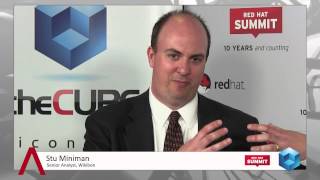
Scott Firth, IBM, at Red Hat Summit 2014 with John Furrier and Stu Miniman
@thecube
#RHSummit
Scott Firth, IBMIBM has been supporting Red Hat for over 10 years and has established a well-known reputation as one of the most notable corporate sponsors of Linux in general. This year at Red Hat Summit 2014, The CUBE hosts John Furrier and Stu Miniman had a chat with Scott Firth, IBM’s Director of Software-Defined Environments, about the growth of the IBM-Red Hat partnership and how the two companies are shaping the landscape of software-defined environments.
Firth began by talking about the evolution of Linux as an enterprise OS. He described it as “almost a toy” 14 years ago when IBM decided to invest a billion dollars in it. It was a time when many did not think that was a good idea, but IBM had a vision of a time when companies would be driven to collaborate on innovation rather than chiefly competing for it.
As open source software for the cloud continues to evolve, Firth explained, the community will take it to the next level, Open Stack being the chief example. “Ask 10 people what you mean by cloud, you’ll get 10 different answers. My definition of cloud is it’s a way to transform IT”.
IBM sees its role in transforming IT as the provider of tools to make it easier, simpler and more accessible to end users. The cloud will not completely replace the data center, but rather the two are part of a continuum. Companies are focused on data and how they interact with it. In some cases, it might be more secure and practical to host some data on-premise, whereas other portions of data might be more comfortable in the cloud. IBM’s job, he said, is to make sure it is easy to move back and forth between the two.
That interoperability is where software-defined environments begin. Organizations want to find ways to make compute, storage and networking work well together and be more efficient. IBM is working with Red Hat to treat data like a natural resource and turn that resource into something productive in the cloud and beyond.
You can learn more about IBM’s work with Red Hat by watching the entire interview right here at SiliconANGLE.com
Forgot Password
Almost there!
We just sent you a verification email. Please verify your account to gain access to
Red Hat Summit 2014 | San Francisco. If you don’t think you received an email check your
spam folder.
In order to sign in, enter the email address you used to registered for the event. Once completed, you will receive an email with a verification link. Open this link to automatically sign into the site.
Register For Red Hat Summit 2014 | San Francisco
Please fill out the information below. You will recieve an email with a verification link confirming your registration. Click the link to automatically sign into the site.
You’re almost there!
We just sent you a verification email. Please click the verification button in the email. Once your email address is verified, you will have full access to all event content for Red Hat Summit 2014 | San Francisco.
I want my badge and interests to be visible to all attendees.
Checking this box will display your presense on the attendees list, view your profile and allow other attendees to contact you via 1-1 chat. Read the Privacy Policy. At any time, you can choose to disable this preference.
Select your Interests!
add
Upload your photo
Uploading..
OR
Connect via Twitter
Connect via Linkedin
EDIT PASSWORD
Share
Forgot Password
Almost there!
We just sent you a verification email. Please verify your account to gain access to
Red Hat Summit 2014 | San Francisco. If you don’t think you received an email check your
spam folder.
In order to sign in, enter the email address you used to registered for the event. Once completed, you will receive an email with a verification link. Open this link to automatically sign into the site.
Sign in to gain access to Red Hat Summit 2014 | San Francisco
Please sign in with LinkedIn to continue to Red Hat Summit 2014 | San Francisco. Signing in with LinkedIn ensures a professional environment.
Are you sure you want to remove access rights for this user?
Details
Manage Access
email address
Community Invitation
Scott Firth - Red Hat Summit 2014 - TheCUBE
Scott Firth, IBM, at Red Hat Summit 2014 with John Furrier and Stu Miniman
@thecube
#RHSummit
Scott Firth, IBMIBM has been supporting Red Hat for over 10 years and has established a well-known reputation as one of the most notable corporate sponsors of Linux in general. This year at Red Hat Summit 2014, The CUBE hosts John Furrier and Stu Miniman had a chat with Scott Firth, IBM’s Director of Software-Defined Environments, about the growth of the IBM-Red Hat partnership and how the two companies are shaping the landscape of software-defined environments.
Firth began by talking about the evolution of Linux as an enterprise OS. He described it as “almost a toy” 14 years ago when IBM decided to invest a billion dollars in it. It was a time when many did not think that was a good idea, but IBM had a vision of a time when companies would be driven to collaborate on innovation rather than chiefly competing for it.
As open source software for the cloud continues to evolve, Firth explained, the community will take it to the next level, Open Stack being the chief example. “Ask 10 people what you mean by cloud, you’ll get 10 different answers. My definition of cloud is it’s a way to transform IT”.
IBM sees its role in transforming IT as the provider of tools to make it easier, simpler and more accessible to end users. The cloud will not completely replace the data center, but rather the two are part of a continuum. Companies are focused on data and how they interact with it. In some cases, it might be more secure and practical to host some data on-premise, whereas other portions of data might be more comfortable in the cloud. IBM’s job, he said, is to make sure it is easy to move back and forth between the two.
That interoperability is where software-defined environments begin. Organizations want to find ways to make compute, storage and networking work well together and be more efficient. IBM is working with Red Hat to treat data like a natural resource and turn that resource into something productive in the cloud and beyond.
You can learn more about IBM’s work with Red Hat by watching the entire interview right here at SiliconANGLE.com