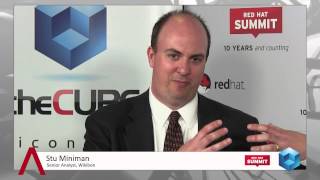
Tim Yeaton, Red Hat, at Red Hat Summit 2014 with John Furrier and Stu Miniman
@thecube
#RHSummit
Hybrid computing is a natural evolution of IT service delivery that extends far beyond the current discussion around data centers and cloud services, according to Red Hat senior vice president of infrastructure Tim Yeaton, transcending the underlying physical deployment models without regard to type or scale. As he sees it, in an era where data is no longer confined to the four walls of an organization, abstracting away the details has become an absolute necessity to effectively meeting workload requirements. And the explosion of use cases occurring in the enterprise today is making simplicity more important than ever before.
“At a philosophical level, first and foremost we embrace diversity. We know that customer environments are complex, and what we see our role as doing is making that complexity as manageable as possible,” Yeaton tells SiliconANGLE founder John Furrier and Wikibon’s Stu Miniman in an interview on theCUBE at the recently concluded Red Hat Summit.
Building from the ground up
.
Yeaton says that Red Hat is pursuing four primary objectives in its push to realize that promise. The first is taking an active role in the open source ecosystem, which it had been doing from the very start and already boasts an unequaled reputation in doing. He explains that his firm is looking to deliver the same reliability and ease of use that it has successfully enabled with Linux for emerging community-developed technologies such as OpenStack.
Another priority for Red Hat is storage, an area where it’s taking a software-defined approach to management, providing a single namespace that increases data availability while reducing the administrative burden on IT.
Higher up the stack, Red Hat is trying to implement a simplified application development and deployment model across the entire enterprise infrastructure landscape, from single-server setups through “classical” virtual environments to the public cloud. As part of that effort, the vendor has thrown its weight behind Docker, a Linux container engine that makes it possible to create lightweight and portable application images. Containerization has been around for a while, Yeaton notes, but what sets Docker apart and ultimately caught Red Hat’s attention is that it streamlines the creation of composite apps consisting of multiple containerized components like databases and load balancers.
Lastly, the vendor is trying to provide unified management capabilities through the CloudForms platform, which is built on technology it obtained as part of the 2012 acquisition of ManageIQ. Yeaton notes that Red Hat’s definition of the hybrid cloud not only encompasses private and public clouds but bare metal and virtualized servers as well, including those running on competing hypervisors from VMware and Microsoft.
“CloudForms brings all those kinds of capabilities – provisioning, orchestration, monitoring, billing and alike – to that diverse heterogeneous environment so you can have a single view of all your resources, understand how they’re performing and how you can migrate them across, whether it’s Red Hat infrastructure or others,” Yeaton says.
Not losing sight of the goal
.
The executive sees his firm’s aggressive hybrid computing strategy not as a change of direction but rather a continuation of its mission to harness the open source innovation model to drive business value in the enterprise.
“Our job is to enable customers to move forward on the cloud maturity curve, if you will, but that doesn’t mean necessarily to get them all the way to the public cloud – that’s just not gonna happen,” Yeaton summarizes. “It’s about getting them to a natural place where workloads are deployed on the infrastructure that makes the most sense but give them the flexibility to change their mind if they got it wrong or if they want to evolve.”
Decoupling the management layer from the underlying infrastructure is the next leg of this journey. Yeaton says that the growing industry momentum behind the software-defined data center paradigm reflects a “recognition that innovation is happening at software many times faster than hardware and it’s easier to accelerate those innovations on industry-standard platforms.” This paradigm shift presents a major threat to proprietary hardware vendors, as well as traditional software provides such as Microsoft and Oracle that generate most of their revenue from perpetual on-premise licenses.
Red Hat, on the other hand, has been a subscription-oriented company from day one. “I like to say that it keeps us honest because our customers have the ability to vote with their feet every 365 days,” Yeaton remarks. “It keeps us aggressive in terms of participating in communities to drive innovation and be disciplined at the same time about how we bring it in and productize it.”
Forgot Password
Almost there!
We just sent you a verification email. Please verify your account to gain access to
Red Hat Summit 2014 | San Francisco. If you don’t think you received an email check your
spam folder.
In order to sign in, enter the email address you used to registered for the event. Once completed, you will receive an email with a verification link. Open this link to automatically sign into the site.
Register For Red Hat Summit 2014 | San Francisco
Please fill out the information below. You will recieve an email with a verification link confirming your registration. Click the link to automatically sign into the site.
You’re almost there!
We just sent you a verification email. Please click the verification button in the email. Once your email address is verified, you will have full access to all event content for Red Hat Summit 2014 | San Francisco.
I want my badge and interests to be visible to all attendees.
Checking this box will display your presense on the attendees list, view your profile and allow other attendees to contact you via 1-1 chat. Read the Privacy Policy. At any time, you can choose to disable this preference.
Select your Interests!
add
Upload your photo
Uploading..
OR
Connect via Twitter
Connect via Linkedin
EDIT PASSWORD
Share
Forgot Password
Almost there!
We just sent you a verification email. Please verify your account to gain access to
Red Hat Summit 2014 | San Francisco. If you don’t think you received an email check your
spam folder.
In order to sign in, enter the email address you used to registered for the event. Once completed, you will receive an email with a verification link. Open this link to automatically sign into the site.
Sign in to gain access to Red Hat Summit 2014 | San Francisco
Please sign in with LinkedIn to continue to Red Hat Summit 2014 | San Francisco. Signing in with LinkedIn ensures a professional environment.
Are you sure you want to remove access rights for this user?
Details
Manage Access
email address
Community Invitation
Tim Yeaton - Red Hat Summit 2014 - theCUBE
Tim Yeaton, Red Hat, at Red Hat Summit 2014 with John Furrier and Stu Miniman
@thecube
#RHSummit
Hybrid computing is a natural evolution of IT service delivery that extends far beyond the current discussion around data centers and cloud services, according to Red Hat senior vice president of infrastructure Tim Yeaton, transcending the underlying physical deployment models without regard to type or scale. As he sees it, in an era where data is no longer confined to the four walls of an organization, abstracting away the details has become an absolute necessity to effectively meeting workload requirements. And the explosion of use cases occurring in the enterprise today is making simplicity more important than ever before.
“At a philosophical level, first and foremost we embrace diversity. We know that customer environments are complex, and what we see our role as doing is making that complexity as manageable as possible,” Yeaton tells SiliconANGLE founder John Furrier and Wikibon’s Stu Miniman in an interview on theCUBE at the recently concluded Red Hat Summit.
Building from the ground up
.
Yeaton says that Red Hat is pursuing four primary objectives in its push to realize that promise. The first is taking an active role in the open source ecosystem, which it had been doing from the very start and already boasts an unequaled reputation in doing. He explains that his firm is looking to deliver the same reliability and ease of use that it has successfully enabled with Linux for emerging community-developed technologies such as OpenStack.
Another priority for Red Hat is storage, an area where it’s taking a software-defined approach to management, providing a single namespace that increases data availability while reducing the administrative burden on IT.
Higher up the stack, Red Hat is trying to implement a simplified application development and deployment model across the entire enterprise infrastructure landscape, from single-server setups through “classical” virtual environments to the public cloud. As part of that effort, the vendor has thrown its weight behind Docker, a Linux container engine that makes it possible to create lightweight and portable application images. Containerization has been around for a while, Yeaton notes, but what sets Docker apart and ultimately caught Red Hat’s attention is that it streamlines the creation of composite apps consisting of multiple containerized components like databases and load balancers.
Lastly, the vendor is trying to provide unified management capabilities through the CloudForms platform, which is built on technology it obtained as part of the 2012 acquisition of ManageIQ. Yeaton notes that Red Hat’s definition of the hybrid cloud not only encompasses private and public clouds but bare metal and virtualized servers as well, including those running on competing hypervisors from VMware and Microsoft.
“CloudForms brings all those kinds of capabilities – provisioning, orchestration, monitoring, billing and alike – to that diverse heterogeneous environment so you can have a single view of all your resources, understand how they’re performing and how you can migrate them across, whether it’s Red Hat infrastructure or others,” Yeaton says.
Not losing sight of the goal
.
The executive sees his firm’s aggressive hybrid computing strategy not as a change of direction but rather a continuation of its mission to harness the open source innovation model to drive business value in the enterprise.
“Our job is to enable customers to move forward on the cloud maturity curve, if you will, but that doesn’t mean necessarily to get them all the way to the public cloud – that’s just not gonna happen,” Yeaton summarizes. “It’s about getting them to a natural place where workloads are deployed on the infrastructure that makes the most sense but give them the flexibility to change their mind if they got it wrong or if they want to evolve.”
Decoupling the management layer from the underlying infrastructure is the next leg of this journey. Yeaton says that the growing industry momentum behind the software-defined data center paradigm reflects a “recognition that innovation is happening at software many times faster than hardware and it’s easier to accelerate those innovations on industry-standard platforms.” This paradigm shift presents a major threat to proprietary hardware vendors, as well as traditional software provides such as Microsoft and Oracle that generate most of their revenue from perpetual on-premise licenses.
Red Hat, on the other hand, has been a subscription-oriented company from day one. “I like to say that it keeps us honest because our customers have the ability to vote with their feet every 365 days,” Yeaton remarks. “It keeps us aggressive in terms of participating in communities to drive innovation and be disciplined at the same time about how we bring it in and productize it.”