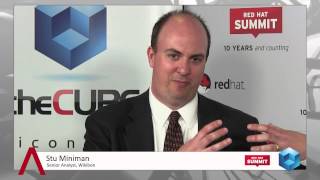
Brian Stevens, Red Hat, at Red Hat Summit 2014 with John Furrier and Stu Miniman
@thecube
#RHSummit
At this week's Red Hat Summit, celebrating its 10th anniversary, co-hosts of SiliconANGLE's theCUBE, John Furrier and Stu Miniman, welcomed several members of the Red Hat executive team. Early yesterday, Brian Stevens, Executive Vice President and CTO for the company, stopped in to discuss this year's summit, how the open source community will effectively erase any delineation between infrastructure and platform, converging them into one idea, and how he sees the role of open source in a world becoming increasingly data-centric.
For those who follow the Red Hat Summit, you know the previous few years saw the conference in Boston. Stevens commented how bringing the summit out west this year really opened Red Hat to a new, wider audience. And many in this new audience had one thing on their minds: OpenStack. Furrier asked Stevens, as EVP and CTO of Red Hat, to share the top conversation he found he was having with both the public, and also with customers and partners.
"The top conversation," Stevens began, "is actually starting to get kind of boring, honestly. It's always about OpenStack. It's nice to mix it up once in a while. But the reality is that it's a good problem to have."
Stevens went on to say that perhaps not every conversation started focused on OpenStack, but near every conversation ended there. "That's the destination that most in the industry say 'that's our path forward' because it's about Cloud. And Amazon's not exactly sharing their intellectual property." Stevens sees OpenStack as a means for customers to achieve an Amazon-like model.
Watch the interview in its entirety here:
.
Start-ups, noted Furrier, love Amazon because, "...you can jump right in there. They have no legacy. It's a green field for them." He continued, "You've got auto-scaling and all this greatness going on in there. With OpenStack, is that going to be something we're going to see?"
When Two Become One
.
That specific future is really an unknown. "That remains to be seen," Stevens responded. That uncertainty, according to Stevens, stems from his belief the whole landscape of the environment is going to look a lot different fairly soon.
"The whole infrastructure category and platform category are going to be completely obliterated," Stevens said. "It's going to become one. You could name a million services that Amazon has. Are they infrastructure services or are they platform services? Who the hell cares. It all needs to be one."
He claims Red Hat and the open source community are going to be the drivers of this imminent convergence, saying, "We're going to drive, in our case it's OpenShift, but we're going to drive the convergence of that with OpenStack. You end up with a better mousetrap."
Stevens sees Big Data as soon becoming a major play for Red Hat, their partners and the open source community. However, its relative youth in the market means effective strategies are not necessarily available for non-web scale companies.
"It's certainly one of the hottest areas but I think that there hasn't been this exact recipe or science on it yet," he said. "If you have to have a data scientist, that's a fact of just how not well understood it is."
He credits advancement in the field to those web scale companies that are taking in a rich supply of daily data, and acting upon it. "Traditional corporations are still in that BI phase," he stated. "They're actually looking to figure out how to store, secure and scale out data and really analyze it." He's sees the industry moving in that direction. They just aren't there yet.
Forgot Password
Almost there!
We just sent you a verification email. Please verify your account to gain access to
Red Hat Summit 2014 | San Francisco. If you don’t think you received an email check your
spam folder.
In order to sign in, enter the email address you used to registered for the event. Once completed, you will receive an email with a verification link. Open this link to automatically sign into the site.
Register For Red Hat Summit 2014 | San Francisco
Please fill out the information below. You will recieve an email with a verification link confirming your registration. Click the link to automatically sign into the site.
You’re almost there!
We just sent you a verification email. Please click the verification button in the email. Once your email address is verified, you will have full access to all event content for Red Hat Summit 2014 | San Francisco.
I want my badge and interests to be visible to all attendees.
Checking this box will display your presense on the attendees list, view your profile and allow other attendees to contact you via 1-1 chat. Read the Privacy Policy. At any time, you can choose to disable this preference.
Select your Interests!
add
Upload your photo
Uploading..
OR
Connect via Twitter
Connect via Linkedin
EDIT PASSWORD
Share
Forgot Password
Almost there!
We just sent you a verification email. Please verify your account to gain access to
Red Hat Summit 2014 | San Francisco. If you don’t think you received an email check your
spam folder.
In order to sign in, enter the email address you used to registered for the event. Once completed, you will receive an email with a verification link. Open this link to automatically sign into the site.
Sign in to gain access to Red Hat Summit 2014 | San Francisco
Please sign in with LinkedIn to continue to Red Hat Summit 2014 | San Francisco. Signing in with LinkedIn ensures a professional environment.
Are you sure you want to remove access rights for this user?
Details
Manage Access
email address
Community Invitation
Brian Stevens - Red Hat Summit 2014 - TheCUBE
Brian Stevens, Red Hat, at Red Hat Summit 2014 with John Furrier and Stu Miniman
@thecube
#RHSummit
At this week's Red Hat Summit, celebrating its 10th anniversary, co-hosts of SiliconANGLE's theCUBE, John Furrier and Stu Miniman, welcomed several members of the Red Hat executive team. Early yesterday, Brian Stevens, Executive Vice President and CTO for the company, stopped in to discuss this year's summit, how the open source community will effectively erase any delineation between infrastructure and platform, converging them into one idea, and how he sees the role of open source in a world becoming increasingly data-centric.
For those who follow the Red Hat Summit, you know the previous few years saw the conference in Boston. Stevens commented how bringing the summit out west this year really opened Red Hat to a new, wider audience. And many in this new audience had one thing on their minds: OpenStack. Furrier asked Stevens, as EVP and CTO of Red Hat, to share the top conversation he found he was having with both the public, and also with customers and partners.
"The top conversation," Stevens began, "is actually starting to get kind of boring, honestly. It's always about OpenStack. It's nice to mix it up once in a while. But the reality is that it's a good problem to have."
Stevens went on to say that perhaps not every conversation started focused on OpenStack, but near every conversation ended there. "That's the destination that most in the industry say 'that's our path forward' because it's about Cloud. And Amazon's not exactly sharing their intellectual property." Stevens sees OpenStack as a means for customers to achieve an Amazon-like model.
Watch the interview in its entirety here:
.
Start-ups, noted Furrier, love Amazon because, "...you can jump right in there. They have no legacy. It's a green field for them." He continued, "You've got auto-scaling and all this greatness going on in there. With OpenStack, is that going to be something we're going to see?"
When Two Become One
.
That specific future is really an unknown. "That remains to be seen," Stevens responded. That uncertainty, according to Stevens, stems from his belief the whole landscape of the environment is going to look a lot different fairly soon.
"The whole infrastructure category and platform category are going to be completely obliterated," Stevens said. "It's going to become one. You could name a million services that Amazon has. Are they infrastructure services or are they platform services? Who the hell cares. It all needs to be one."
He claims Red Hat and the open source community are going to be the drivers of this imminent convergence, saying, "We're going to drive, in our case it's OpenShift, but we're going to drive the convergence of that with OpenStack. You end up with a better mousetrap."
Stevens sees Big Data as soon becoming a major play for Red Hat, their partners and the open source community. However, its relative youth in the market means effective strategies are not necessarily available for non-web scale companies.
"It's certainly one of the hottest areas but I think that there hasn't been this exact recipe or science on it yet," he said. "If you have to have a data scientist, that's a fact of just how not well understood it is."
He credits advancement in the field to those web scale companies that are taking in a rich supply of daily data, and acting upon it. "Traditional corporations are still in that BI phase," he stated. "They're actually looking to figure out how to store, secure and scale out data and really analyze it." He's sees the industry moving in that direction. They just aren't there yet.