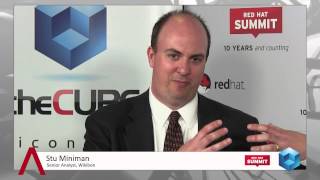
Jim Whitehurst, Red Hat,at Red Hat Summit 2014 with John Furrier and Stu Miniman
@thecube
#RHSummit
Jim Whitehurst, Red Hat CEO, discussed open source evolution and its role in driving innovation with theCUBE co-hosts John Furrier and Stu Miniman in a live interview yesterday at Red Hat Summit 2014. The birth and growth of web 2.0 companies, explained Whitehurst, are leading to the increased amount of code developed by the open source community. "Before, most code came from large enterprises. Large web 2.0 companies use open source to drive innovation."
"Everything happening in Big Data is happening in open source," Whitehurst added. "Linux has been around for 20 years, and Enterprise Linux has been around for 12 years...to make open source consumable, now paired with the web 2.0 phenomenon. DevOps, continuous deployment — they all came from web 2.0 which is open source," Whitehurst explained. "Half of my conversations with customers are more about understanding the innovation model."
Commenting on what's next for the company, Whitehurst said "Red Hat really is becoming cloud."
From the early days when technology solutions were custom tailored, the field evolved towards the industrialization of IT, and then to the commoditization of hardware. Right now the focus is on just building the app that's expected to run on commodity hardware. "It's no longer about building a whole infrastructure, it's about building an application that runs on existing ones," Whitehurst said.
"Developers want to build their own personal brand and reputation, you can't do that if you're not contributing to code people can see," Whitehurst continued. Companies want their developers to contribute, because it's a way to keep the best and the brightest.
Asked about innovation across the U.S., Whitehurst thinks it's dispersed. "The interesting thing you see in the Valley, the core technologies around cloud happened here," said Whitehurst. "Web 2.0 companies had applications intended to run into a cloud environment." Most companies don't have that luxury with legacy applications, he explained, noting that while "OpenStack is phenomenal and can do a lot of things, we're still trying to bring in the features that support traditional applications."
Commenting on Red Hat's subscription model, Whitehurst stated "the most important thing that a company needs to do is be able to understand deeply," and drive its competitive advantage.
Red Hat always asks "is this an area where there's an ecosystem of innovation where Red Hat can add value?" The second question is whether Red Hat can build a commercial model that can bring value to its customers.
Monetizing open source
.
Asked when OpenStack was expected to generate significant revenue, Whitehurst said there is a difference with the subscription model between selling, collect billings, and then seeing revenue. He estimated more big deals closing this year, which will turn into revenue for the next fiscal year.
Furrier then asked, "why aren't there more billion-dollar open source companies out there?"
Whitehurst responded by saying that "selling free software is hard. The functionality itself is free." Red Hat's business model is taking the power of the open source model and commit to supporting it in the long run. The mistake many companies make when considering an open source, subscription based model was to "mix the value that the code offers with the value their company can add," said Whitehurst.
Asked if there will be another Red Hat in a different industry segment, Whitehurst says there will be. "I certainly think we will see a new Red Hat in other areas. Hadoop is the best candidate." Another opportunity would be for a next generation NoSQL database.
Commenting on the Red Hat Summit's evolution, Whitehurst said that the perception of open source was radically changed. Back in 2008 it was considered an "almost as good, dramatically cheaper alternative. Now, if you look at it, open source is perceived much more about driving innovation," he concluded.
Forgot Password
Almost there!
We just sent you a verification email. Please verify your account to gain access to
Red Hat Summit 2014 | San Francisco. If you don’t think you received an email check your
spam folder.
In order to sign in, enter the email address you used to registered for the event. Once completed, you will receive an email with a verification link. Open this link to automatically sign into the site.
Register For Red Hat Summit 2014 | San Francisco
Please fill out the information below. You will recieve an email with a verification link confirming your registration. Click the link to automatically sign into the site.
You’re almost there!
We just sent you a verification email. Please click the verification button in the email. Once your email address is verified, you will have full access to all event content for Red Hat Summit 2014 | San Francisco.
I want my badge and interests to be visible to all attendees.
Checking this box will display your presense on the attendees list, view your profile and allow other attendees to contact you via 1-1 chat. Read the Privacy Policy. At any time, you can choose to disable this preference.
Select your Interests!
add
Upload your photo
Uploading..
OR
Connect via Twitter
Connect via Linkedin
EDIT PASSWORD
Share
Forgot Password
Almost there!
We just sent you a verification email. Please verify your account to gain access to
Red Hat Summit 2014 | San Francisco. If you don’t think you received an email check your
spam folder.
In order to sign in, enter the email address you used to registered for the event. Once completed, you will receive an email with a verification link. Open this link to automatically sign into the site.
Sign in to gain access to Red Hat Summit 2014 | San Francisco
Please sign in with LinkedIn to continue to Red Hat Summit 2014 | San Francisco. Signing in with LinkedIn ensures a professional environment.
Are you sure you want to remove access rights for this user?
Details
Manage Access
email address
Community Invitation
Jim Whitehurst, Red Hat | Red Hat Summit 2014
Jim Whitehurst, Red Hat,at Red Hat Summit 2014 with John Furrier and Stu Miniman
@thecube
#RHSummit
Jim Whitehurst, Red Hat CEO, discussed open source evolution and its role in driving innovation with theCUBE co-hosts John Furrier and Stu Miniman in a live interview yesterday at Red Hat Summit 2014. The birth and growth of web 2.0 companies, explained Whitehurst, are leading to the increased amount of code developed by the open source community. "Before, most code came from large enterprises. Large web 2.0 companies use open source to drive innovation."
"Everything happening in Big Data is happening in open source," Whitehurst added. "Linux has been around for 20 years, and Enterprise Linux has been around for 12 years...to make open source consumable, now paired with the web 2.0 phenomenon. DevOps, continuous deployment — they all came from web 2.0 which is open source," Whitehurst explained. "Half of my conversations with customers are more about understanding the innovation model."
Commenting on what's next for the company, Whitehurst said "Red Hat really is becoming cloud."
From the early days when technology solutions were custom tailored, the field evolved towards the industrialization of IT, and then to the commoditization of hardware. Right now the focus is on just building the app that's expected to run on commodity hardware. "It's no longer about building a whole infrastructure, it's about building an application that runs on existing ones," Whitehurst said.
"Developers want to build their own personal brand and reputation, you can't do that if you're not contributing to code people can see," Whitehurst continued. Companies want their developers to contribute, because it's a way to keep the best and the brightest.
Asked about innovation across the U.S., Whitehurst thinks it's dispersed. "The interesting thing you see in the Valley, the core technologies around cloud happened here," said Whitehurst. "Web 2.0 companies had applications intended to run into a cloud environment." Most companies don't have that luxury with legacy applications, he explained, noting that while "OpenStack is phenomenal and can do a lot of things, we're still trying to bring in the features that support traditional applications."
Commenting on Red Hat's subscription model, Whitehurst stated "the most important thing that a company needs to do is be able to understand deeply," and drive its competitive advantage.
Red Hat always asks "is this an area where there's an ecosystem of innovation where Red Hat can add value?" The second question is whether Red Hat can build a commercial model that can bring value to its customers.
Monetizing open source
.
Asked when OpenStack was expected to generate significant revenue, Whitehurst said there is a difference with the subscription model between selling, collect billings, and then seeing revenue. He estimated more big deals closing this year, which will turn into revenue for the next fiscal year.
Furrier then asked, "why aren't there more billion-dollar open source companies out there?"
Whitehurst responded by saying that "selling free software is hard. The functionality itself is free." Red Hat's business model is taking the power of the open source model and commit to supporting it in the long run. The mistake many companies make when considering an open source, subscription based model was to "mix the value that the code offers with the value their company can add," said Whitehurst.
Asked if there will be another Red Hat in a different industry segment, Whitehurst says there will be. "I certainly think we will see a new Red Hat in other areas. Hadoop is the best candidate." Another opportunity would be for a next generation NoSQL database.
Commenting on the Red Hat Summit's evolution, Whitehurst said that the perception of open source was radically changed. Back in 2008 it was considered an "almost as good, dramatically cheaper alternative. Now, if you look at it, open source is perceived much more about driving innovation," he concluded.