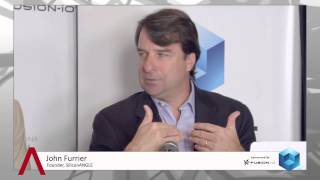
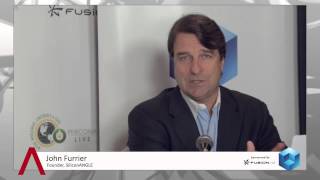
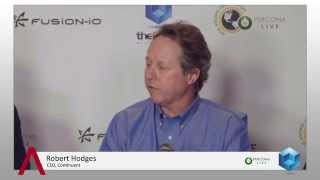
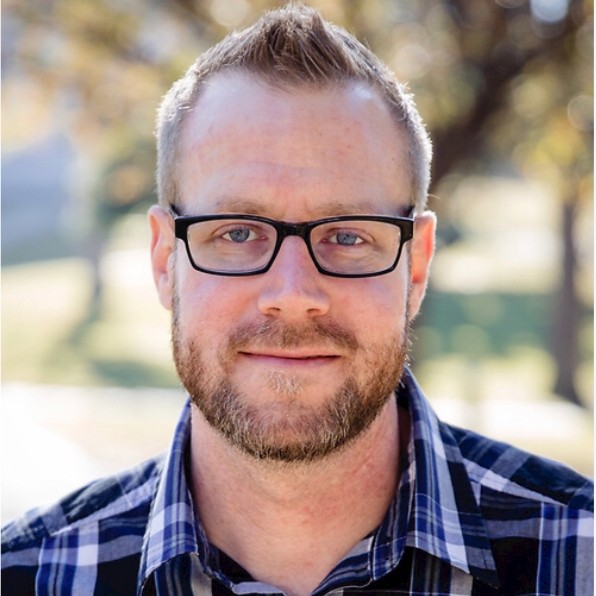
Sean Anderson, and Daniel Morris Sr. Rackspace,at PerconaLive 2014 with John Furrier and Jeff Frick
@thecube #theCUBE #PerconaLive #Rackspace #SiliconANGLE
Percona Live 2014 is a conference that might not have all of the flashy marketing and promotions, but its importance to the developer community cannot go unnoticed. At the event #theCUBE welcomes Sam Anderson, Product Marketing Manager for Cloud Big Data Solutions at Rackspace, and Daniel Morris, Manager of Database Products at Rackspace. Anderson and Morris joined #theCUBE hosts John Furrier and Jeffrey Kelly to discuss cloud as an engine to innovation.
Data lives in the cloud natively, explains Anderson, whether social data or machine data. Therefore, the explosion of cloud computing is directly related to people realizing that data can live and act in the cloud natively. MySQL is a conduit for transitioning workloads to the cloud, as data technologies can process the data in the cloud.
In the same fashion as SkySQL's Roger Levy, the Rackspace guys compare the success of MySQL to MongoDB's successful journey. A key cog in the wheel of MySQL's success is the ability to have multiple forks within its ecosystem. MariaDB, Percona, Consortium, and WebscaleSQL — all are different forks of MySQL that contribute to a common mission and goal of advancing MySQL.
With the tsunami of data that is happening thanks to machine-to-machine communication within the Internet of Things movement, understanding how companies like Google and Facebook transition and scale data further proves the importance of the cloud. Companies are exploring new technologies, and SiliconANGLE is noticing a trend that bigger enterprises are the ones actually struggling the most. With enterprises, it's not just a single switch on the back end. Legacy systems are a headache to transition to the cloud.
So does that mean the cloud is something of an outsource model? Where is the control point and can the enterprise maintain control?
Rackspace believes it's uniquely positioned because it has multiple models it can offer. In listening to Anderson and Morris, an important takeaway would be that the model for cloud success is not a single source of truth. Our research at SiliconANGLE and Wikibon supports this notion. Multiple offerings will win: dedicated, private, and public clouds. Morris details how Rackspace even has a model for customers that want DIY cloud solutions. They key for Rackspace is to offer a host of options to lower the barrier to entry.
Anderson speaks of how there is still a lot of "toe dipping" by enterprises who are not ready to fully commit to the cloud. Furrier pushes the Rackspace guys to see if they thought that cloud adoption was "slowing down," but Anderson and Morris are steadfast in their stance that it is actually picking up in some areas. An interesting point Anderson makes is that the roadmap becomes increasingly more important. Where are enterprises taking their infrastructure because data is very hard to move? Data is extremely sticky, and an enterprise wants complete confidence in its cloud providers' portfolio.
The days of having three database vendors to pick from and building your application around them are over. People are developing around open source, with more choices than ever in the database market. To compound the new challenges to this market shift, customers are choosing multiple technologies, too. Application developers are wanting to do less and less with scaling the database and managing the database of their workloads. In essence, they want the open source technologies to "work better" and "work smarter". Rackspace sees this as a very unique opportunity to position its products and services: How can we enable our customers to run these more complicated workloads?
Rackspace is attacking this new opportunity by creating a portfolio of data services. It is taking an assertive effort to ramp up the capabilities around data.
To Morris, "open" is more than just open source. One point he makes is that open should mean being able to bring your workload to a service provider and not be locked-in to that provider. Rackspace's OpenStack supports this concept, and Morris is seeing some very complicated workloads get run on OpenStack. But can OpenStack survive, or is it slowing down to die, asks Furrier?
Anderson and Morris believe that people are asking real and challenging questions, beyond the high level theories of what OpenStack can do. That is why they believe OpenStack isn't slowing down. That is why they believe OpenStack has legs, and that open source will win. People are running open source, scaling it, and constant improvements are being committed back into its community.
Rackspace sees a lot of overlap between the MySQL and OpenStack communities, too.
Forgot Password
Almost there!
We just sent you a verification email. Please verify your account to gain access to
Percona Live 2014 | Santa Clara, CA. If you don’t think you received an email check your
spam folder.
In order to sign in, enter the email address you used to registered for the event. Once completed, you will receive an email with a verification link. Open this link to automatically sign into the site.
Register For Percona Live 2014 | Santa Clara, CA
Please fill out the information below. You will recieve an email with a verification link confirming your registration. Click the link to automatically sign into the site.
You’re almost there!
We just sent you a verification email. Please click the verification button in the email. Once your email address is verified, you will have full access to all event content for Percona Live 2014 | Santa Clara, CA.
I want my badge and interests to be visible to all attendees.
Checking this box will display your presense on the attendees list, view your profile and allow other attendees to contact you via 1-1 chat. Read the Privacy Policy. At any time, you can choose to disable this preference.
Select your Interests!
add
Upload your photo
Uploading..
OR
Connect via Twitter
Connect via Linkedin
EDIT PASSWORD
Share
Forgot Password
Almost there!
We just sent you a verification email. Please verify your account to gain access to
Percona Live 2014 | Santa Clara, CA. If you don’t think you received an email check your
spam folder.
In order to sign in, enter the email address you used to registered for the event. Once completed, you will receive an email with a verification link. Open this link to automatically sign into the site.
Sign in to gain access to Percona Live 2014 | Santa Clara, CA
Please sign in with LinkedIn to continue to Percona Live 2014 | Santa Clara, CA. Signing in with LinkedIn ensures a professional environment.
Are you sure you want to remove access rights for this user?
Details
Manage Access
email address
Community Invitation
Sean Anderson & Daniel Morris Sr., Rackspace | PerconaLive 2014
Sean Anderson, and Daniel Morris Sr. Rackspace,at PerconaLive 2014 with John Furrier and Jeff Frick
@thecube #theCUBE #PerconaLive #Rackspace #SiliconANGLE
Percona Live 2014 is a conference that might not have all of the flashy marketing and promotions, but its importance to the developer community cannot go unnoticed. At the event #theCUBE welcomes Sam Anderson, Product Marketing Manager for Cloud Big Data Solutions at Rackspace, and Daniel Morris, Manager of Database Products at Rackspace. Anderson and Morris joined #theCUBE hosts John Furrier and Jeffrey Kelly to discuss cloud as an engine to innovation.
Data lives in the cloud natively, explains Anderson, whether social data or machine data. Therefore, the explosion of cloud computing is directly related to people realizing that data can live and act in the cloud natively. MySQL is a conduit for transitioning workloads to the cloud, as data technologies can process the data in the cloud.
In the same fashion as SkySQL's Roger Levy, the Rackspace guys compare the success of MySQL to MongoDB's successful journey. A key cog in the wheel of MySQL's success is the ability to have multiple forks within its ecosystem. MariaDB, Percona, Consortium, and WebscaleSQL — all are different forks of MySQL that contribute to a common mission and goal of advancing MySQL.
With the tsunami of data that is happening thanks to machine-to-machine communication within the Internet of Things movement, understanding how companies like Google and Facebook transition and scale data further proves the importance of the cloud. Companies are exploring new technologies, and SiliconANGLE is noticing a trend that bigger enterprises are the ones actually struggling the most. With enterprises, it's not just a single switch on the back end. Legacy systems are a headache to transition to the cloud.
So does that mean the cloud is something of an outsource model? Where is the control point and can the enterprise maintain control?
Rackspace believes it's uniquely positioned because it has multiple models it can offer. In listening to Anderson and Morris, an important takeaway would be that the model for cloud success is not a single source of truth. Our research at SiliconANGLE and Wikibon supports this notion. Multiple offerings will win: dedicated, private, and public clouds. Morris details how Rackspace even has a model for customers that want DIY cloud solutions. They key for Rackspace is to offer a host of options to lower the barrier to entry.
Anderson speaks of how there is still a lot of "toe dipping" by enterprises who are not ready to fully commit to the cloud. Furrier pushes the Rackspace guys to see if they thought that cloud adoption was "slowing down," but Anderson and Morris are steadfast in their stance that it is actually picking up in some areas. An interesting point Anderson makes is that the roadmap becomes increasingly more important. Where are enterprises taking their infrastructure because data is very hard to move? Data is extremely sticky, and an enterprise wants complete confidence in its cloud providers' portfolio.
The days of having three database vendors to pick from and building your application around them are over. People are developing around open source, with more choices than ever in the database market. To compound the new challenges to this market shift, customers are choosing multiple technologies, too. Application developers are wanting to do less and less with scaling the database and managing the database of their workloads. In essence, they want the open source technologies to "work better" and "work smarter". Rackspace sees this as a very unique opportunity to position its products and services: How can we enable our customers to run these more complicated workloads?
Rackspace is attacking this new opportunity by creating a portfolio of data services. It is taking an assertive effort to ramp up the capabilities around data.
To Morris, "open" is more than just open source. One point he makes is that open should mean being able to bring your workload to a service provider and not be locked-in to that provider. Rackspace's OpenStack supports this concept, and Morris is seeing some very complicated workloads get run on OpenStack. But can OpenStack survive, or is it slowing down to die, asks Furrier?
Anderson and Morris believe that people are asking real and challenging questions, beyond the high level theories of what OpenStack can do. That is why they believe OpenStack isn't slowing down. That is why they believe OpenStack has legs, and that open source will win. People are running open source, scaling it, and constant improvements are being committed back into its community.
Rackspace sees a lot of overlap between the MySQL and OpenStack communities, too.