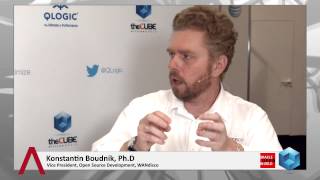
Vinay Gaonkar, XtremIO, at Oracle OpenWorld 2014 with Dave Vellante
@theCUBE
#*OOW14*
Open source plays a key role in IT innovation strategy this year and it’s obvious from watching Oracle do its thing. In fact, Recent years have seen the emergence of a system in which the open source and free software are keeping innovation in IT world. This system takes root in some large web companies that do not consider their core system as the owner, but as technologies that they can share with others and pool.
At the Oracle OpenWorld 2013 held from September 22 to 26 at the Moscone Center in San Francisco, CA, the company offered IT organizations with a one stop shop from heterogeneous collection of newer cloud-based solutions, middleware solutions and data sources to legacy applications for IT operational and business processes.
For developers looking to automate some of these processes, Oracle provided tools such as Concurrent Manager and Process Scheduler for Oracle E-Business Suite (EBS) and PeopleSoft or PL/SQL scripts to automate Oracle database processes.
Managing DB dependent development
How do you manage development when development depends on underlying databases? Databases have no data control like source control for code. Because these development environments depend on databases and those databases are large and/or complex to build the build time can take anywhere between a few days to weeks.
ManageEngine, which offers enterprise IT management solutions including network, server, desktop and application management, announced significant upgrades to the Oracle database monitoring feature in Applications Manager, its application performance monitoring solution.
The latest upgrade improves tuning and troubleshooting of Oracle systems by enhancing real-time visibility into the health and performance of Oracle databases and their related applications. Whenever a business-critical Oracle application or process is underperforming, IT teams tend to point fingers at areas that are not well understood. Applications Manager monitors across the Oracle application stack — and any other heterogeneous set of servers, app servers and databases. The performance insight now offered by Applications Manager reveals exactly what’s running and whether a problem is at the application, database or network level; so, you can solve performance problems faster and spend less time.
Oracle 12c is capable of managing a set of guests or “pluggable databases” beneath its core system. Darryl Smith, Chief Database Architect for EMC IT, shared that Oracle databases allow database administrators to focus on getting in front of the business, understand what their problems are, so that IT can be more agile and responsive.
Forgot Password
Almost there!
We just sent you a verification email. Please verify your account to gain access to
Oracle OpenWorld 2014 - Studio QLogic | San Francisco. If you don’t think you received an email check your
spam folder.
Sign in to Oracle OpenWorld 2014 - Studio QLogic | San Francisco.
In order to sign in, enter the email address you used to registered for the event. Once completed, you will receive an email with a verification link. Open this link to automatically sign into the site.
Register For Oracle OpenWorld 2014 - Studio QLogic | San Francisco
Please fill out the information below. You will recieve an email with a verification link confirming your registration. Click the link to automatically sign into the site.
You’re almost there!
We just sent you a verification email. Please click the verification button in the email. Once your email address is verified, you will have full access to all event content for Oracle OpenWorld 2014 - Studio QLogic | San Francisco.
I want my badge and interests to be visible to all attendees.
Checking this box will display your presense on the attendees list, view your profile and allow other attendees to contact you via 1-1 chat. Read the Privacy Policy. At any time, you can choose to disable this preference.
Select your Interests!
add
Upload your photo
Uploading..
OR
Connect via Twitter
Connect via Linkedin
EDIT PASSWORD
Share
Forgot Password
Almost there!
We just sent you a verification email. Please verify your account to gain access to
Oracle OpenWorld 2014 - Studio QLogic | San Francisco. If you don’t think you received an email check your
spam folder.
Sign in to Oracle OpenWorld 2014 - Studio QLogic | San Francisco.
In order to sign in, enter the email address you used to registered for the event. Once completed, you will receive an email with a verification link. Open this link to automatically sign into the site.
Sign in to gain access to Oracle OpenWorld 2014 - Studio QLogic | San Francisco
Please sign in with LinkedIn to continue to Oracle OpenWorld 2014 - Studio QLogic | San Francisco. Signing in with LinkedIn ensures a professional environment.
Are you sure you want to remove access rights for this user?
Details
Manage Access
email address
Community Invitation
Vinay Gaonkar - Oracle OpenWorld 2014 - theCUBE Studio QLogic
Vinay Gaonkar, XtremIO, at Oracle OpenWorld 2014 with Dave Vellante
@theCUBE
#*OOW14*
Open source plays a key role in IT innovation strategy this year and it’s obvious from watching Oracle do its thing. In fact, Recent years have seen the emergence of a system in which the open source and free software are keeping innovation in IT world. This system takes root in some large web companies that do not consider their core system as the owner, but as technologies that they can share with others and pool.
At the Oracle OpenWorld 2013 held from September 22 to 26 at the Moscone Center in San Francisco, CA, the company offered IT organizations with a one stop shop from heterogeneous collection of newer cloud-based solutions, middleware solutions and data sources to legacy applications for IT operational and business processes.
For developers looking to automate some of these processes, Oracle provided tools such as Concurrent Manager and Process Scheduler for Oracle E-Business Suite (EBS) and PeopleSoft or PL/SQL scripts to automate Oracle database processes.
Managing DB dependent development
How do you manage development when development depends on underlying databases? Databases have no data control like source control for code. Because these development environments depend on databases and those databases are large and/or complex to build the build time can take anywhere between a few days to weeks.
ManageEngine, which offers enterprise IT management solutions including network, server, desktop and application management, announced significant upgrades to the Oracle database monitoring feature in Applications Manager, its application performance monitoring solution.
The latest upgrade improves tuning and troubleshooting of Oracle systems by enhancing real-time visibility into the health and performance of Oracle databases and their related applications. Whenever a business-critical Oracle application or process is underperforming, IT teams tend to point fingers at areas that are not well understood. Applications Manager monitors across the Oracle application stack — and any other heterogeneous set of servers, app servers and databases. The performance insight now offered by Applications Manager reveals exactly what’s running and whether a problem is at the application, database or network level; so, you can solve performance problems faster and spend less time.
Oracle 12c is capable of managing a set of guests or “pluggable databases” beneath its core system. Darryl Smith, Chief Database Architect for EMC IT, shared that Oracle databases allow database administrators to focus on getting in front of the business, understand what their problems are, so that IT can be more agile and responsive.