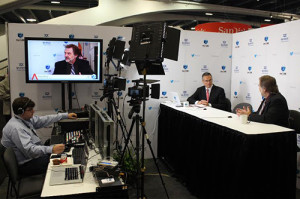
Day 1 Intro, Oracle OpenWorld 2014 with Dave Vellante and Jeff Kelly
@theCUBE
#*OOW14*
Oracle_Openworld_2014Today theCUBE kicks off three days of coverage of Oracle OpenWorld 2014 at a critical time in Oracle Corp.’s history. Like many of the old-line vendors, Oracle is seeing its markets shift radically beneath it. Once-stable business foundations are cracking under the pressure from open source, Big Data, mobile and cloud. To remain a strong and viable company, Oracle needs to evolve rapidly. So far it has introduced new directions each year in response to some of these pressures while resisting others, particularly open source. Today Oracle is still a highly profitable company, but increasingly those profits are coming from renewals and maintenance. Its new sales rate is slipping in part because of competition from cloud-based competitors such as Workday. The time for it to move into that new age is now, before its profits begin seriously slipping and it no longer has the financial strength to support the bold moves it needs.
In this environment, Oracle OpenWorld provides Oracle users with a window into where it is and, more importantly, where it is going. SiliconAngle CEO John Furrier and, Wikibon CEO David Vellante will be on hand to ask Oracle executives, partners and users the hard questions starting at 10:00 A.M. PT (1:00 P.M. ET).
Big Data is the gorilla in the room. Relational database technology is proving inadequate to handle the huge volume of data and new data types that this discipline demands. Viewers of theCUBE’s coverage at the HP Vertica conference, for instance, heard several practitioners, including Janath Manohararaj, team lead for database services at BlueCrossBlueShield of Chicago, say that their relational data warehouses simply cannot keep up with the volume of data demanded. Their answer was to turn to Hadoop into their main data warehouse with Vertica running on top as a high speed data analysis engine. This provides much faster response times, is less expensive and allows them to manage a wide range of data types, including structured data. This is obviously a long-term threat to Oracle’s core business. Oracle must respond to prevent a growing erosion of customers while not cannibalizing its present income sources, which is the perpetual innovator’s dilemma.
A related question for Oracle is open source. While it likes to talk open, Oracle today is still one of the most proprietary companies in the market. Open today means much more than adopting some industry standard interfaces. It means implementing a strategy of full participation in the open source community, including both contributing talent and code and using open source code wherever appropriate. Today, Oracle’s biggest competitor is not IBM DB2, Sybase and Informix but Hadoop. And Hadoop’s big advantage is that it is supported and being developed by a huge community including teams from several major vendors. It is evolving faster than any single vendor, even Oracle, can drive its proprietary code. Unless Oracle reverses its stance on open source it will be at an increasing technical disadvantage.
Cloud and Mobile
.
Oracle_CloudA third major question is cloud and mobile. Oracle “is throwing everything at its cloud,” says Vellante, but creating a successful software-as-a-service offering requires more than just putting putting existing software on a public server. It often requires a full redesign of the user interface, including mobile access. Oracle has yet to articulate a full mobile strategy. Its competition, including Workday.com and, as viewers of theCUBE’s recent coverage of Inforum 2014 heard, Infor’s Lawson ERP, are ahead in this area.
On top of that, Oracle has just announced a changing of the guard at the top, with founder Larry Ellison stepping down from the CEO’s post in favor of co-CEOs Safra Catz and Mike Hurd. How much this really changes things is a question. Vellante notes that Ellison has always run Oracle’s research and development, and he is likely to be a power behind the throne as long as he is in the building. But, says Vellante, this could be the first step toward establishing a line of succession for the day when Ellison is no longer involved in the company. This conference will give users a chance to get the measure of both co-CEOs.
Overall, this will be an interesting event for Oracle users, competitors and industry watchers. theCUBE will provide in-depth coverage with two CUBE studios on site for three days. Log in and get a ringside seat for what may be the most important industry event of the year, and Oracle’s most important event in recent memory.
Forgot Password
Almost there!
We just sent you a verification email. Please verify your account to gain access to
Oracle OpenWorld 2014 - Studio QLogic | San Francisco. If you don’t think you received an email check your
spam folder.
Sign in to Oracle OpenWorld 2014 - Studio QLogic | San Francisco.
In order to sign in, enter the email address you used to registered for the event. Once completed, you will receive an email with a verification link. Open this link to automatically sign into the site.
Register For Oracle OpenWorld 2014 - Studio QLogic | San Francisco
Please fill out the information below. You will recieve an email with a verification link confirming your registration. Click the link to automatically sign into the site.
You’re almost there!
We just sent you a verification email. Please click the verification button in the email. Once your email address is verified, you will have full access to all event content for Oracle OpenWorld 2014 - Studio QLogic | San Francisco.
I want my badge and interests to be visible to all attendees.
Checking this box will display your presense on the attendees list, view your profile and allow other attendees to contact you via 1-1 chat. Read the Privacy Policy. At any time, you can choose to disable this preference.
Select your Interests!
add
Upload your photo
Uploading..
OR
Connect via Twitter
Connect via Linkedin
EDIT PASSWORD
Share
Forgot Password
Almost there!
We just sent you a verification email. Please verify your account to gain access to
Oracle OpenWorld 2014 - Studio QLogic | San Francisco. If you don’t think you received an email check your
spam folder.
Sign in to Oracle OpenWorld 2014 - Studio QLogic | San Francisco.
In order to sign in, enter the email address you used to registered for the event. Once completed, you will receive an email with a verification link. Open this link to automatically sign into the site.
Sign in to gain access to Oracle OpenWorld 2014 - Studio QLogic | San Francisco
Please sign in with LinkedIn to continue to Oracle OpenWorld 2014 - Studio QLogic | San Francisco. Signing in with LinkedIn ensures a professional environment.
Are you sure you want to remove access rights for this user?
Details
Manage Access
email address
Community Invitation
Day 1 Intro - Oracle OpenWorld 2014 - theCUBE Studio QLogic
Day 1 Intro, Oracle OpenWorld 2014 with Dave Vellante and Jeff Kelly
@theCUBE
#*OOW14*
Oracle_Openworld_2014Today theCUBE kicks off three days of coverage of Oracle OpenWorld 2014 at a critical time in Oracle Corp.’s history. Like many of the old-line vendors, Oracle is seeing its markets shift radically beneath it. Once-stable business foundations are cracking under the pressure from open source, Big Data, mobile and cloud. To remain a strong and viable company, Oracle needs to evolve rapidly. So far it has introduced new directions each year in response to some of these pressures while resisting others, particularly open source. Today Oracle is still a highly profitable company, but increasingly those profits are coming from renewals and maintenance. Its new sales rate is slipping in part because of competition from cloud-based competitors such as Workday. The time for it to move into that new age is now, before its profits begin seriously slipping and it no longer has the financial strength to support the bold moves it needs.
In this environment, Oracle OpenWorld provides Oracle users with a window into where it is and, more importantly, where it is going. SiliconAngle CEO John Furrier and, Wikibon CEO David Vellante will be on hand to ask Oracle executives, partners and users the hard questions starting at 10:00 A.M. PT (1:00 P.M. ET).
Big Data is the gorilla in the room. Relational database technology is proving inadequate to handle the huge volume of data and new data types that this discipline demands. Viewers of theCUBE’s coverage at the HP Vertica conference, for instance, heard several practitioners, including Janath Manohararaj, team lead for database services at BlueCrossBlueShield of Chicago, say that their relational data warehouses simply cannot keep up with the volume of data demanded. Their answer was to turn to Hadoop into their main data warehouse with Vertica running on top as a high speed data analysis engine. This provides much faster response times, is less expensive and allows them to manage a wide range of data types, including structured data. This is obviously a long-term threat to Oracle’s core business. Oracle must respond to prevent a growing erosion of customers while not cannibalizing its present income sources, which is the perpetual innovator’s dilemma.
A related question for Oracle is open source. While it likes to talk open, Oracle today is still one of the most proprietary companies in the market. Open today means much more than adopting some industry standard interfaces. It means implementing a strategy of full participation in the open source community, including both contributing talent and code and using open source code wherever appropriate. Today, Oracle’s biggest competitor is not IBM DB2, Sybase and Informix but Hadoop. And Hadoop’s big advantage is that it is supported and being developed by a huge community including teams from several major vendors. It is evolving faster than any single vendor, even Oracle, can drive its proprietary code. Unless Oracle reverses its stance on open source it will be at an increasing technical disadvantage.
Cloud and Mobile
.
Oracle_CloudA third major question is cloud and mobile. Oracle “is throwing everything at its cloud,” says Vellante, but creating a successful software-as-a-service offering requires more than just putting putting existing software on a public server. It often requires a full redesign of the user interface, including mobile access. Oracle has yet to articulate a full mobile strategy. Its competition, including Workday.com and, as viewers of theCUBE’s recent coverage of Inforum 2014 heard, Infor’s Lawson ERP, are ahead in this area.
On top of that, Oracle has just announced a changing of the guard at the top, with founder Larry Ellison stepping down from the CEO’s post in favor of co-CEOs Safra Catz and Mike Hurd. How much this really changes things is a question. Vellante notes that Ellison has always run Oracle’s research and development, and he is likely to be a power behind the throne as long as he is in the building. But, says Vellante, this could be the first step toward establishing a line of succession for the day when Ellison is no longer involved in the company. This conference will give users a chance to get the measure of both co-CEOs.
Overall, this will be an interesting event for Oracle users, competitors and industry watchers. theCUBE will provide in-depth coverage with two CUBE studios on site for three days. Log in and get a ringside seat for what may be the most important industry event of the year, and Oracle’s most important event in recent memory.