Analysis, Day 1, at Oracle OpenWorld 2014 with Dave Vellante and Jeff Kelly
@theCUBE
#*OOW14*
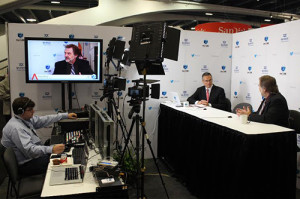
There’s a new business model in town for technology stalwart Oracle Corp., now based on the three layers of cloud: infrastructure as a service, platform as a service, and the company’s enormous portfolio, led by applications. In this new model, applications are what drive infrastructure, explained Dave Vellante in a deep analysis discussion with Stu Miniman, broadcasting live from theCUBE’s QLogic studio at Oracle OpenWorld 2014.
“Most infrastructure companies start by building a platform, a solution. Oracle starts with an application,” Miniman stated, pointing out that Oracle was the first converged infrastructure company in the market and remains in a great position for this sector.
The company’s messaging at this week’s event is heavy on cloud messaging, analytics, and Hadoop. “Oracle’s messaging might be a couple years behind the bleeding edge,” Miniman said, going on to note that it’s the sweet spot for adoption for most companies, which is perfect for Oracle’s huge install base.
Commenting on Oracle founder and Chairman Larry Ellison’s past statements about the cloud being little more than vapor, Vellante explained that the point of that statement was the cloud is still in the datacenters — it’s storage, microprocessors and databases. “The cloud is really a business model,” Vellante emphasized, and Oracle is now starting to recognize it as revenue. “They’re running now at almost $2 billion a year in cloud revenue,” he added.
Looking comparitively at a cloud rival’s business model, Amazon.com Inc’s strategy to “bring your own software” is a way for the company to strong-arm software companies to be in the Amazon Marketplace. “Oracle does not want to sell software in the Amazon marketplace if they don’t have to,” explained Vellante, saying Oracle wants it purchased on top of their own platform.
Forgot Password
Almost there!
We just sent you a verification email. Please verify your account to gain access to
Oracle OpenWorld 2014 - Studio QLogic | San Francisco. If you don’t think you received an email check your
spam folder.
Sign in to Oracle OpenWorld 2014 - Studio QLogic | San Francisco.
In order to sign in, enter the email address you used to registered for the event. Once completed, you will receive an email with a verification link. Open this link to automatically sign into the site.
Register For Oracle OpenWorld 2014 - Studio QLogic | San Francisco
Please fill out the information below. You will recieve an email with a verification link confirming your registration. Click the link to automatically sign into the site.
You’re almost there!
We just sent you a verification email. Please click the verification button in the email. Once your email address is verified, you will have full access to all event content for Oracle OpenWorld 2014 - Studio QLogic | San Francisco.
I want my badge and interests to be visible to all attendees.
Checking this box will display your presense on the attendees list, view your profile and allow other attendees to contact you via 1-1 chat. Read the Privacy Policy. At any time, you can choose to disable this preference.
Select your Interests!
add
Upload your photo
Uploading..
OR
Connect via Twitter
Connect via Linkedin
EDIT PASSWORD
Share
Forgot Password
Almost there!
We just sent you a verification email. Please verify your account to gain access to
Oracle OpenWorld 2014 - Studio QLogic | San Francisco. If you don’t think you received an email check your
spam folder.
Sign in to Oracle OpenWorld 2014 - Studio QLogic | San Francisco.
In order to sign in, enter the email address you used to registered for the event. Once completed, you will receive an email with a verification link. Open this link to automatically sign into the site.
Sign in to gain access to Oracle OpenWorld 2014 - Studio QLogic | San Francisco
Please sign in with LinkedIn to continue to Oracle OpenWorld 2014 - Studio QLogic | San Francisco. Signing in with LinkedIn ensures a professional environment.
Are you sure you want to remove access rights for this user?
Details
Manage Access
email address
Community Invitation
Analysis, Day 1 - Oracle OpenWorld 2014 - theCUBE Studio QLogic
Analysis, Day 1, at Oracle OpenWorld 2014 with Dave Vellante and Jeff Kelly
@theCUBE
#*OOW14*
There’s a new business model in town for technology stalwart Oracle Corp., now based on the three layers of cloud: infrastructure as a service, platform as a service, and the company’s enormous portfolio, led by applications. In this new model, applications are what drive infrastructure, explained Dave Vellante in a deep analysis discussion with Stu Miniman, broadcasting live from theCUBE’s QLogic studio at Oracle OpenWorld 2014.
“Most infrastructure companies start by building a platform, a solution. Oracle starts with an application,” Miniman stated, pointing out that Oracle was the first converged infrastructure company in the market and remains in a great position for this sector.
The company’s messaging at this week’s event is heavy on cloud messaging, analytics, and Hadoop. “Oracle’s messaging might be a couple years behind the bleeding edge,” Miniman said, going on to note that it’s the sweet spot for adoption for most companies, which is perfect for Oracle’s huge install base.
Commenting on Oracle founder and Chairman Larry Ellison’s past statements about the cloud being little more than vapor, Vellante explained that the point of that statement was the cloud is still in the datacenters — it’s storage, microprocessors and databases. “The cloud is really a business model,” Vellante emphasized, and Oracle is now starting to recognize it as revenue. “They’re running now at almost $2 billion a year in cloud revenue,” he added.
Looking comparitively at a cloud rival’s business model, Amazon.com Inc’s strategy to “bring your own software” is a way for the company to strong-arm software companies to be in the Amazon Marketplace. “Oracle does not want to sell software in the Amazon marketplace if they don’t have to,” explained Vellante, saying Oracle wants it purchased on top of their own platform.