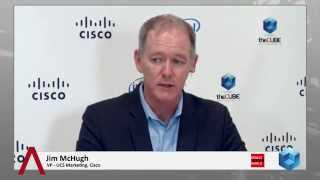
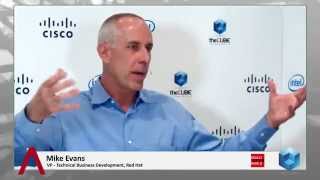
Shannon Poulin, Intel, and Jim McHugh, Cisco, at Oracle OpenWorld 2014 with John Furrier and Jeff Frick
@theCUBE
#*OOW14*
*CiscoUCS*
As Oracle Corp. shifts its focus to the cloud, its partners Cisco Systems Inc. and Intel Corp. provide invaluable support: Oracle runs on Cisco’s Unified Computing System (UCS), which is powered by Intel’s Xeon processor. Jim McHugh, VP of UCS Marketing at Cisco, and Intel’s VP and GM of Data Center Marketing and Enterprise IT, Shannon Poulin, see the Oracle OpenWorld conference as an event that reinforces cloud as a viable business option.
Poulin described Oracle’s strategy as a “culmination approach” in which the company helps its customers get where they want to go through a diverse range of software options and cloud functionality.
Cisco’s UCS is a something of a lynchpin: it brings together compute, storage, and networking in one integrated infrastructure. As a top provider of x86 blades, McHugh explained that because Cisco “caught the market at a transition,” it was able to become the number two leader in this market. McHugh attributes Cisco’s success to the fact that the company “did things slightly different” and was able to disrupt the market.
Why Cisco and Intel innovate on multiple levels
Cisco’s “engineering approach” to business keeps them working on both the hardware and software levels. Poulin explained that by working on “different levels, you’re going to capture more customers.” Especially as methods of consumption have shifted towards cloud, companies need to adapt to new environments and figure out how to remain competitive. In this day and age, Poulin said, being competitive means offering “mobile apps, maybe a multi-tenant environment on infrastructure that has the capability to accelerate different types of workloads.”
At present, McHugh said there’s still a “trade off with being agile enough with your infrastructure…and having something that’s driven to what the needs of the applications are.” For McHugh, it makes sense to have the “application tied to the platform, tied to the infrastructure underneath.” This approach, Furrier pointed out, drives DevOps and architecture.
Xeon sets standards
Because the two companies had congruent road maps and long histories of innovation, McHugh explained that when it came to Cisco’s UCS product, Intel was their first choice partner. Cisco, he said, was able to provide more value to their customers by focusing on Intel as their sole partner.
Xeon is such an integral part of UCS because it “enables a bunch of solutions that can it on top of [Intel] products,” according to Poulin. In order to deploy new technologies and support orchestration solutions Intel needed to ensure that Xeon could run at its “the absolute fastest” in any environment, whether it’s VMware, OpenStack, or Microsoft. To accomplish this, Poulin explained, Intel made “enhancements to the architecture itself.”
Read more after the video.
.
.
Biggest trends in the database
Turning their discussion to customers, Poulin said that he has noticed that as IT departments are asked to innovate without an increased budget, they turn to private clouds for a cost-efficient solution. Turning to cloud environments, he pointed out, is also a response to legacy business units requesting “more flexibility” from their infrastructure.
McHugh chimed in, adding that the tech industry is rethinking what a datacenter is. Data centers are essential to “all mobile apps” and need to function at “cloud scale” for Hadoop deployments. What McHugh says he sees throughout the industry, is a “spread out” of the data center.
Forgot Password
Almost there!
We just sent you a verification email. Please verify your account to gain access to
Oracle OpenWorld 2014 | San Francisco. If you don’t think you received an email check your
spam folder.
In order to sign in, enter the email address you used to registered for the event. Once completed, you will receive an email with a verification link. Open this link to automatically sign into the site.
Register For Oracle OpenWorld 2014 | San Francisco
Please fill out the information below. You will recieve an email with a verification link confirming your registration. Click the link to automatically sign into the site.
You’re almost there!
We just sent you a verification email. Please click the verification button in the email. Once your email address is verified, you will have full access to all event content for Oracle OpenWorld 2014 | San Francisco.
I want my badge and interests to be visible to all attendees.
Checking this box will display your presense on the attendees list, view your profile and allow other attendees to contact you via 1-1 chat. Read the Privacy Policy. At any time, you can choose to disable this preference.
Select your Interests!
add
Upload your photo
Uploading..
OR
Connect via Twitter
Connect via Linkedin
EDIT PASSWORD
Share
Forgot Password
Almost there!
We just sent you a verification email. Please verify your account to gain access to
Oracle OpenWorld 2014 | San Francisco. If you don’t think you received an email check your
spam folder.
In order to sign in, enter the email address you used to registered for the event. Once completed, you will receive an email with a verification link. Open this link to automatically sign into the site.
Sign in to gain access to Oracle OpenWorld 2014 | San Francisco
Please sign in with LinkedIn to continue to Oracle OpenWorld 2014 | San Francisco. Signing in with LinkedIn ensures a professional environment.
Are you sure you want to remove access rights for this user?
Details
Manage Access
email address
Community Invitation
Shannon Poulin & Jim McHugh - Oracle OpenWorld 2014 - theCUBE Studio Cisco
Shannon Poulin, Intel, and Jim McHugh, Cisco, at Oracle OpenWorld 2014 with John Furrier and Jeff Frick
@theCUBE
#*OOW14*
*CiscoUCS*
As Oracle Corp. shifts its focus to the cloud, its partners Cisco Systems Inc. and Intel Corp. provide invaluable support: Oracle runs on Cisco’s Unified Computing System (UCS), which is powered by Intel’s Xeon processor. Jim McHugh, VP of UCS Marketing at Cisco, and Intel’s VP and GM of Data Center Marketing and Enterprise IT, Shannon Poulin, see the Oracle OpenWorld conference as an event that reinforces cloud as a viable business option.
Poulin described Oracle’s strategy as a “culmination approach” in which the company helps its customers get where they want to go through a diverse range of software options and cloud functionality.
Cisco’s UCS is a something of a lynchpin: it brings together compute, storage, and networking in one integrated infrastructure. As a top provider of x86 blades, McHugh explained that because Cisco “caught the market at a transition,” it was able to become the number two leader in this market. McHugh attributes Cisco’s success to the fact that the company “did things slightly different” and was able to disrupt the market.
Why Cisco and Intel innovate on multiple levels
Cisco’s “engineering approach” to business keeps them working on both the hardware and software levels. Poulin explained that by working on “different levels, you’re going to capture more customers.” Especially as methods of consumption have shifted towards cloud, companies need to adapt to new environments and figure out how to remain competitive. In this day and age, Poulin said, being competitive means offering “mobile apps, maybe a multi-tenant environment on infrastructure that has the capability to accelerate different types of workloads.”
At present, McHugh said there’s still a “trade off with being agile enough with your infrastructure…and having something that’s driven to what the needs of the applications are.” For McHugh, it makes sense to have the “application tied to the platform, tied to the infrastructure underneath.” This approach, Furrier pointed out, drives DevOps and architecture.
Xeon sets standards
Because the two companies had congruent road maps and long histories of innovation, McHugh explained that when it came to Cisco’s UCS product, Intel was their first choice partner. Cisco, he said, was able to provide more value to their customers by focusing on Intel as their sole partner.
Xeon is such an integral part of UCS because it “enables a bunch of solutions that can it on top of [Intel] products,” according to Poulin. In order to deploy new technologies and support orchestration solutions Intel needed to ensure that Xeon could run at its “the absolute fastest” in any environment, whether it’s VMware, OpenStack, or Microsoft. To accomplish this, Poulin explained, Intel made “enhancements to the architecture itself.”
Read more after the video.
.
.
Biggest trends in the database
Turning their discussion to customers, Poulin said that he has noticed that as IT departments are asked to innovate without an increased budget, they turn to private clouds for a cost-efficient solution. Turning to cloud environments, he pointed out, is also a response to legacy business units requesting “more flexibility” from their infrastructure.
McHugh chimed in, adding that the tech industry is rethinking what a datacenter is. Data centers are essential to “all mobile apps” and need to function at “cloud scale” for Hadoop deployments. What McHugh says he sees throughout the industry, is a “spread out” of the data center.