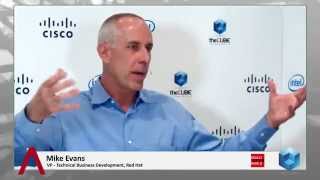
Ron Zapar, Re-Quest, at Oracle OpenWorld 2014 with Dave Vellante and David Floyer
@theCUBE
#OOW14
Converged appliances offer to do away with the colossal hassle of cobbling together different infrastructure components into a cohesive and functioning whole, thereby freeing up a proportionally large chunk of the technology budget for CIOs. The flip side of the equation is that the systems integrators typically contracted to carry out the work are seeing with less and less demand for their core services, but that trend doesn’t seem to concern Re-Quest Inc. CEO Ron Zapar all that much.
Appearing on SiliconANGLE’s theCUBE at Oracle OpenWorld 2014 last week (see full interview below), the executive told hosts Dave Vellante and David Floyer that the new way of deploying enterprise infrastructure is conducive rather than disruptive to his firm’s long-term goals. And it’s been positioning accordingly from the very outset of the phenomenon.
When Oracle Corp. started working on its converged appliance series following the $7.3 billion acquisition of Sun Microsystems Inc. in 2009, Re-Quest was one the select few consultancy partners to have been chosen to participate in the development process. The 23-year-old systems integrator provided valuable input that helped shape the final product, which it’s now actively pitching to customers as a way of streamlining deployment and management while cutting costs.
Less complexity translates into a reduced need for professional services like the kind Re-Quest offers, but according to Zapar, the trade-off is more than worthwhile. “In order for us to be competitive in the marketplace with some of the global providers of services, we have to be leaner and leaner. So have to be able to do it better, faster and more predictability,” he said. Embracing converged infrastructure enabled the firm to achieve exactly that.
Massive improvements
.
Earlier this year, Re-Quest partook in a Wikibon study that found the pre-integrated Oracle Database Appliance, or ODA for short, offers double-digit improvements over white-box deployments put together from scratch in both cost and setup time. In the case studies examined as part of the survey, customers had to spend an average of $700,000 to install ODA with a third party application operating on top. compared with $1.2 million for a custom architecture running the same software.
Additionally, it took only one week to bring the app online on ODA, less than a third of the 23 days that the organizations which opted to take the DIY approach had to wait until they could start putting their investments to use. And that’s just the beginning.
“When you’re buying an application as an end-user, you’re not really buying the technology that lives underneath it, but you have to and you have to think about the cost of acquisition and the cost of management. So you look at the capital expenditure initially, then the operating expense,” Zapar explained.
.
.
Ongoing value
Since Oracle licenses its database based on the total number of cores available in the customer’s environment, organizations typically find themselves paying for considerably more software than they use. At $70,000 per copy, that’s something CIOs would rather void, which Zapar said ODA makes enables.
The $60,000 appliance consists of two 14-core servers packing a combined capacity of 18 terabytes and a complete Oracle stack extending from the BIOS all the way up to the database. Assuming a high-availability RAC configuration, that adds up to $980,000 in licensing costs, but Zapar highlighted that a customer only has to pay that much in the event they’re using the full processing capacity of the appliance.
Forgot Password
Almost there!
We just sent you a verification email. Please verify your account to gain access to
Oracle OpenWorld 2014 | San Francisco. If you don’t think you received an email check your
spam folder.
In order to sign in, enter the email address you used to registered for the event. Once completed, you will receive an email with a verification link. Open this link to automatically sign into the site.
Register For Oracle OpenWorld 2014 | San Francisco
Please fill out the information below. You will recieve an email with a verification link confirming your registration. Click the link to automatically sign into the site.
You’re almost there!
We just sent you a verification email. Please click the verification button in the email. Once your email address is verified, you will have full access to all event content for Oracle OpenWorld 2014 | San Francisco.
I want my badge and interests to be visible to all attendees.
Checking this box will display your presense on the attendees list, view your profile and allow other attendees to contact you via 1-1 chat. Read the Privacy Policy. At any time, you can choose to disable this preference.
Select your Interests!
add
Upload your photo
Uploading..
OR
Connect via Twitter
Connect via Linkedin
EDIT PASSWORD
Share
Forgot Password
Almost there!
We just sent you a verification email. Please verify your account to gain access to
Oracle OpenWorld 2014 | San Francisco. If you don’t think you received an email check your
spam folder.
In order to sign in, enter the email address you used to registered for the event. Once completed, you will receive an email with a verification link. Open this link to automatically sign into the site.
Sign in to gain access to Oracle OpenWorld 2014 | San Francisco
Please sign in with LinkedIn to continue to Oracle OpenWorld 2014 | San Francisco. Signing in with LinkedIn ensures a professional environment.
Are you sure you want to remove access rights for this user?
Details
Manage Access
email address
Community Invitation
Ron Zapar - Oracle OpenWorld 2014 - theCUBE Studio QLogic
Ron Zapar, Re-Quest, at Oracle OpenWorld 2014 with Dave Vellante and David Floyer
@theCUBE
#OOW14
Converged appliances offer to do away with the colossal hassle of cobbling together different infrastructure components into a cohesive and functioning whole, thereby freeing up a proportionally large chunk of the technology budget for CIOs. The flip side of the equation is that the systems integrators typically contracted to carry out the work are seeing with less and less demand for their core services, but that trend doesn’t seem to concern Re-Quest Inc. CEO Ron Zapar all that much.
Appearing on SiliconANGLE’s theCUBE at Oracle OpenWorld 2014 last week (see full interview below), the executive told hosts Dave Vellante and David Floyer that the new way of deploying enterprise infrastructure is conducive rather than disruptive to his firm’s long-term goals. And it’s been positioning accordingly from the very outset of the phenomenon.
When Oracle Corp. started working on its converged appliance series following the $7.3 billion acquisition of Sun Microsystems Inc. in 2009, Re-Quest was one the select few consultancy partners to have been chosen to participate in the development process. The 23-year-old systems integrator provided valuable input that helped shape the final product, which it’s now actively pitching to customers as a way of streamlining deployment and management while cutting costs.
Less complexity translates into a reduced need for professional services like the kind Re-Quest offers, but according to Zapar, the trade-off is more than worthwhile. “In order for us to be competitive in the marketplace with some of the global providers of services, we have to be leaner and leaner. So have to be able to do it better, faster and more predictability,” he said. Embracing converged infrastructure enabled the firm to achieve exactly that.
Massive improvements
.
Earlier this year, Re-Quest partook in a Wikibon study that found the pre-integrated Oracle Database Appliance, or ODA for short, offers double-digit improvements over white-box deployments put together from scratch in both cost and setup time. In the case studies examined as part of the survey, customers had to spend an average of $700,000 to install ODA with a third party application operating on top. compared with $1.2 million for a custom architecture running the same software.
Additionally, it took only one week to bring the app online on ODA, less than a third of the 23 days that the organizations which opted to take the DIY approach had to wait until they could start putting their investments to use. And that’s just the beginning.
“When you’re buying an application as an end-user, you’re not really buying the technology that lives underneath it, but you have to and you have to think about the cost of acquisition and the cost of management. So you look at the capital expenditure initially, then the operating expense,” Zapar explained.
.
.
Ongoing value
Since Oracle licenses its database based on the total number of cores available in the customer’s environment, organizations typically find themselves paying for considerably more software than they use. At $70,000 per copy, that’s something CIOs would rather void, which Zapar said ODA makes enables.
The $60,000 appliance consists of two 14-core servers packing a combined capacity of 18 terabytes and a complete Oracle stack extending from the BIOS all the way up to the database. Assuming a high-availability RAC configuration, that adds up to $980,000 in licensing costs, but Zapar highlighted that a customer only has to pay that much in the event they’re using the full processing capacity of the appliance.