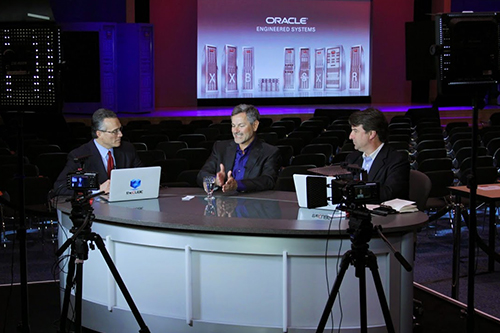
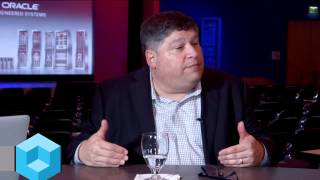
Aaron de Los Reyes, Cognizant, at Oracle Next Generation Engineered Systems Launch with John Furrier and Dave Vellante
@theCUBE
#datacenter
With the rise of cloud services, it has become rather difficult to justify buying a traditional on-premise appliance when the same functionality is available from an outside provider at a fraction of the cost. For many smaller companies, the refrigerator-sized systems that the likes of Oracle make their living selling aren’t even on the table in the first place.
But for deep-pocketed global enterprises with decades worth of existing infrastructure investments to sustain, including relational databases and other mission-critical software from Larry Ellison’s firm, that’s often the best option. Aaron de Los Reyes of Cognizant Technology Solutions Inc. dropped by theCUBE recently to share his insights on how switching to Oracle’s newly-refreshed converged appliances series helped his company streamline operations.
With over 200,000 workers spread across more than 100 countries, Cognizant is among the largest system integrators in the world. But the bragging rights come at the cost of supporting that presence, which until a few years ago required the company’s operations team to maintain some 200 aging P-Series blade servers from IBM.
Since Cognizant bought the machines in 2003, its business has expanded more than tenfold, growth that de Los Reyes explained the legacy environment simply couldn’t accommodate. But when the operations team started looking at modernizing the deployment around 2010, it evaluated the newer systems in IBM’s portfolio and decided that they offered only a marginal improvement over their existing machines.
Cognizant settled on converged appliances from Oracle. The company took a rather unusual approach to the upgrade, starting with the middleware stack underlying its environment to establish the groundwork before moving its human resources management software onto the new appliances and then adding more production workloads.
“We did it exactly the way most don’t,” de Los Reyes summarized. “We run over 40 modules of PeopleSoft. Playing around with that back-end database is not where you want to start, so the middle[ware] tier – which is the same Java runtime across all of PeopleSoft – is a very logical place. And in a weird way, [advancing directly to] production was also logical, because it all had to be highly uniform.”
Over time, Cognizant also migrated its financial applications, customer relationship management system and learning environment onto the new appliances. The size and capacity of each appliance allows the company to run a much bigger load on each node than it could with its IBM-made blade servers, which de Los Reyes said enabled his company to cut the number of machines in its deployment by over 90 percent to just 10.
Cognizant also reduced the associated labor costs in the process, he added, shifting half of its PeopleSoft administrators to roles where they can make a more active contribution to the bottom line. But the company is only at the start of its modernization journey. According to de Los Reyes, it plans to realign its entire operations around the converged systems to remove the legacy silos that still remain in some corners of the network.
“In the beginning, this was about getting all the engineered systems up and co-existing with what was already there,” the executive reflected. “Now it’s about truly synthesizing them together, so you can have one true platform to have a more push-button atmosphere – and then integrate with cloud services.”
Forgot Password
Almost there!
We just sent you a verification email. Please verify your account to gain access to
Oracle Next Gen Engineered Systems Launch 2015 | Redwood City. If you don’t think you received an email check your
spam folder.
Sign in to Oracle Next Gen Engineered Systems Launch 2015 | Redwood City.
In order to sign in, enter the email address you used to registered for the event. Once completed, you will receive an email with a verification link. Open this link to automatically sign into the site.
Register For Oracle Next Gen Engineered Systems Launch 2015 | Redwood City
Please fill out the information below. You will recieve an email with a verification link confirming your registration. Click the link to automatically sign into the site.
You’re almost there!
We just sent you a verification email. Please click the verification button in the email. Once your email address is verified, you will have full access to all event content for Oracle Next Gen Engineered Systems Launch 2015 | Redwood City.
I want my badge and interests to be visible to all attendees.
Checking this box will display your presense on the attendees list, view your profile and allow other attendees to contact you via 1-1 chat. Read the Privacy Policy. At any time, you can choose to disable this preference.
Select your Interests!
add
Upload your photo
Uploading..
OR
Connect via Twitter
Connect via Linkedin
EDIT PASSWORD
Share
Forgot Password
Almost there!
We just sent you a verification email. Please verify your account to gain access to
Oracle Next Gen Engineered Systems Launch 2015 | Redwood City. If you don’t think you received an email check your
spam folder.
Sign in to Oracle Next Gen Engineered Systems Launch 2015 | Redwood City.
In order to sign in, enter the email address you used to registered for the event. Once completed, you will receive an email with a verification link. Open this link to automatically sign into the site.
Sign in to gain access to Oracle Next Gen Engineered Systems Launch 2015 | Redwood City
Please sign in with LinkedIn to continue to Oracle Next Gen Engineered Systems Launch 2015 | Redwood City. Signing in with LinkedIn ensures a professional environment.
Are you sure you want to remove access rights for this user?
Details
Manage Access
email address
Community Invitation
Aaron de Los Reyes - Oracle Next Generation Engineered Systems Launch - theCUBE
Aaron de Los Reyes, Cognizant, at Oracle Next Generation Engineered Systems Launch with John Furrier and Dave Vellante
@theCUBE
#datacenter
With the rise of cloud services, it has become rather difficult to justify buying a traditional on-premise appliance when the same functionality is available from an outside provider at a fraction of the cost. For many smaller companies, the refrigerator-sized systems that the likes of Oracle make their living selling aren’t even on the table in the first place.
But for deep-pocketed global enterprises with decades worth of existing infrastructure investments to sustain, including relational databases and other mission-critical software from Larry Ellison’s firm, that’s often the best option. Aaron de Los Reyes of Cognizant Technology Solutions Inc. dropped by theCUBE recently to share his insights on how switching to Oracle’s newly-refreshed converged appliances series helped his company streamline operations.
With over 200,000 workers spread across more than 100 countries, Cognizant is among the largest system integrators in the world. But the bragging rights come at the cost of supporting that presence, which until a few years ago required the company’s operations team to maintain some 200 aging P-Series blade servers from IBM.
Since Cognizant bought the machines in 2003, its business has expanded more than tenfold, growth that de Los Reyes explained the legacy environment simply couldn’t accommodate. But when the operations team started looking at modernizing the deployment around 2010, it evaluated the newer systems in IBM’s portfolio and decided that they offered only a marginal improvement over their existing machines.
Cognizant settled on converged appliances from Oracle. The company took a rather unusual approach to the upgrade, starting with the middleware stack underlying its environment to establish the groundwork before moving its human resources management software onto the new appliances and then adding more production workloads.
“We did it exactly the way most don’t,” de Los Reyes summarized. “We run over 40 modules of PeopleSoft. Playing around with that back-end database is not where you want to start, so the middle[ware] tier – which is the same Java runtime across all of PeopleSoft – is a very logical place. And in a weird way, [advancing directly to] production was also logical, because it all had to be highly uniform.”
Over time, Cognizant also migrated its financial applications, customer relationship management system and learning environment onto the new appliances. The size and capacity of each appliance allows the company to run a much bigger load on each node than it could with its IBM-made blade servers, which de Los Reyes said enabled his company to cut the number of machines in its deployment by over 90 percent to just 10.
Cognizant also reduced the associated labor costs in the process, he added, shifting half of its PeopleSoft administrators to roles where they can make a more active contribution to the bottom line. But the company is only at the start of its modernization journey. According to de Los Reyes, it plans to realign its entire operations around the converged systems to remove the legacy silos that still remain in some corners of the network.
“In the beginning, this was about getting all the engineered systems up and co-existing with what was already there,” the executive reflected. “Now it’s about truly synthesizing them together, so you can have one true platform to have a more push-button atmosphere – and then integrate with cloud services.”