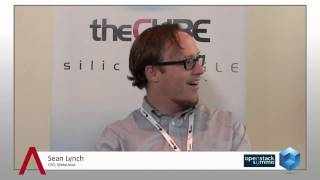
Joshua McKenty of Piston Cloud, takes a seat inside theCUBE
at Openstack, with SiliconAngle's John Furrier and Jeff Fick.
#theCUBE #OpenStack #SiliconANGLE #PistonCloud
Here is a cool fact for you: the original version of OpenStack was published on Joshua McKenty’s blog. When OpenStack launched Nova, there were some 6,000 lines of code. OpenStack now has over 1.25 million lines, and some 200 man years of work invested into the platform. With no better person to discuss the history and success of OpenStack, Joshua McKenty – CTO, Piston Cloud and Board Member of OpenStack, stopped by theCUBE at OpenStack Summit this week to discuss OpenStack and the #CloudWars with co-hosts John Furrier – Founder, SiliconANGLE and Jeff Frick – theCUBE.
McKenty sees the current #CloudWars as the private cloud vendors and public cloud operators. In simpler language, Amazon vs. OpenStack. And he likes how OpenStack stacks up against AWS (Amazon Web Services). They are close to 80 percent interoperability and have a very sound governance.
“I think we iterated faster on our governance than we did our code,” McKenty says. In its beginnings, OpenStack original goal was creating an infrastructure layer to make the application developers happy. Software-defined data centers/everything. An OpenStack and open source world is a software-defined world.
If you ever doubted that theCUBE was live, Furrier dismantled that doubt when he took some real-time questions from Twitter, asking McKenty to give an OpenStack 101:
ONE community
TWO kinds of clouds (Public, Private)
THREE kinds of interfaces (commanand, web dashboard, program API)
FOUR kinds of resources (2 storage, 2 virtual)
FIVE actors (vendors, operators, auditors, users, end users)
I wanted to briefly cover the backstory of how OpenStack started, because I think it’s very cool. McKenty and his team at NASA were trying to build a solution that basically let people on the outside do what NASA was doing internally, without having to let them tunnel through NASA’s firewall. When they first met the team at Rackspace to go over what each were building, in his words, “It was like meeting your long-lost twin.” They were both on the exact same page at the exact same time and shared the same mission, vision and execution.
OpenStack allows the application developers to do amazing things on top of the software-defined infrastructure. The most disruptive industry because of OpenStack? Storage, according to McKenty. “Storage is terrified right now. Storage is a giant baston of proprietary software.”
Stay tunned to our coverage of OpenStack throughout the rest of the week, because, as McKenty points out, you’re going to see some web scale SaaS companies coming off AWS and to OpenStack. (Furrier chimes in that he’s see companies save 8x from switching from Oracle or VMWare licenses to OpenStack)
The guys ended the interview asking what should CIO’s tooling up for the modern era in the cloud know?
“With software-defined data centers the biggest thing is cultural change. DevOps culture change. They only own the operations side, and they’ve jealousy guarded it,” McKenty says. A parting question: How do you really change how your operators change? The evolution of Big Data and the Cloud makes the rearranging of musical chairs can’t miss entertainment. Oh and by the way, it’s pretty important to your bottom line too.
Forgot Password
Almost there!
We just sent you a verification email. Please verify your account to gain access to
OpenStack Summit 2013 | Portland. If you don’t think you received an email check your
spam folder.
In order to sign in, enter the email address you used to registered for the event. Once completed, you will receive an email with a verification link. Open this link to automatically sign into the site.
Register For OpenStack Summit 2013 | Portland
Please fill out the information below. You will recieve an email with a verification link confirming your registration. Click the link to automatically sign into the site.
You’re almost there!
We just sent you a verification email. Please click the verification button in the email. Once your email address is verified, you will have full access to all event content for OpenStack Summit 2013 | Portland.
I want my badge and interests to be visible to all attendees.
Checking this box will display your presense on the attendees list, view your profile and allow other attendees to contact you via 1-1 chat. Read the Privacy Policy. At any time, you can choose to disable this preference.
Select your Interests!
add
Upload your photo
Uploading..
OR
Connect via Twitter
Connect via Linkedin
EDIT PASSWORD
Share
Forgot Password
Almost there!
We just sent you a verification email. Please verify your account to gain access to
OpenStack Summit 2013 | Portland. If you don’t think you received an email check your
spam folder.
In order to sign in, enter the email address you used to registered for the event. Once completed, you will receive an email with a verification link. Open this link to automatically sign into the site.
Sign in to gain access to OpenStack Summit 2013 | Portland
Please sign in with LinkedIn to continue to OpenStack Summit 2013 | Portland. Signing in with LinkedIn ensures a professional environment.
Joshua McKenty of Piston Cloud, takes a seat inside theCUBE
at Openstack, with SiliconAngle's John Furrier and Jeff Fick.
#theCUBE #OpenStack #SiliconANGLE #PistonCloud
Here is a cool fact for you: the original version of OpenStack was published on Joshua McKenty’s blog. When OpenStack launched Nova, there were some 6,000 lines of code. OpenStack now has over 1.25 million lines, and some 200 man years of work invested into the platform. With no better person to discuss the history and success of OpenStack, Joshua McKenty – CTO, Piston Cloud and Board Member of OpenStack, stopped by theCUBE at OpenStack Summit this week to discuss OpenStack and the #CloudWars with co-hosts John Furrier – Founder, SiliconANGLE and Jeff Frick – theCUBE.
McKenty sees the current #CloudWars as the private cloud vendors and public cloud operators. In simpler language, Amazon vs. OpenStack. And he likes how OpenStack stacks up against AWS (Amazon Web Services). They are close to 80 percent interoperability and have a very sound governance.
“I think we iterated faster on our governance than we did our code,” McKenty says. In its beginnings, OpenStack original goal was creating an infrastructure layer to make the application developers happy. Software-defined data centers/everything. An OpenStack and open source world is a software-defined world.
If you ever doubted that theCUBE was live, Furrier dismantled that doubt when he took some real-time questions from Twitter, asking McKenty to give an OpenStack 101:
ONE community
TWO kinds of clouds (Public, Private)
THREE kinds of interfaces (commanand, web dashboard, program API)
FOUR kinds of resources (2 storage, 2 virtual)
FIVE actors (vendors, operators, auditors, users, end users)
I wanted to briefly cover the backstory of how OpenStack started, because I think it’s very cool. McKenty and his team at NASA were trying to build a solution that basically let people on the outside do what NASA was doing internally, without having to let them tunnel through NASA’s firewall. When they first met the team at Rackspace to go over what each were building, in his words, “It was like meeting your long-lost twin.” They were both on the exact same page at the exact same time and shared the same mission, vision and execution.
OpenStack allows the application developers to do amazing things on top of the software-defined infrastructure. The most disruptive industry because of OpenStack? Storage, according to McKenty. “Storage is terrified right now. Storage is a giant baston of proprietary software.”
Stay tunned to our coverage of OpenStack throughout the rest of the week, because, as McKenty points out, you’re going to see some web scale SaaS companies coming off AWS and to OpenStack. (Furrier chimes in that he’s see companies save 8x from switching from Oracle or VMWare licenses to OpenStack)
The guys ended the interview asking what should CIO’s tooling up for the modern era in the cloud know?
“With software-defined data centers the biggest thing is cultural change. DevOps culture change. They only own the operations side, and they’ve jealousy guarded it,” McKenty says. A parting question: How do you really change how your operators change? The evolution of Big Data and the Cloud makes the rearranging of musical chairs can’t miss entertainment. Oh and by the way, it’s pretty important to your bottom line too.