Bringing flexibility and heterogeneity to enterprise platforms | #OpenStackSV
by Brittany Greaner | Aug 10, 2016
With 70 percent growth in the past year and offices in five different countries, it’s fair to say that Puppet, Inc. is doing well.
“We’ve been doing this so long that we know what problems we’re solving, what customers need our services and how to market those services,” said Luke Kanies, CEO of Puppet, Inc. The major two problems they solve are helping customers acquire situational awareness and control of the systems.
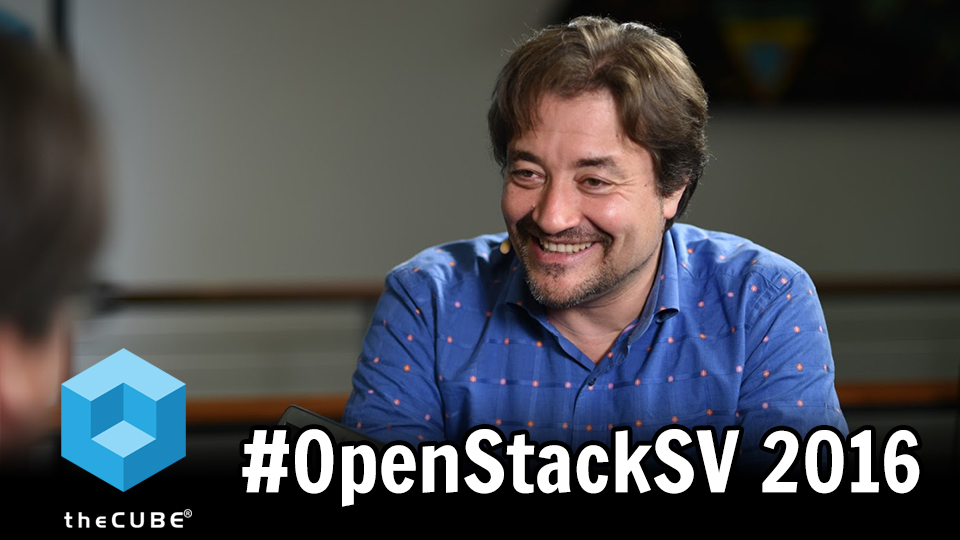
Kanies was interviewed by John Furrier (@furrier) and Lisa Martin (@Luccazara), hosts of theCUBE, from the SiliconANGLE Media team, during OpenStack Days at the Computer History Museum in Mountain View, CA.
Flexibility and heterogeneity are key, as no enterprise has just one platform and they all have to be integrated. “We help you manage whatever you have with common language, common tools,” said Kanies.
Every organization has different stacks that they’ve built, and while many of them would like to automate the process as much as possible, it’s impossible without that critical understanding of how their systems work. This is why awareness is so important. “We’ve been hearing from enterprises that it can take up to six weeks to get answers from their support team, but if they’ve got Puppet running it takes less than a day, with the exact same questions,” added Kanies.
Cultivating little risks
One methodology Kanies advocates is putting a little “peanut butter” over the whole platform instead of expanding all at once. This allows an organization to test out little changes over the whole system that can be tested with little risk. After doing so and having established a basic idea of what works and what doesn’t work, an organization can take bigger, more calculated risks.
It’s also important to perform tests in an environment as realistic as possible, which unfortunately is something that many tests don’t take into consideration. If a change is tested in a completely different environment from actual deployment, the site could very well crash or a team could only have 24 hours to do a massive overall, leaving a shaken system and unhappy customers.
Overall, Kanies said he’s excited about the future, as the industry is slowly learning it doesn’t have to compete all the time but can instead partner and learn from each other.
Forgot Password
Almost there!
We just sent you a verification email. Please verify your account to gain access to
OpenStack Days Silicon Valley 2016 | Mountain View. If you don’t think you received an email check your
spam folder.
Sign in to OpenStack Days Silicon Valley 2016 | Mountain View.
In order to sign in, enter the email address you used to registered for the event. Once completed, you will receive an email with a verification link. Open this link to automatically sign into the site.
Register For OpenStack Days Silicon Valley 2016 | Mountain View
Please fill out the information below. You will recieve an email with a verification link confirming your registration. Click the link to automatically sign into the site.
You’re almost there!
We just sent you a verification email. Please click the verification button in the email. Once your email address is verified, you will have full access to all event content for OpenStack Days Silicon Valley 2016 | Mountain View.
I want my badge and interests to be visible to all attendees.
Checking this box will display your presense on the attendees list, view your profile and allow other attendees to contact you via 1-1 chat. Read the Privacy Policy. At any time, you can choose to disable this preference.
Select your Interests!
add
Upload your photo
Uploading..
OR
Connect via Twitter
Connect via Linkedin
EDIT PASSWORD
Share
Forgot Password
Almost there!
We just sent you a verification email. Please verify your account to gain access to
OpenStack Days Silicon Valley 2016 | Mountain View. If you don’t think you received an email check your
spam folder.
Sign in to OpenStack Days Silicon Valley 2016 | Mountain View.
In order to sign in, enter the email address you used to registered for the event. Once completed, you will receive an email with a verification link. Open this link to automatically sign into the site.
Sign in to gain access to OpenStack Days Silicon Valley 2016 | Mountain View
Please sign in with LinkedIn to continue to OpenStack Days Silicon Valley 2016 | Mountain View. Signing in with LinkedIn ensures a professional environment.
Are you sure you want to remove access rights for this user?
Details
Manage Access
email address
Community Invitation
Luke Kanies, Puppet | OpenStack SV 2016
Bringing flexibility and heterogeneity to enterprise platforms | #OpenStackSV
by Brittany Greaner | Aug 10, 2016
With 70 percent growth in the past year and offices in five different countries, it’s fair to say that Puppet, Inc. is doing well.
“We’ve been doing this so long that we know what problems we’re solving, what customers need our services and how to market those services,” said Luke Kanies, CEO of Puppet, Inc. The major two problems they solve are helping customers acquire situational awareness and control of the systems.
Kanies was interviewed by John Furrier (@furrier) and Lisa Martin (@Luccazara), hosts of theCUBE, from the SiliconANGLE Media team, during OpenStack Days at the Computer History Museum in Mountain View, CA.
Flexibility and heterogeneity are key, as no enterprise has just one platform and they all have to be integrated. “We help you manage whatever you have with common language, common tools,” said Kanies.
Every organization has different stacks that they’ve built, and while many of them would like to automate the process as much as possible, it’s impossible without that critical understanding of how their systems work. This is why awareness is so important. “We’ve been hearing from enterprises that it can take up to six weeks to get answers from their support team, but if they’ve got Puppet running it takes less than a day, with the exact same questions,” added Kanies.
Cultivating little risks
One methodology Kanies advocates is putting a little “peanut butter” over the whole platform instead of expanding all at once. This allows an organization to test out little changes over the whole system that can be tested with little risk. After doing so and having established a basic idea of what works and what doesn’t work, an organization can take bigger, more calculated risks.
It’s also important to perform tests in an environment as realistic as possible, which unfortunately is something that many tests don’t take into consideration. If a change is tested in a completely different environment from actual deployment, the site could very well crash or a team could only have 24 hours to do a massive overall, leaving a shaken system and unhappy customers.
Overall, Kanies said he’s excited about the future, as the industry is slowly learning it doesn’t have to compete all the time but can instead partner and learn from each other.