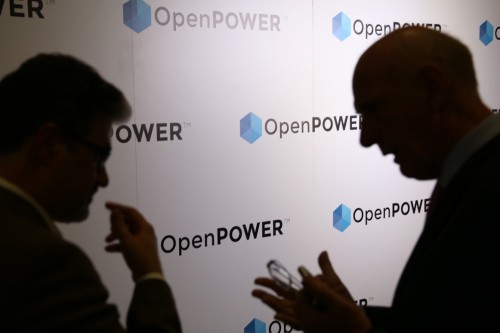
The future of problem solving with deep learning | #OpenPOWERSummit
by R. Danes | Apr 22, 2016
Bringing together silicon and software is what the conversation is about around OpenPOWER. Today’s application architects love the breathing room that open-source software gives them, and IBM thinks all in IT are going to welcome the “opening” of hardware.
John Ashley, senior IBM software developer relations manager at NVIDIA Corp., told David Floyer (@dfloyer), cohost of theCUBE, from the SiliconANGLE Media team, that there are still developers who want to do all the dirty work themselves, and for them, IBM still offers the low level tools. But, he said, “For a lot of other developers, they may not be all that interested in being developers; they’re interested in solving some other problem.”
The later type, he said will be happy with some of IBM’s new processors that provide agility at a deep level of the stack. “We get down into the weeds and code that stuff up to be maximally efficient and fast, ” he said.
New potential for deep learning
Ashley said that the new processors are solving part of the deep learning process, and this will enable more use-cases for deep learning to develop.
“It’s not just about deciding whether a picture is a cat or a person,” he said. “There’s a lot of really fundamental science and business problems that are being attacked that way. I think you’re starting to see the fruits of that showing up here.”
@theCUBE
#OpenPOWERSummit
Forgot Password
Almost there!
We just sent you a verification email. Please verify your account to gain access to
OpenPOWER Summit 2016 | San Jose. If you don’t think you received an email check your
spam folder.
In order to sign in, enter the email address you used to registered for the event. Once completed, you will receive an email with a verification link. Open this link to automatically sign into the site.
Register For OpenPOWER Summit 2016 | San Jose
Please fill out the information below. You will recieve an email with a verification link confirming your registration. Click the link to automatically sign into the site.
You’re almost there!
We just sent you a verification email. Please click the verification button in the email. Once your email address is verified, you will have full access to all event content for OpenPOWER Summit 2016 | San Jose.
I want my badge and interests to be visible to all attendees.
Checking this box will display your presense on the attendees list, view your profile and allow other attendees to contact you via 1-1 chat. Read the Privacy Policy. At any time, you can choose to disable this preference.
Select your Interests!
add
Upload your photo
Uploading..
OR
Connect via Twitter
Connect via Linkedin
EDIT PASSWORD
Share
Forgot Password
Almost there!
We just sent you a verification email. Please verify your account to gain access to
OpenPOWER Summit 2016 | San Jose. If you don’t think you received an email check your
spam folder.
In order to sign in, enter the email address you used to registered for the event. Once completed, you will receive an email with a verification link. Open this link to automatically sign into the site.
Sign in to gain access to OpenPOWER Summit 2016 | San Jose
Please sign in with LinkedIn to continue to OpenPOWER Summit 2016 | San Jose. Signing in with LinkedIn ensures a professional environment.
Are you sure you want to remove access rights for this user?
Details
Manage Access
email address
Community Invitation
John Ashley, IBM | OpenPOWER Summit 2016
The future of problem solving with deep learning | #OpenPOWERSummit
by R. Danes | Apr 22, 2016
Bringing together silicon and software is what the conversation is about around OpenPOWER. Today’s application architects love the breathing room that open-source software gives them, and IBM thinks all in IT are going to welcome the “opening” of hardware.
John Ashley, senior IBM software developer relations manager at NVIDIA Corp., told David Floyer (@dfloyer), cohost of theCUBE, from the SiliconANGLE Media team, that there are still developers who want to do all the dirty work themselves, and for them, IBM still offers the low level tools. But, he said, “For a lot of other developers, they may not be all that interested in being developers; they’re interested in solving some other problem.”
The later type, he said will be happy with some of IBM’s new processors that provide agility at a deep level of the stack. “We get down into the weeds and code that stuff up to be maximally efficient and fast, ” he said.
New potential for deep learning
Ashley said that the new processors are solving part of the deep learning process, and this will enable more use-cases for deep learning to develop.
“It’s not just about deciding whether a picture is a cat or a person,” he said. “There’s a lot of really fundamental science and business problems that are being attacked that way. I think you’re starting to see the fruits of that showing up here.”
@theCUBE
#OpenPOWERSummit