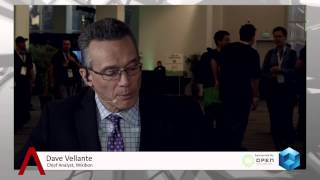
Thomas Sohmers, REX Computing, at Open Compute Summit V (2014) with John Furrier and Dave Vellante
@thecube
#OCPSummit
It's not everyday that theCUBE co-hosts get to interview teenagers, but for this edition at the Open Compute Project Summit in San Jose, California, John Furrier and Dave Vellante had the chance to catch up with Thomas Sohmers, CEO and founder of REX Computing, not to mention a genuine wunderkind.
Last year Sohmers received a two-year, $100,000 fellowship from the Thiel Foundation ("20 under 20″) just to pursue his interests and... drop out of school.
It was his third time applying, and he focused on high-performance computing and "reducing the costs and the energy needs." As soon as he received his fellowship he started his own company.
The early, early years
Furrier stressed on the commoditization of journalism and publishing: "the information flow is the new normal," you don't need to go to linear school, you can just use MOOC. "People can move at such different paces," pondered Furrier.
"It was kind of a surreal experience for the first couple of days," remembers Sohmers. "But prior to receiving the scholarship I had been working at MIT for over three years."
With a self-employed mom who had her own desk publishing business, Sohmers had unlimited access to computers from an early age and he just fell in love with them. At around the age of seven his dad gave him his first electronics kit, and Thomas found it pretty amazing that a bunch of components which couldn't do anything on their own could be made into something entirely new. At that point, he already knew what he wanted to do with his life.
The product he designed is following the current trends: it is low power and sporting multi-cores. He originally had this idea back in the MIT days.
The fun of evolution
"What do you see as breakthrough?" asked Vellante.
"In the evolution process from a fun project to a company, we were fascinated with the ARM processors and what you could do with a bunch of wimpy cores. That evolved into what we're doing today, which is utilizing co-processors to get the performance boost against the conventional Intel processor when doing high-performances computing tasks," explained Sohmers.
He proceeded to show the viewers a development board called Parallella by Adapteva, which has a dual-core ARM cortex A9 processor with an integrated FPGA, but the really good part about it was, in Sohmers' opinion, the 16 core co-processor which can get about 30 GFLOPS while using about 2 Watts of electricity. "That is beating the Intel CPU performance per Watt," boasted Sohmers.
"How long til these things will take over the data center?" inquired Vellante.
"We came here with a prototype we put together in about three weeks; we filled it up with these boards and we are using it as a development platform because we wanted to test the software waters. There's the open computer hackathon going on here right now and we're giving them access to these boards, systems and our rack. Development for ARM and co-processors is difficult because companies do not want to port software. We are looking at some new ways to ease development of highly-scalable systems and utilizing co-processors," said Sohmers.
Entrepreneur vs. high school
"Is being an entrepreneur what you thought it would be?" asked Furrier.
"I feel like I'm contributing something to society by building something and creating value of some sort. It's a lot more than I would be doing if I were still in high school," admitted Sohmers.
Talking about education, Furrier said that, in his opinion, education is completely broken and asked Sohmers what he thinks is the best path possible for education in the future.
"Many schools know creativity is good, but they try to structure it into a mold. That may be detrimental to society," thinks Sohmers.
Forgot Password
Almost there!
We just sent you a verification email. Please verify your account to gain access to
Open Compute Project Summit | 2014 San Jose. If you don’t think you received an email check your
spam folder.
Sign in to Open Compute Project Summit | 2014 San Jose.
In order to sign in, enter the email address you used to registered for the event. Once completed, you will receive an email with a verification link. Open this link to automatically sign into the site.
Register For Open Compute Project Summit | 2014 San Jose
Please fill out the information below. You will recieve an email with a verification link confirming your registration. Click the link to automatically sign into the site.
You’re almost there!
We just sent you a verification email. Please click the verification button in the email. Once your email address is verified, you will have full access to all event content for Open Compute Project Summit | 2014 San Jose.
I want my badge and interests to be visible to all attendees.
Checking this box will display your presense on the attendees list, view your profile and allow other attendees to contact you via 1-1 chat. Read the Privacy Policy. At any time, you can choose to disable this preference.
Select your Interests!
add
Upload your photo
Uploading..
OR
Connect via Twitter
Connect via Linkedin
EDIT PASSWORD
Share
Forgot Password
Almost there!
We just sent you a verification email. Please verify your account to gain access to
Open Compute Project Summit | 2014 San Jose. If you don’t think you received an email check your
spam folder.
Sign in to Open Compute Project Summit | 2014 San Jose.
In order to sign in, enter the email address you used to registered for the event. Once completed, you will receive an email with a verification link. Open this link to automatically sign into the site.
Sign in to gain access to Open Compute Project Summit | 2014 San Jose
Please sign in with LinkedIn to continue to Open Compute Project Summit | 2014 San Jose. Signing in with LinkedIn ensures a professional environment.
Are you sure you want to remove access rights for this user?
Details
Manage Access
email address
Community Invitation
Thomas Sohmers, Rex Computing - Open Compute Summit V (2014) #theCUBE
Thomas Sohmers, REX Computing, at Open Compute Summit V (2014) with John Furrier and Dave Vellante
@thecube
#OCPSummit
It's not everyday that theCUBE co-hosts get to interview teenagers, but for this edition at the Open Compute Project Summit in San Jose, California, John Furrier and Dave Vellante had the chance to catch up with Thomas Sohmers, CEO and founder of REX Computing, not to mention a genuine wunderkind.
Last year Sohmers received a two-year, $100,000 fellowship from the Thiel Foundation ("20 under 20″) just to pursue his interests and... drop out of school.
It was his third time applying, and he focused on high-performance computing and "reducing the costs and the energy needs." As soon as he received his fellowship he started his own company.
The early, early years
Furrier stressed on the commoditization of journalism and publishing: "the information flow is the new normal," you don't need to go to linear school, you can just use MOOC. "People can move at such different paces," pondered Furrier.
"It was kind of a surreal experience for the first couple of days," remembers Sohmers. "But prior to receiving the scholarship I had been working at MIT for over three years."
With a self-employed mom who had her own desk publishing business, Sohmers had unlimited access to computers from an early age and he just fell in love with them. At around the age of seven his dad gave him his first electronics kit, and Thomas found it pretty amazing that a bunch of components which couldn't do anything on their own could be made into something entirely new. At that point, he already knew what he wanted to do with his life.
The product he designed is following the current trends: it is low power and sporting multi-cores. He originally had this idea back in the MIT days.
The fun of evolution
"What do you see as breakthrough?" asked Vellante.
"In the evolution process from a fun project to a company, we were fascinated with the ARM processors and what you could do with a bunch of wimpy cores. That evolved into what we're doing today, which is utilizing co-processors to get the performance boost against the conventional Intel processor when doing high-performances computing tasks," explained Sohmers.
He proceeded to show the viewers a development board called Parallella by Adapteva, which has a dual-core ARM cortex A9 processor with an integrated FPGA, but the really good part about it was, in Sohmers' opinion, the 16 core co-processor which can get about 30 GFLOPS while using about 2 Watts of electricity. "That is beating the Intel CPU performance per Watt," boasted Sohmers.
"How long til these things will take over the data center?" inquired Vellante.
"We came here with a prototype we put together in about three weeks; we filled it up with these boards and we are using it as a development platform because we wanted to test the software waters. There's the open computer hackathon going on here right now and we're giving them access to these boards, systems and our rack. Development for ARM and co-processors is difficult because companies do not want to port software. We are looking at some new ways to ease development of highly-scalable systems and utilizing co-processors," said Sohmers.
Entrepreneur vs. high school
"Is being an entrepreneur what you thought it would be?" asked Furrier.
"I feel like I'm contributing something to society by building something and creating value of some sort. It's a lot more than I would be doing if I were still in high school," admitted Sohmers.
Talking about education, Furrier said that, in his opinion, education is completely broken and asked Sohmers what he thinks is the best path possible for education in the future.
"Many schools know creativity is good, but they try to structure it into a mold. That may be detrimental to society," thinks Sohmers.