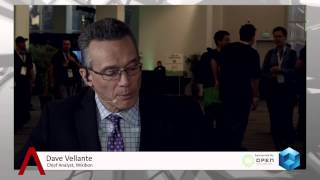
J.R. Rivers, Cumulus Networks, at Open Compute Summit V (2014) with John Furrier and Dave Vellante
@thecube
#OCPSummit
JR Rivers, the CEO at Cumulus Networks, discussed the company's new deal with Dell, and bare-metal networking trends with theCUBE co-hosts John Furrier and Dave Vellante, live from the Open Compute Project Summit in California.
Giving an update on Cumulus, Rivers mentioned a lot of customer interest and customer engagement all boils down to proven concepts. "The real interesting evolution or change in the industry," he says, which was just announced, was Dell's decision to open up their networking platform. This also led to the deal with Cumulus Linux on their networking platform solution.
The industry shift from proprietary to openness
Dell is trying to prove they are not about proprietary strategies, Rivers explained. Storage solutions from Dell come with included software, or allow customers to put in their own software. Networking was one of the only areas where the company took the proprietary software approach.
"The customers wanted to see Cumulus and Dell together and we made it happen," Rivers said. Citing a Wall Street Journal headline on Dell embracing bare-metal networking through the Cumulus deal, Furrier asked River to explain what that meant and whether bare-metal networking was fully differentiated from cloud.
Rivers said that in the context of networking there were a lot of little known name brands. "We separate that from what's called bare-metal networking. We'll offer that and you can put whatever software you want on it." Differentiation happens on both hardware quality and software solutions.
Rivers then noted that the two were "kind of mutually exclusive." As a consumer, "you should be able to go fill out a bill of materials and buy that hardware, then put software on top of it." In the context on bare-metal networking, one should expect the networking elements to be the same as storage -- buy it, get it from any supplier, and build the solution you need.
Other trends for Cumulus
Commenting on other developments besides the Dell deal, Rivers mentioned Cumulus currently has a number of "extremely large customers that we are working with, working towards production." The company also works with more smaller companies in private hosting, social media, and is currently tested by pharma and financial institutions.
Asked to compare VMware NSX and Cisco's Application Centric Initiative, Rivers said what matters is "the grip that any of those solutions has on the customer." vShpere allows them to build a data center and choose to run it on top but they can give up VMware at any time, they are not locked in at all. Cisco ACI comes with a vendor lock in.
Cumulus' strategy is to have "a platform that's open for people to orchestrate around in a meaningful way," that is a model that will be successful, Rivers explained, one that allows customers to mix and match the best solution.
Asked where the company was in terms of funding, Rivers said they have had a second round of investments which provided funds to last two-to-three years. The company has a "great set of investors, they believe in what we're doing."
Forgot Password
Almost there!
We just sent you a verification email. Please verify your account to gain access to
Open Compute Project Summit | 2014 San Jose. If you don’t think you received an email check your
spam folder.
Sign in to Open Compute Project Summit | 2014 San Jose.
In order to sign in, enter the email address you used to registered for the event. Once completed, you will receive an email with a verification link. Open this link to automatically sign into the site.
Register For Open Compute Project Summit | 2014 San Jose
Please fill out the information below. You will recieve an email with a verification link confirming your registration. Click the link to automatically sign into the site.
You’re almost there!
We just sent you a verification email. Please click the verification button in the email. Once your email address is verified, you will have full access to all event content for Open Compute Project Summit | 2014 San Jose.
I want my badge and interests to be visible to all attendees.
Checking this box will display your presense on the attendees list, view your profile and allow other attendees to contact you via 1-1 chat. Read the Privacy Policy. At any time, you can choose to disable this preference.
Select your Interests!
add
Upload your photo
Uploading..
OR
Connect via Twitter
Connect via Linkedin
EDIT PASSWORD
Share
Forgot Password
Almost there!
We just sent you a verification email. Please verify your account to gain access to
Open Compute Project Summit | 2014 San Jose. If you don’t think you received an email check your
spam folder.
Sign in to Open Compute Project Summit | 2014 San Jose.
In order to sign in, enter the email address you used to registered for the event. Once completed, you will receive an email with a verification link. Open this link to automatically sign into the site.
Sign in to gain access to Open Compute Project Summit | 2014 San Jose
Please sign in with LinkedIn to continue to Open Compute Project Summit | 2014 San Jose. Signing in with LinkedIn ensures a professional environment.
Are you sure you want to remove access rights for this user?
Details
Manage Access
email address
Community Invitation
J.R. Rivers, Cumulus Networks - Open Compute Summit V (2014) #theCUBE
J.R. Rivers, Cumulus Networks, at Open Compute Summit V (2014) with John Furrier and Dave Vellante
@thecube
#OCPSummit
JR Rivers, the CEO at Cumulus Networks, discussed the company's new deal with Dell, and bare-metal networking trends with theCUBE co-hosts John Furrier and Dave Vellante, live from the Open Compute Project Summit in California.
Giving an update on Cumulus, Rivers mentioned a lot of customer interest and customer engagement all boils down to proven concepts. "The real interesting evolution or change in the industry," he says, which was just announced, was Dell's decision to open up their networking platform. This also led to the deal with Cumulus Linux on their networking platform solution.
The industry shift from proprietary to openness
Dell is trying to prove they are not about proprietary strategies, Rivers explained. Storage solutions from Dell come with included software, or allow customers to put in their own software. Networking was one of the only areas where the company took the proprietary software approach.
"The customers wanted to see Cumulus and Dell together and we made it happen," Rivers said. Citing a Wall Street Journal headline on Dell embracing bare-metal networking through the Cumulus deal, Furrier asked River to explain what that meant and whether bare-metal networking was fully differentiated from cloud.
Rivers said that in the context of networking there were a lot of little known name brands. "We separate that from what's called bare-metal networking. We'll offer that and you can put whatever software you want on it." Differentiation happens on both hardware quality and software solutions.
Rivers then noted that the two were "kind of mutually exclusive." As a consumer, "you should be able to go fill out a bill of materials and buy that hardware, then put software on top of it." In the context on bare-metal networking, one should expect the networking elements to be the same as storage -- buy it, get it from any supplier, and build the solution you need.
Other trends for Cumulus
Commenting on other developments besides the Dell deal, Rivers mentioned Cumulus currently has a number of "extremely large customers that we are working with, working towards production." The company also works with more smaller companies in private hosting, social media, and is currently tested by pharma and financial institutions.
Asked to compare VMware NSX and Cisco's Application Centric Initiative, Rivers said what matters is "the grip that any of those solutions has on the customer." vShpere allows them to build a data center and choose to run it on top but they can give up VMware at any time, they are not locked in at all. Cisco ACI comes with a vendor lock in.
Cumulus' strategy is to have "a platform that's open for people to orchestrate around in a meaningful way," that is a model that will be successful, Rivers explained, one that allows customers to mix and match the best solution.
Asked where the company was in terms of funding, Rivers said they have had a second round of investments which provided funds to last two-to-three years. The company has a "great set of investors, they believe in what we're doing."