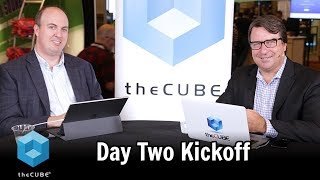
Ed Warnicke sits down with John Furrier & Stu Miniman at OpenSource Summit 2017 in Los Angeles, CA
#OSSummit #theCUBE
https://siliconangle.com/2017/09/13/open-source-tech-unites-networking-devops-ossummit/
Open-source tech unites networking and DevOps
In the tech world, innovation and new systems are great, but nothing moves unless the network can handle it. This truth makes networking very important for businesses, because a company can only be as agile as its network. Part of that agility comes from making the network easy to use. Open-source tech is coming to the rescue.
“The truth is, there’s a lot of work that goes into making the network invisible and ubiquitous for people,” said Ed Warnicke (pictured), distinguished consulting engineer at Cisco Systems Inc. “In particular, one of the challenges that we see arising as the world moves more cloud native, as the microservices get smaller, as the … the shift happens toward serverless, as Kubernetes [container orchestration management] is coming on with containers is that the network is really becoming the runtime, and that runtime has the need to scale and perform like it never has before.”
Warnicke spoke with John Furrier (@furrier) and Stu Miniman (@stu), co-hosts of theCUBE, SiliconANGLE’s mobile livestreaming studio, during the Open Source Summit in Los Angeles. They discussed networking and DevOps, new open-source tools and the need to scale out networks. (* Disclosure below.)
DevOps and NetOps need each other
When it comes to DevOps, the network infrastructure needs to be invisible, according to Warnicke. While DevOps does need certain things from the network, they don’t want to be bothered by the nitty-gritty details. That holds true for most network users. The network itself is becoming a runtime, and because of that, networking must perform and scale like never before, Warnicke added.
The network used to be a bottleneck when it came to building out systems. New tools, including open-source tech, are changing that. One of these is FD.io (pronounced “Fido”) — a Linux Foundation project — an extensible Input/Output services framework. Among other benefits, FD.io can be extended just by dropping plugins into a directory rather than rebuilding the system.
However, being able to look under the hood on the network is still very important, Warnicke stated. “The more invisible the network is, the more visibility you need when things go wrong,” he said.
While tools like FD.io can provide traditional visibility, developers have produced other innovative tools for networking. A tool that can trace in-bound network flow per customer is one example.
Because of this relationship between DevOps and networking, the network operations community also must reach out to the DevOps people, according to Warnicke. The network team needs to know what DevOps wants in order to write new code that’s useful to everyone.
“You have to make sure you’re supporting all the stuff that’s there, and you have to work to take advantage of new features in existing APIs [application program interface],” Warnicke concluded.
Watch the complete video interview below, and be sure to check out more of SiliconANGLE’s and theCUBE’s coverage of Open Source Summit 2017. (* Disclosure: TheCUBE is a paid media partner for Open Source Summit 2017. Neither The Linux Foundation nor Red Hat Inc. have editorial control over content on theCUBE or SiliconANGLE.)
Forgot Password
Almost there!
We just sent you a verification email. Please verify your account to gain access to
Open Source Summit 2017 | Los Angeles. If you don’t think you received an email check your
spam folder.
In order to sign in, enter the email address you used to registered for the event. Once completed, you will receive an email with a verification link. Open this link to automatically sign into the site.
Register For Open Source Summit 2017 | Los Angeles
Please fill out the information below. You will recieve an email with a verification link confirming your registration. Click the link to automatically sign into the site.
You’re almost there!
We just sent you a verification email. Please click the verification button in the email. Once your email address is verified, you will have full access to all event content for Open Source Summit 2017 | Los Angeles.
I want my badge and interests to be visible to all attendees.
Checking this box will display your presense on the attendees list, view your profile and allow other attendees to contact you via 1-1 chat. Read the Privacy Policy. At any time, you can choose to disable this preference.
Select your Interests!
add
Upload your photo
Uploading..
OR
Connect via Twitter
Connect via Linkedin
EDIT PASSWORD
Share
Forgot Password
Almost there!
We just sent you a verification email. Please verify your account to gain access to
Open Source Summit 2017 | Los Angeles. If you don’t think you received an email check your
spam folder.
In order to sign in, enter the email address you used to registered for the event. Once completed, you will receive an email with a verification link. Open this link to automatically sign into the site.
Sign in to gain access to Open Source Summit 2017 | Los Angeles
Please sign in with LinkedIn to continue to Open Source Summit 2017 | Los Angeles. Signing in with LinkedIn ensures a professional environment.
Are you sure you want to remove access rights for this user?
Details
Manage Access
email address
Community Invitation
Ed Warnicke, Cisco | Open Source Summit 2017
Ed Warnicke sits down with John Furrier & Stu Miniman at OpenSource Summit 2017 in Los Angeles, CA
#OSSummit #theCUBE
https://siliconangle.com/2017/09/13/open-source-tech-unites-networking-devops-ossummit/
Open-source tech unites networking and DevOps
In the tech world, innovation and new systems are great, but nothing moves unless the network can handle it. This truth makes networking very important for businesses, because a company can only be as agile as its network. Part of that agility comes from making the network easy to use. Open-source tech is coming to the rescue.
“The truth is, there’s a lot of work that goes into making the network invisible and ubiquitous for people,” said Ed Warnicke (pictured), distinguished consulting engineer at Cisco Systems Inc. “In particular, one of the challenges that we see arising as the world moves more cloud native, as the microservices get smaller, as the … the shift happens toward serverless, as Kubernetes [container orchestration management] is coming on with containers is that the network is really becoming the runtime, and that runtime has the need to scale and perform like it never has before.”
Warnicke spoke with John Furrier (@furrier) and Stu Miniman (@stu), co-hosts of theCUBE, SiliconANGLE’s mobile livestreaming studio, during the Open Source Summit in Los Angeles. They discussed networking and DevOps, new open-source tools and the need to scale out networks. (* Disclosure below.)
DevOps and NetOps need each other
When it comes to DevOps, the network infrastructure needs to be invisible, according to Warnicke. While DevOps does need certain things from the network, they don’t want to be bothered by the nitty-gritty details. That holds true for most network users. The network itself is becoming a runtime, and because of that, networking must perform and scale like never before, Warnicke added.
The network used to be a bottleneck when it came to building out systems. New tools, including open-source tech, are changing that. One of these is FD.io (pronounced “Fido”) — a Linux Foundation project — an extensible Input/Output services framework. Among other benefits, FD.io can be extended just by dropping plugins into a directory rather than rebuilding the system.
However, being able to look under the hood on the network is still very important, Warnicke stated. “The more invisible the network is, the more visibility you need when things go wrong,” he said.
While tools like FD.io can provide traditional visibility, developers have produced other innovative tools for networking. A tool that can trace in-bound network flow per customer is one example.
Because of this relationship between DevOps and networking, the network operations community also must reach out to the DevOps people, according to Warnicke. The network team needs to know what DevOps wants in order to write new code that’s useful to everyone.
“You have to make sure you’re supporting all the stuff that’s there, and you have to work to take advantage of new features in existing APIs [application program interface],” Warnicke concluded.
Watch the complete video interview below, and be sure to check out more of SiliconANGLE’s and theCUBE’s coverage of Open Source Summit 2017. (* Disclosure: TheCUBE is a paid media partner for Open Source Summit 2017. Neither The Linux Foundation nor Red Hat Inc. have editorial control over content on theCUBE or SiliconANGLE.)