Juniper plans to help companies break free with disaggregation | #NXTWORK
by Nelson Williams | Nov 3, 2015
The tech world has seen many changes in recent years, but one that too often goes unnoticed is that hardware and software are moving apart. It used to be that a company bought its systems from one vendor, ran that vendor’s applications and used that vendor’s services. Now, a business might build its stack from a dozen different sources. Breaking away from one-vendor solutions is the point of disaggregation, and the benefits can be great.
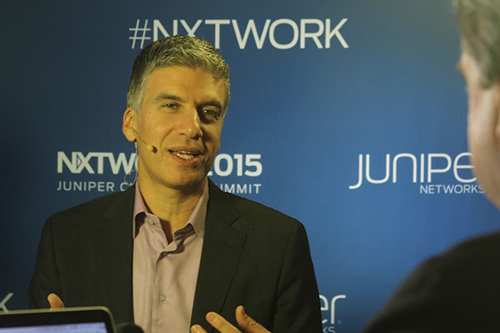
To shed some light on the disaggregation strategy, John Furrier and Stu Miniman, cohosts of theCUBE, from the SiliconANGLE Media team, sat down with Jonathan Davidson at the Juniper Networks NXTWORK 2015 conference. Davidson is the executive VP and GM of Development and Innovation at Juniper Networks, Inc.
End of an era
The discussion started off with a thought about the end of the client-server era. Davidson spoke about Juniper’s strategy for disaggregation. “We believe we are in the business of connectivity,” he said. The market, he explained, no longer wanted hardware and software to be so tightly coupled together. It all comes down to agility.
He continued, describing how from Juniper’s perspective, there’s a technology transformation, but also a business transformation. Customers want to be able to deploy Juniper’s products on any system, he said, but enabling that requires a change in how business does things.
Matching market trends
Certain classes of customers have their own integration teams and a different level of expectations than companies with smaller IT departments, Davidson said. A smaller company probably wants a turnkey solution, but if the customer wants to build their own system, they should be able to do that.
Things come down, Davidson said, to customers who own their applications and customers who buy their applications. How a business buys their network infrastructure depends on the applications they need to run. The ownership of apps controls everything about how networks are built and leads to different expectations about what the company’s tech people can do.
@theCUBE
#NXTWORK
Forgot Password
Almost there!
We just sent you a verification email. Please verify your account to gain access to
Juniper NXTWORK 2015 | Santa Clara. If you don’t think you received an email check your
spam folder.
In order to sign in, enter the email address you used to registered for the event. Once completed, you will receive an email with a verification link. Open this link to automatically sign into the site.
Register For Juniper NXTWORK 2015 | Santa Clara
Please fill out the information below. You will recieve an email with a verification link confirming your registration. Click the link to automatically sign into the site.
You’re almost there!
We just sent you a verification email. Please click the verification button in the email. Once your email address is verified, you will have full access to all event content for Juniper NXTWORK 2015 | Santa Clara.
I want my badge and interests to be visible to all attendees.
Checking this box will display your presense on the attendees list, view your profile and allow other attendees to contact you via 1-1 chat. Read the Privacy Policy. At any time, you can choose to disable this preference.
Select your Interests!
add
Upload your photo
Uploading..
OR
Connect via Twitter
Connect via Linkedin
EDIT PASSWORD
Share
Forgot Password
Almost there!
We just sent you a verification email. Please verify your account to gain access to
Juniper NXTWORK 2015 | Santa Clara. If you don’t think you received an email check your
spam folder.
In order to sign in, enter the email address you used to registered for the event. Once completed, you will receive an email with a verification link. Open this link to automatically sign into the site.
Sign in to gain access to Juniper NXTWORK 2015 | Santa Clara
Please sign in with LinkedIn to continue to Juniper NXTWORK 2015 | Santa Clara. Signing in with LinkedIn ensures a professional environment.
Are you sure you want to remove access rights for this user?
Details
Manage Access
email address
Community Invitation
Jonathan Davidson, Juniper Networks - #NXTWORK 2015 - #theCUBE
Juniper plans to help companies break free with disaggregation | #NXTWORK
by Nelson Williams | Nov 3, 2015
The tech world has seen many changes in recent years, but one that too often goes unnoticed is that hardware and software are moving apart. It used to be that a company bought its systems from one vendor, ran that vendor’s applications and used that vendor’s services. Now, a business might build its stack from a dozen different sources. Breaking away from one-vendor solutions is the point of disaggregation, and the benefits can be great.
To shed some light on the disaggregation strategy, John Furrier and Stu Miniman, cohosts of theCUBE, from the SiliconANGLE Media team, sat down with Jonathan Davidson at the Juniper Networks NXTWORK 2015 conference. Davidson is the executive VP and GM of Development and Innovation at Juniper Networks, Inc.
End of an era
The discussion started off with a thought about the end of the client-server era. Davidson spoke about Juniper’s strategy for disaggregation. “We believe we are in the business of connectivity,” he said. The market, he explained, no longer wanted hardware and software to be so tightly coupled together. It all comes down to agility.
He continued, describing how from Juniper’s perspective, there’s a technology transformation, but also a business transformation. Customers want to be able to deploy Juniper’s products on any system, he said, but enabling that requires a change in how business does things.
Matching market trends
Certain classes of customers have their own integration teams and a different level of expectations than companies with smaller IT departments, Davidson said. A smaller company probably wants a turnkey solution, but if the customer wants to build their own system, they should be able to do that.
Things come down, Davidson said, to customers who own their applications and customers who buy their applications. How a business buys their network infrastructure depends on the applications they need to run. The ownership of apps controls everything about how networks are built and leads to different expectations about what the company’s tech people can do.
@theCUBE
#NXTWORK