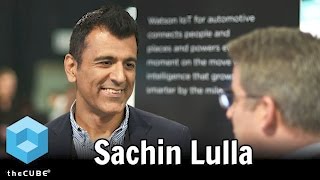
Danny Shapiro, Senior Director of Automotive. NVIDIA, talks with Jeff Frick at the North American International Auto Show (NAIAS) in Detroit, Michigan.
Leveraging the power of the GPU in the quest for driverless cars
https://siliconangle.com/2017/01/12/leveraging-power-gpu-quest-driverless-cars-naias/
Using the same graphic processors that make computer gaming so fun, Nvidia Corp. is working with more than 80 car makers to apply the chips’ massive processing power toward making driverless cars a reality.
During the 2017 North American International Auto Show in Detroit this week, Jeff Frick (@JeffFrick), host of theCUBE, SiliconANGLE Media’s mobile live streaming studio, spoke to Danny Shapiro, Nvidia’s senior director of automotive, about how the company’s graphics processing unit, or GPU, chips can also power the artificial intelligence needed for autonomous cars.
The brains behind AI
Founded more than 20 years ago, Nvidia developed video graphics chips for the personal computer gaming market with its invention of the GPU. In 2009, the company took its first big step into AI as it became apparent that GPUs’ massively parallel processing was ideal for crunching massive amounts of data crucial for the new generation of AI.
Shapiro explained the GPU chip technology by comparing it to central processing units such as Intel Corp.’s. If you think of chip cores as lanes on a highway, CPUs have only two or four lanes for the data or traffic to travel. GPUs have orders of magnitude more cores.
“Our cores count goes to thousands, so imagine a highway with 3,000 lanes,” he said. “How much data could you push through that, and that’s why we’re able to handle this mass amount of computation on a very small chip.”
From gaming to the car
Through GPU technology, Nvidia created a custom supercomputer for the car. It uses artificial intelligence in a product called Nvidia Drive PX 2, an open AI car-computing platform. Shapiro told Frick that this second edition is powering self-driving prototypes, as well as standard production vehicles.
According to Shapiro, Tesla Motors Inc.’s Model S is taking advantage of the Drive PX 2 technology. Additionally, adding a sensor array makes it possible to detect everything going on around the car, as it acts as the brain of the car.
“We are trying to track different objects, people, cars, buses, motorcycles, whatever,” he said. “We have a map, so we know where the roads go. We know where we are on those roads; then we can figure out and predict where the other vehicles are going to be to avoid them.”
This data collection enhances AI performance. Thanks to machine learning, there is no longer the need to write extensive recognition programs. The system can train itself through AI, enabling it to recognize street signs as well as other objects in the area.
Recently, Nvidia announced a continuation of the company’s partnership with Audi. “[We are] moving beyond graphics in the car to use artificial intelligence to put a Level 4 automated driving vehicle on the road, starting in 2020,” revealed Shapiro. Level 4 is one step below a completely driverless car. A Level 5 car has no one controlling it.
Shapiro believes the Drive PX 2 technology goes beyond cars and affects the $10 trillion transportation industry, from trucking to ride-sharing.
More than cars
The auto industry is a small vertical for Nvidia, but the underlying technology, the GPU and artificial intelligence, can be applied to many industries, such healthcare and financial services.
GPU deep learning is already being used for AI in the cloud at companies such as Amazon.com Inc., Google Inc., Netflix Inc. and Facebook Inc. “By [using] it, they’re developing solutions on the GPU, [using] that same core technology we apply to self-driving cars,” Shapiro said.
Watch the complete video interview below, and check out more of SiliconANGLE’s and theCUBE’s coverage of the North American International Auto Show.
#theCUBE #NVIDIA #NAIAS #SiliconANGLE @NVIDIA
Forgot Password
Almost there!
We just sent you a verification email. Please verify your account to gain access to
North American International Auto Show 2017 #NAIAS. If you don’t think you received an email check your
spam folder.
Sign in to North American International Auto Show 2017 #NAIAS.
In order to sign in, enter the email address you used to registered for the event. Once completed, you will receive an email with a verification link. Open this link to automatically sign into the site.
Register For North American International Auto Show 2017 #NAIAS
Please fill out the information below. You will recieve an email with a verification link confirming your registration. Click the link to automatically sign into the site.
You’re almost there!
We just sent you a verification email. Please click the verification button in the email. Once your email address is verified, you will have full access to all event content for North American International Auto Show 2017 #NAIAS.
I want my badge and interests to be visible to all attendees.
Checking this box will display your presense on the attendees list, view your profile and allow other attendees to contact you via 1-1 chat. Read the Privacy Policy. At any time, you can choose to disable this preference.
Select your Interests!
add
Upload your photo
Uploading..
OR
Connect via Twitter
Connect via Linkedin
EDIT PASSWORD
Share
Forgot Password
Almost there!
We just sent you a verification email. Please verify your account to gain access to
North American International Auto Show 2017 #NAIAS. If you don’t think you received an email check your
spam folder.
Sign in to North American International Auto Show 2017 #NAIAS.
In order to sign in, enter the email address you used to registered for the event. Once completed, you will receive an email with a verification link. Open this link to automatically sign into the site.
Sign in to gain access to North American International Auto Show 2017 #NAIAS
Please sign in with LinkedIn to continue to North American International Auto Show 2017 #NAIAS. Signing in with LinkedIn ensures a professional environment.
Are you sure you want to remove access rights for this user?
Details
Manage Access
email address
Community Invitation
Danny Shapiro, NVIDIA | North American International Auto Show (NAIAS) 2017
Danny Shapiro, Senior Director of Automotive. NVIDIA, talks with Jeff Frick at the North American International Auto Show (NAIAS) in Detroit, Michigan.
Leveraging the power of the GPU in the quest for driverless cars
https://siliconangle.com/2017/01/12/leveraging-power-gpu-quest-driverless-cars-naias/
Using the same graphic processors that make computer gaming so fun, Nvidia Corp. is working with more than 80 car makers to apply the chips’ massive processing power toward making driverless cars a reality.
During the 2017 North American International Auto Show in Detroit this week, Jeff Frick (@JeffFrick), host of theCUBE, SiliconANGLE Media’s mobile live streaming studio, spoke to Danny Shapiro, Nvidia’s senior director of automotive, about how the company’s graphics processing unit, or GPU, chips can also power the artificial intelligence needed for autonomous cars.
The brains behind AI
Founded more than 20 years ago, Nvidia developed video graphics chips for the personal computer gaming market with its invention of the GPU. In 2009, the company took its first big step into AI as it became apparent that GPUs’ massively parallel processing was ideal for crunching massive amounts of data crucial for the new generation of AI.
Shapiro explained the GPU chip technology by comparing it to central processing units such as Intel Corp.’s. If you think of chip cores as lanes on a highway, CPUs have only two or four lanes for the data or traffic to travel. GPUs have orders of magnitude more cores.
“Our cores count goes to thousands, so imagine a highway with 3,000 lanes,” he said. “How much data could you push through that, and that’s why we’re able to handle this mass amount of computation on a very small chip.”
From gaming to the car
Through GPU technology, Nvidia created a custom supercomputer for the car. It uses artificial intelligence in a product called Nvidia Drive PX 2, an open AI car-computing platform. Shapiro told Frick that this second edition is powering self-driving prototypes, as well as standard production vehicles.
According to Shapiro, Tesla Motors Inc.’s Model S is taking advantage of the Drive PX 2 technology. Additionally, adding a sensor array makes it possible to detect everything going on around the car, as it acts as the brain of the car.
“We are trying to track different objects, people, cars, buses, motorcycles, whatever,” he said. “We have a map, so we know where the roads go. We know where we are on those roads; then we can figure out and predict where the other vehicles are going to be to avoid them.”
This data collection enhances AI performance. Thanks to machine learning, there is no longer the need to write extensive recognition programs. The system can train itself through AI, enabling it to recognize street signs as well as other objects in the area.
Recently, Nvidia announced a continuation of the company’s partnership with Audi. “[We are] moving beyond graphics in the car to use artificial intelligence to put a Level 4 automated driving vehicle on the road, starting in 2020,” revealed Shapiro. Level 4 is one step below a completely driverless car. A Level 5 car has no one controlling it.
Shapiro believes the Drive PX 2 technology goes beyond cars and affects the $10 trillion transportation industry, from trucking to ride-sharing.
More than cars
The auto industry is a small vertical for Nvidia, but the underlying technology, the GPU and artificial intelligence, can be applied to many industries, such healthcare and financial services.
GPU deep learning is already being used for AI in the cloud at companies such as Amazon.com Inc., Google Inc., Netflix Inc. and Facebook Inc. “By [using] it, they’re developing solutions on the GPU, [using] that same core technology we apply to self-driving cars,” Shapiro said.
Watch the complete video interview below, and check out more of SiliconANGLE’s and theCUBE’s coverage of the North American International Auto Show.
#theCUBE #NVIDIA #NAIAS #SiliconANGLE @NVIDIA