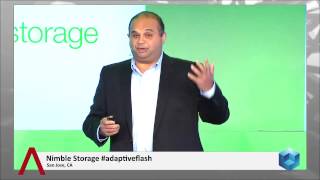
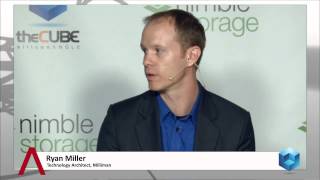
Suresh Vasudevan, Nimble Storage, with John Furrier and Stu Miniman at Nimble Adaptive Flash Launch - (2014)
@thecube
Some organizations hire wave-making “superstars” without considering their effect on a business’ team atmosphere. Nimble Storage is not that type of organization, said CEO Suresh Vasudevan, when he stopped by theCUBE during the Nimble Storage Adaptive Flash Platform launch event. Their collaborative, “no jerks” company culture has helped Nimble Storage continue to provide innovative product offerings in a tumultuous storage market.
Responding to host John Furrier’s question about whether massive changes in the storage market confuse customers, Vasudevan spoke to the huge variety of choices with which customers are now faced. He cautioned, though, that while there seem to be a plethora of startups in the storage market– “forty, fifty startups in just the last three or four years–” their ability to stay in business varies drastically: “of the fifty, only five will survive.”
Amidst the rapid change, Vasudevan commented, business priorities also confused customers:
“It was growth at all costs.” Recently though, Vasudevan explained that he has been seeing the market try to find a way to deliver “hyper growth” without sacrificing “operating leverage” or “a sustainable business model.” He credits part of Nimble Storage’s current success to the fact that they’ve always “held dear” all three of the business concepts.
Nimble Storage’s Adaptive Flash Platform
June 11th marked the product launch of Nimble Storage’s newest product offering, an Adaptive Flash Storage Platform. This new platform’s main strength, Vasudevan said, is it’s ability to blend “performance and capacity.” “The architecture,” he said, “is built to flexibly deliver” what the application needs to perform the customer’s workloads most efficiently. He described the product as a “high-end version” of their platform that offers “performance that rivals mainstream flash arrays,” so clients can “scale out faster.” It’s also “extremely cost-effective for storage capacity.” Indeed, Vasudevan said, the “breadth of the platform” allows it to “address any workload.” It offers the “performance of all flash drives with the price of hybrid.”
Why Compression rather than Deduplication?
Responding to host Stu Miniman’s question about why Nimble Storage decided against using deduplication, Vasudevan explained why he thinks compression and provision are adequate:
1. “The new system doesn’t address object storage” and so, “with 10 snapshots we’re solving the same problem that deduplicated backups do.”
2. “In the case of server farms, typically you can use zero-copy cloning to deliver the benefits that dedupe does.”
.
The typical benefit that dedupe delivers, says Vasudevan, is about 20-35 percent. He doesn’t consider that benefit high enough to “go after dedupe specifically because [Nimble Storage] systems deliver very high performance using low-cost drives.”
That was the “underpinning” Vasudevan says his company wrestled with: “given that we were already using low-cost drives, we would have to spend a lot on memory to maintain the dedupe hash tables and the savings are going to be 20-30 percent so they don’t cost-justify.”
With more Flash, dedupe is inevitable
Vasudevan was sure to call out, though, that “as you start to evolve toward systems that have very high Flash content,” deduplication becomes necessary. It’s a question of cost: “If you’re going to spend more on memory to facilitate deduplication, more one CPU — at what point does the underlying media-cost reduction justify that extra expense?”
Forgot Password
Almost there!
We just sent you a verification email. Please verify your account to gain access to
Nimble Storage Adaptive Flash Launch 2014 | San Jose. If you don’t think you received an email check your
spam folder.
Sign in to Nimble Storage Adaptive Flash Launch 2014 | San Jose.
In order to sign in, enter the email address you used to registered for the event. Once completed, you will receive an email with a verification link. Open this link to automatically sign into the site.
Register For Nimble Storage Adaptive Flash Launch 2014 | San Jose
Please fill out the information below. You will recieve an email with a verification link confirming your registration. Click the link to automatically sign into the site.
You’re almost there!
We just sent you a verification email. Please click the verification button in the email. Once your email address is verified, you will have full access to all event content for Nimble Storage Adaptive Flash Launch 2014 | San Jose.
I want my badge and interests to be visible to all attendees.
Checking this box will display your presense on the attendees list, view your profile and allow other attendees to contact you via 1-1 chat. Read the Privacy Policy. At any time, you can choose to disable this preference.
Select your Interests!
add
Upload your photo
Uploading..
OR
Connect via Twitter
Connect via Linkedin
EDIT PASSWORD
Share
Forgot Password
Almost there!
We just sent you a verification email. Please verify your account to gain access to
Nimble Storage Adaptive Flash Launch 2014 | San Jose. If you don’t think you received an email check your
spam folder.
Sign in to Nimble Storage Adaptive Flash Launch 2014 | San Jose.
In order to sign in, enter the email address you used to registered for the event. Once completed, you will receive an email with a verification link. Open this link to automatically sign into the site.
Sign in to gain access to Nimble Storage Adaptive Flash Launch 2014 | San Jose
Please sign in with LinkedIn to continue to Nimble Storage Adaptive Flash Launch 2014 | San Jose. Signing in with LinkedIn ensures a professional environment.
Suresh Vasudevan, Nimble Storage, with John Furrier and Stu Miniman at Nimble Adaptive Flash Launch - (2014)
@thecube
Some organizations hire wave-making “superstars” without considering their effect on a business’ team atmosphere. Nimble Storage is not that type of organization, said CEO Suresh Vasudevan, when he stopped by theCUBE during the Nimble Storage Adaptive Flash Platform launch event. Their collaborative, “no jerks” company culture has helped Nimble Storage continue to provide innovative product offerings in a tumultuous storage market.
Responding to host John Furrier’s question about whether massive changes in the storage market confuse customers, Vasudevan spoke to the huge variety of choices with which customers are now faced. He cautioned, though, that while there seem to be a plethora of startups in the storage market– “forty, fifty startups in just the last three or four years–” their ability to stay in business varies drastically: “of the fifty, only five will survive.”
Amidst the rapid change, Vasudevan commented, business priorities also confused customers:
“It was growth at all costs.” Recently though, Vasudevan explained that he has been seeing the market try to find a way to deliver “hyper growth” without sacrificing “operating leverage” or “a sustainable business model.” He credits part of Nimble Storage’s current success to the fact that they’ve always “held dear” all three of the business concepts.
Nimble Storage’s Adaptive Flash Platform
June 11th marked the product launch of Nimble Storage’s newest product offering, an Adaptive Flash Storage Platform. This new platform’s main strength, Vasudevan said, is it’s ability to blend “performance and capacity.” “The architecture,” he said, “is built to flexibly deliver” what the application needs to perform the customer’s workloads most efficiently. He described the product as a “high-end version” of their platform that offers “performance that rivals mainstream flash arrays,” so clients can “scale out faster.” It’s also “extremely cost-effective for storage capacity.” Indeed, Vasudevan said, the “breadth of the platform” allows it to “address any workload.” It offers the “performance of all flash drives with the price of hybrid.”
Why Compression rather than Deduplication?
Responding to host Stu Miniman’s question about why Nimble Storage decided against using deduplication, Vasudevan explained why he thinks compression and provision are adequate:
1. “The new system doesn’t address object storage” and so, “with 10 snapshots we’re solving the same problem that deduplicated backups do.”
2. “In the case of server farms, typically you can use zero-copy cloning to deliver the benefits that dedupe does.”
.
The typical benefit that dedupe delivers, says Vasudevan, is about 20-35 percent. He doesn’t consider that benefit high enough to “go after dedupe specifically because [Nimble Storage] systems deliver very high performance using low-cost drives.”
That was the “underpinning” Vasudevan says his company wrestled with: “given that we were already using low-cost drives, we would have to spend a lot on memory to maintain the dedupe hash tables and the savings are going to be 20-30 percent so they don’t cost-justify.”
With more Flash, dedupe is inevitable
Vasudevan was sure to call out, though, that “as you start to evolve toward systems that have very high Flash content,” deduplication becomes necessary. It’s a question of cost: “If you’re going to spend more on memory to facilitate deduplication, more one CPU — at what point does the underlying media-cost reduction justify that extra expense?”