Exploring trust in AI-driven operations, Bob Friday, Chief AI Officer at HPE Networking, joins Bob Laliberte, principal analyst at theCUBE Research, at the Networking for AI Summit. Friday uses the analogy of self-driving cars to explain how enterprises are progressing through stages of automation on the road to fully self-driving networks. He details the shift from reactive IT operations to proactive, AI-assisted approaches and the importance of building confidence in automation step by step.
Friday talks about how HPE Networking is enabling self-driving networks with AI assistants like Marvis, robust telemetry, and agentic AI to deliver proactive fixes and improved user experiences. Friday highlights the launch of Marvis Actions 2.0 and explains how feedback loops, audit logs, and user experience metrics are central to building trust in autonomous operations. He also underscores the role of senior IT experts in refining AI models and ensuring that automation delivers tangible improvements in accuracy and reliability.
Looking ahead, Friday shares why he believes the industry is nearing a tipping point, with agentic AI and the HPE-Juniper combination accelerating progress toward fully autonomous networking. For enterprises, this evolution promises more time for strategic initiatives, simplified operations, and scalable AI adoption at the infrastructure level.
Forgot Password
Almost there!
We just sent you a verification email. Please verify your account to gain access to
The Networking for AI Summit. If you don’t think you received an email check your
spam folder.
In order to sign in, enter the email address you used to registered for the event. Once completed, you will receive an email with a verification link. Open the link to automatically sign into the site.
Register for Networking for AI Summit
Please fill out the information below. You will receive an email with a verification link confirming your registration. Click the link to automatically sign into the site.
You’re almost there!
We just sent you a verification email. Please click the verification button in the email. Once your email address is verified, you will have full access to all event content for Networking for AI Summit.
I want my badge and interests to be visible to all attendees.
Checking this box will display your presense on the attendees list, view your profile and allow other attendees to contact you via 1-1 chat. Read the Privacy Policy. At any time, you can choose to disable this preference.
Select your Interests!
add
Upload your photo
Uploading..
OR
Connect via Twitter
Connect via Linkedin
EDIT PASSWORD
Share
Forgot Password
Almost there!
We just sent you a verification email. Please verify your account to gain access to
The Networking for AI Summit. If you don’t think you received an email check your
spam folder.
In order to sign in, enter the email address you used to registered for the event. Once completed, you will receive an email with a verification link. Open the link to automatically sign into the site.
Sign in to gain access to The Networking for AI Summit
Please sign in with LinkedIn to continue to The Networking for AI Summit. Signing in with LinkedIn ensures a professional environment.
Are you sure you want to remove access rights for this user?
Details
Manage Access
email address
Community Invitation
Bob Friday, HPE Networking
Exploring trust in AI-driven operations, Bob Friday, Chief AI Officer at HPE Networking, joins Bob Laliberte, principal analyst at theCUBE Research, at the Networking for AI Summit. Friday uses the analogy of self-driving cars to explain how enterprises are progressing through stages of automation on the road to fully self-driving networks. He details the shift from reactive IT operations to proactive, AI-assisted approaches and the importance of building confidence in automation step by step.
Friday talks about how HPE Networking is enabling self-driving networks with AI assistants like Marvis, robust telemetry, and agentic AI to deliver proactive fixes and improved user experiences. Friday highlights the launch of Marvis Actions 2.0 and explains how feedback loops, audit logs, and user experience metrics are central to building trust in autonomous operations. He also underscores the role of senior IT experts in refining AI models and ensuring that automation delivers tangible improvements in accuracy and reliability.
Looking ahead, Friday shares why he believes the industry is nearing a tipping point, with agentic AI and the HPE-Juniper combination accelerating progress toward fully autonomous networking. For enterprises, this evolution promises more time for strategic initiatives, simplified operations, and scalable AI adoption at the infrastructure level.
Group VP, Chief AI Officer; CTO EnterpriseHPE Networking
Exploring trust in AI-driven operations, Bob Friday, Chief AI Officer at HPE Networking, joins Bob Laliberte, principal analyst at theCUBE Research, at the Networking for AI Summit. Friday uses the analogy of self-driving cars to explain how enterprises are progressing through stages of automation on the road to fully self-driving networks. He details the shift from reactive IT operations to proactive, AI-assisted approaches and the importance of building confidence in automation step by step.
Friday talks about how HPE Networking is enabling self-driv...Read more
exploreKeep Exploring
What role is HPE networking expected to play in the development of self-driving networks?add
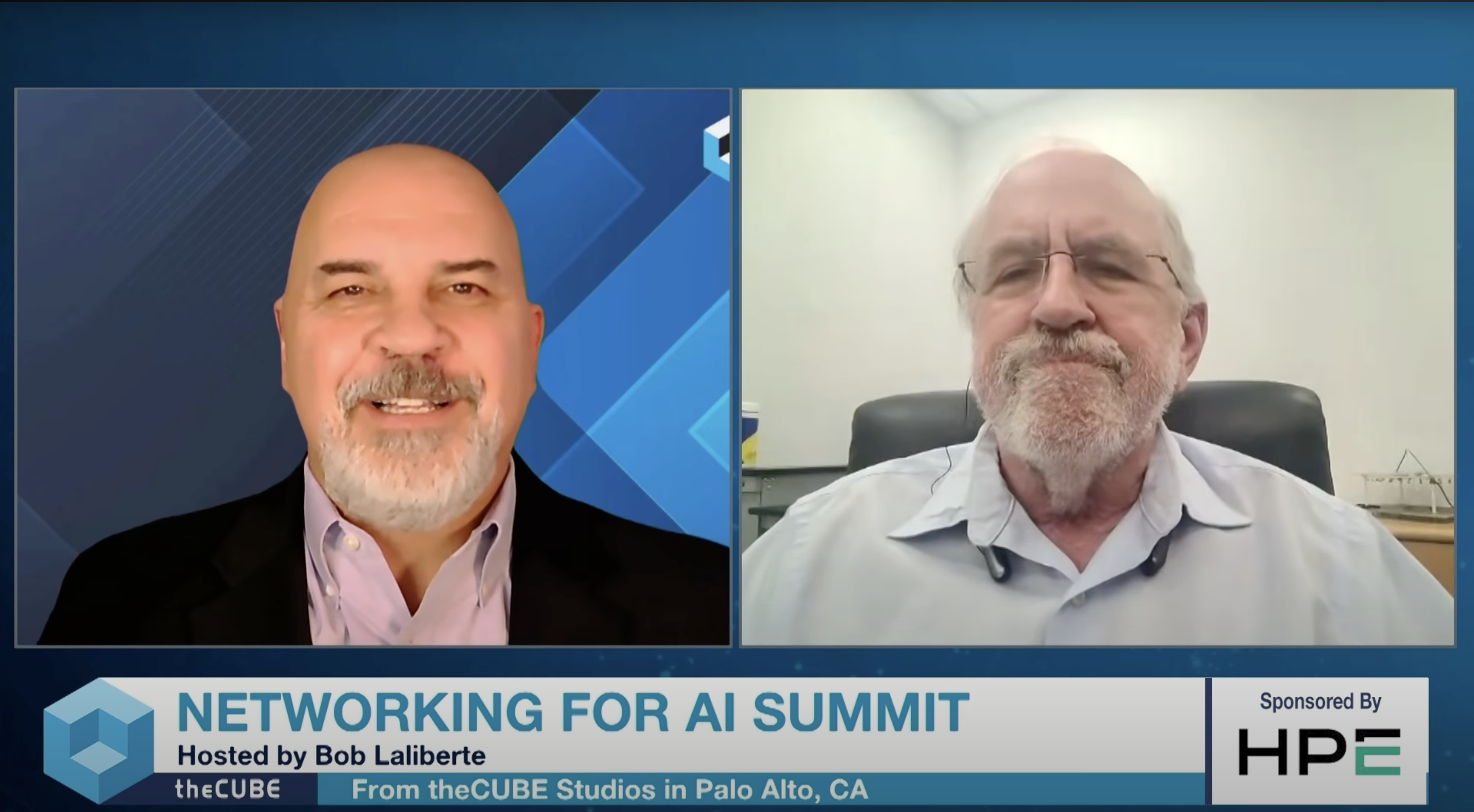
>> Hello and welcome back to the Networking for AI Summit. I'm Bob LaLiberte, principal analyst at theCUBE Research. And in this discussion I'm joined by Luminary Bob Friday, the Chief AI Officer at HPE Networking. Welcome Bob.
Bob Friday
>> Yep. Thank you for having me again, Bob. It's great to be here.
Bob Laliberte
>> That's to Bob's. We're going to try and keep this clear for everyone.
Bob Friday
>> Bob squared.
Bob Laliberte
>> All right, so in this session we're going to explore the concept of self-driving networks and we're going to draw parallels to self-driving cars and then really look at the different stages of autonomy that enterprises can progress through. And our goal is to help you understand where the industry is today, what challenges need to be overcome, and how HPE Networking self-driving networks can help accelerate the adoption of AI at scale. All right, so let's get started. Bob, you've often used the analogy of self-driving cars when you wanted to explain self-driving networks. Can you just walk everyone through how the stages of automation in cars map to networking?
Bob Friday
>> Yeah. When you look at the self-driving Waymo, Uber experience, we saw the whole industry go through that same effort of how do we learn to trust. When you get in that first Waymo, Uber, what made you decide you're going to trust that self-driving car to get you from A to B? And you kind of saw the whole industry go from lane changes. We got comfortable with the, yes, I trusted to keep me in the lanes keeping me in front of cars and you've got enough experience that self-driving Waymo, Uber, you finally made the decision that it is on par with a human driver. I think we're going through the same thing in the networking industry. How do you learn to trust your AI assistants before you turn the keys over to your data plane?
Bob Laliberte
>> Yeah, I think that makes a lot of sense. And a question for you would be, where do you think most IT professionals, networking professionals are today in that progression? Are they at just the lane assist? Are they starting to move into fully automated or somewhere in between?
Bob Friday
>> Yeah. Now interestingly, I would say 10 years ago when I started Mist, I would say everyone was a skeptic. Customers, investors, none of them believed me. This AI stuff was still a research topic. Interestingly, I was with a bunch of probably 50 large customers in Europe last month. And we did the survey of where are you in the adoption of AI, 10 years ago, they were all skeptics, they didn't even want to talk about it. Now they all realize that it's going to be relevant. They're either adopting it or they know it's going to be relevant to their business. They're not quite sure the difference between marketing AI and real AI, but after they've seen ChatGPT, they've seen self-driving Waymo, they know that AI is going to be relevant to their networking IT business.
Bob Laliberte
>> And I think that's a really important point that you bring up because what I've always found is that anytime a technology gets consumerized, the adoption tends to accelerate in the enterprise. It's not like we're trying to push it down the enterprise side first. They've got to experience it. They've gotten a taste of it. So in this case, ChatGPT, like you said, those Waymo that write the self-driving cars and things like that. And they're understanding that, hey, there are benefits to this. So Bob, I'm hoping you could maybe share some of the practical benefits that organizations are realizing today as they move from one stage of the journey to the next.
Bob Friday
>> Yeah, I've talked to some higher ed IT departments and some retail IT departments. And I think one theme you hear from customers enterprises that have moved from standard networking to this cloud AI ops model is that they've gone from being reactive to proactive. If you talk to the average IT person when they walked in the morning, it used to be a very reactive job. There's always a new set of problems they're walking into. I think when you talk to customers that have actually made the leap from the cloud AI ops, you'll just hear that they don't have the same problems every day. They've gone to a more proactive and they, they can focus on other things in their business now besides worrying about the latest IT network fire when they walk in.
Bob Laliberte
>> Yeah, no, I think that makes sense. And organizations are starting to learn to trust these a little bit more as well. One of the things I wanted to touch upon is that similar to self-driving cars, they rely on sensors and a lot of data in order to navigate safely, self-driving networks have to depend on the telemetry, the AI that's actually built into it and automation. I'm wondering how HPE networking brings all these elements together to enable those autonomous actions in the network.
Bob Friday
>> Yeah, this is an interesting one because I always tell when Sujai and I started Mist, we didn't build an access point because we thought the world needed another access point. We did it because we wanted to make sure we were going to get the right data to really be able to predict user experiences and solve that problem. I think what we're seeing right now, old adage, garbage in, garbage out, data is the goal for AI. AI is nothing without data. Now interestingly, when we move into the agentic AI, we're starting to see more data sources become available. If you look at what we're doing here at HPE Networking, we're actually putting minis and software agents into the network itself to bring more data back to the product. And we're starting to tap into MCP to tap into other data sources like Zoom and teams. So I think that's what we're starting to see in the industry is data is king, and more data you bring the more problems you can solve with more granularity.
Bob Laliberte
>> Absolutely. One of the concepts I've always looked at when I was thinking about AI is that time to comfort with the technology. You had mentioned that as well, how do you trust what's going on? Certainly with cars, people had to learn lane keeping, brake assist, maybe even backing up, things of that nature, parking. What do you think are the equivalent trust building steps that have to happen within networking, right? Because it's not like organizations are just going to say, oh, it's fully autonomous. Just flip the switch and let everything go. Where do you see as those important steps and how do you see organizations adopting it?
Bob Friday
>> Yeah, like you said, when we first got our first self-driving cars, first of all we had cruise control, then we had lane assist, then we had driver assist, and you slowly got comfortable with each one of these additions to automation. Now on the IT side, we're starting to see customers start to trust Marvis to start unsticking the port. If there's a stuck port on the switch, you trust Marvis now to unstick it. If you find a missing VLAN, you start to trust Marvis. So I think we're going through that same journey of where it is starting to let Marvis and AI assistants do various things for them. And then eventually when they trust it, then they basically say, "Don't ask me anymore." And they put that action on the trust list. So I think we're on that journey. I think what I tell people now, we've been on that journey for about 10 years. I really see this agentic AI, this nonlinear, non-deterministic programming tool we have now is really going to be the acceleration of the journey. It is really going to accelerate us from driver assist to self-driving.
Bob Laliberte
>> Yeah, I think that makes a lot of sense. And it's interesting. Like I said, I think a lot of times it's going to be a specific use case that gets automated. And again, not all of the functions as people get more comfortable with the technology. I'm wondering if there's anything specifically that HPE networking is doing to help organizations have confidence in these AI driven operations. I used to call it having a closed loop system in place for feedback. I think the more common term now is human in the loop. Is that something that you're also making sure you are embedding into the technology. So that the operators, especially the senior operators who've had 20, 30 years of experience, are able to see some transparency in what's taking place and have that confidence in what it's coming back and telling them?
Bob Friday
>> So interestingly, this spring in May, we actually just introduced Marvis Actions 2.0 to the world. And this is really what we're talking about feedback, is providing the IT team, the ability to decide which actions they're going to trust Marvis to do, and then we give him a full audit log of once you let Marvis do it, how often did he actually apply that action, right? And so that's the beginnings of the feedback loop of yes, you've given Marvis stability to fix something. Let's keep a record of that. I would say interestingly in our case, we've got this Zoom teams model, which is really the user experience. So you can actually see your user experience bad minutes go down. As Marvis starts to fix things, you've actually an improvement directing on the user experience on the network. So that's the feedback loop of yes, it is making a difference, it's making better user experience, and you can see exactly which actions Marvis has taken.
Bob Laliberte
>> And just out of curiosity, I'm also curious as to how it's always been my thought that having those really senior experienced network operators out there providing feedback into that loop is going to also be important. Does that benefit HPE networking as well as you're building out your models and refining them?
Bob Friday
>> I think it's going to be critical. Actually, it's another interesting point of, hey, if you look where agentic AI, you can almost view it as a kind of nonlinear, non-deterministic programming language. So really the whole software QA process is changing as we move into this agentic age because we really need domain experts to give us feedback where we're making progress. So whether I'm doing a troubleshooting CI use case or self-driving use case, I need domain experts, which is really my sales engineer, support team, customers providing that feedback to make sure we're actually making things better. Are we actually improving the accuracy of Marvis?
Bob Laliberte
>> Yeah, absolutely. And I think that's also an important thing to point out for all the network admins and network operators who are watching this, you're actually going to play a very active role in progressing this AI technology and ensuring that it operates the way it should. So again, nothing to fear, something you want to embrace. And the sooner you embrace it, the sooner you jump in, the more benefit you're going to get from it. I know from research that we've done, when we looked at organizations that have had AI operations employed for a longer period of time, more often than not, they're saying that the number one benefit they get is that they've got more time to work on strategic initiatives for the business and drive revenue and so forth, versus the ones who first get it initially are all saying, "Hey, this is great. I can find and fix problems faster." But the ones who've had it for a little bit longer really understand the true value is that they can now take that time that they've saved and put it towards helping to drive towards those business goals.
Bob Friday
>> Yeah. Well, I think if you look at it anyway, I tell people, you look at these AI assistants, you have to treat them like a new employee. If you look at automation in the past it was very deterministic. We built automations and it did the same thing day in out. These new AI assistants, they're more like a dynamic human, right? The more effort you put into train it, the more feedback you get, the better this AI assistant is going to get. And that's probably the big change from what we've seen in the past with automation and what we're doing now with agentic AI and this new generation of automation.
Bob Laliberte
>> Absolutely. Absolutely. That sounds great. So we're running low on time, but I can't end this without asking you, what does the future look like? How do you see the industry starting to move forward from today's partially automated network as it goes to fully self-driving networks? And what's the role that you see that HPE networking is going to play in that?
Bob Friday
>> Yeah, for me personally, I didn't think I would be live long enough to be in a self-driving Waymo Uber. So we are there though in those days, right? It's almost like a sci-fi movie when you go to the Phoenix Airport and watch any self-driving cars. I think I am going to see the self-driving network vision come to life within my career right now. I think we're at this forefront or right at that step breaking point, tipping point of where agentic AI, we have the tools now to really start to make a self-driving network experience. And I think that's where HPE and Juniper coming together really has an opportunity to accelerate. Because we're bringing two market leaders together and we're getting all that data science muscle behind one vision, one mission. So yes, between the agenetic AI, HPE Juniper, I think it's going to happen before I retire.
Bob Laliberte
>> Excellent. Well, I'm glad to hear that. And hopefully that's still a long ways off because I know I've enjoyed following your career and all that you're bringing to it. So that's always much appreciated. And again, Bob, thank you so much for coming on. Thanks for sharing your perspectives on the journey to self-driving networks.
Bob Friday
>> Yeah, thanks for having me. Just something dear to my heart, so always happy to chat.
Bob Laliberte
>> Absolutely. As we've heard, moving from manual operations to higher levels of autonomy is not just about technology, it's also about building trust. It's about simplifying operations and preparing for the future of that AI infrastructure. For all the attendees hope this session provided some clarity on the stages of self-driving networks and how you guys can enable more resilient, efficient, and scalable infrastructure in your environment. Stay tuned with us as we continue with the Networking for AI Summit.









 Bob Laliberte