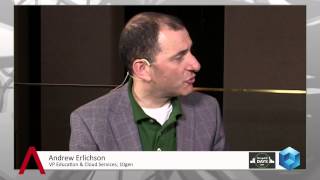
Max Schireson, CEO of 10gen, discussed the latest trends in the database industry and MongoDB's offering within this space with theCUBE co-hosts Dave Vellante and Jeff Kelly, live at the MongoDB Days conference in New York City today.
10gen, having been founded in New York City, "works phenomenally," Schireson said, as the city "has had a great pull in technology." The biggest demand has been coming from the fashion, finance, and media industries which have been the most disrupted by technology. Most of technology demanded is in the application, Internet type of layer and 10gen is working at the deep systems infrastructure lever. New York also offer a "great labor pool."
A new spin on data
Asked what triggered MongoDB's great popularity, Schireson said "the founders really got the basic product concept right." People have have been looking for a database that is more agile and scalable that the traditional offerings. "Many of the problems they're solving now need a different type of technology," he explained, MongoDB's NoSQL database met their requirements.
Explaining the issues traditional data bases could tackle properly, Schireson said that "over the last decade in particular a lot has changed in the way people develop software and what they are developing." Companies are now developing applications at at a more rapid, agile pace, "they want to revive their apps weekly or even daily, often the target platform is mobile," and the data they are working with is no longer rows and numbers in spreadsheets that relational databases were built for.
Asked why MongoDB was so popular with developers, Schireson said the biggest difference between relational databases and MongoDB was the data model. While relational databases' basic unit is a row, a fix set, with which, in order "to model the very ability of real world data you have to bring together many rows and tables and create a fusion," in MongoDB the fundamental unit of storage is a document that has a certain hierarchy, it has a certain order. "That's an order of magnitude simplification for developers and what they want to do."
MongoDB's evolution
Commenting on the company's strategy to target enterprises in general, and the financial sector in particular, Schireson explained that, as they had evolved from web companies and startups and and moved into traditional, mainstream comp, they notices the requirements have a different prioritization. Security and manageablity rank higher for them. That is why 10gen works on development towards monitoring, backup, security, and auditing features.
"There's a reinvention of enterprise infrastructure on the way," Schireson said, as companies move to cloud style deployments, commodity hardware. People look for a different type of technology infrastructure, they are much more open to the cloud and software-based technology, software as a service, and open source. The economy side plays a key part in their decisions, customers are looking for alternatives that are more agile, more reliable, more cost-effective.
1ogen has been growing very quickly in the last 3 years, moving from 20 employees to about 250. "It's been a lot of growth and it's really been in response to the tremendous search and usage of MongoDB, so we want to build it out for the diverse set of requirements we expect," Schireson explained. The company will continue to grow to over 500 people over the next year.
Max Schireson, 10gen, at MongoDB Days 2013, with Dave Vellante and Jeff Kelly
#mongodbdays @thecube
Forgot Password
Almost there!
We just sent you a verification email. Please verify your account to gain access to
MongoDB Days 2013. If you don’t think you received an email check your
spam folder.
In order to sign in, enter the email address you used to registered for the event. Once completed, you will receive an email with a verification link. Open this link to automatically sign into the site.
Register For MongoDB Days 2013
Please fill out the information below. You will recieve an email with a verification link confirming your registration. Click the link to automatically sign into the site.
You’re almost there!
We just sent you a verification email. Please click the verification button in the email. Once your email address is verified, you will have full access to all event content for MongoDB Days 2013.
I want my badge and interests to be visible to all attendees.
Checking this box will display your presense on the attendees list, view your profile and allow other attendees to contact you via 1-1 chat. Read the Privacy Policy. At any time, you can choose to disable this preference.
Select your Interests!
add
Upload your photo
Uploading..
OR
Connect via Twitter
Connect via Linkedin
EDIT PASSWORD
Share
Forgot Password
Almost there!
We just sent you a verification email. Please verify your account to gain access to
MongoDB Days 2013. If you don’t think you received an email check your
spam folder.
In order to sign in, enter the email address you used to registered for the event. Once completed, you will receive an email with a verification link. Open this link to automatically sign into the site.
Sign in to gain access to MongoDB Days 2013
Please sign in with LinkedIn to continue to MongoDB Days 2013. Signing in with LinkedIn ensures a professional environment.
Are you sure you want to remove access rights for this user?
Details
Manage Access
email address
Community Invitation
Max Schireson, 10gen - MongoDB Days 2013 - #MDBDays #theCUBE
Max Schireson, CEO of 10gen, discussed the latest trends in the database industry and MongoDB's offering within this space with theCUBE co-hosts Dave Vellante and Jeff Kelly, live at the MongoDB Days conference in New York City today.
10gen, having been founded in New York City, "works phenomenally," Schireson said, as the city "has had a great pull in technology." The biggest demand has been coming from the fashion, finance, and media industries which have been the most disrupted by technology. Most of technology demanded is in the application, Internet type of layer and 10gen is working at the deep systems infrastructure lever. New York also offer a "great labor pool."
A new spin on data
Asked what triggered MongoDB's great popularity, Schireson said "the founders really got the basic product concept right." People have have been looking for a database that is more agile and scalable that the traditional offerings. "Many of the problems they're solving now need a different type of technology," he explained, MongoDB's NoSQL database met their requirements.
Explaining the issues traditional data bases could tackle properly, Schireson said that "over the last decade in particular a lot has changed in the way people develop software and what they are developing." Companies are now developing applications at at a more rapid, agile pace, "they want to revive their apps weekly or even daily, often the target platform is mobile," and the data they are working with is no longer rows and numbers in spreadsheets that relational databases were built for.
Asked why MongoDB was so popular with developers, Schireson said the biggest difference between relational databases and MongoDB was the data model. While relational databases' basic unit is a row, a fix set, with which, in order "to model the very ability of real world data you have to bring together many rows and tables and create a fusion," in MongoDB the fundamental unit of storage is a document that has a certain hierarchy, it has a certain order. "That's an order of magnitude simplification for developers and what they want to do."
MongoDB's evolution
Commenting on the company's strategy to target enterprises in general, and the financial sector in particular, Schireson explained that, as they had evolved from web companies and startups and and moved into traditional, mainstream comp, they notices the requirements have a different prioritization. Security and manageablity rank higher for them. That is why 10gen works on development towards monitoring, backup, security, and auditing features.
"There's a reinvention of enterprise infrastructure on the way," Schireson said, as companies move to cloud style deployments, commodity hardware. People look for a different type of technology infrastructure, they are much more open to the cloud and software-based technology, software as a service, and open source. The economy side plays a key part in their decisions, customers are looking for alternatives that are more agile, more reliable, more cost-effective.
1ogen has been growing very quickly in the last 3 years, moving from 20 employees to about 250. "It's been a lot of growth and it's really been in response to the tremendous search and usage of MongoDB, so we want to build it out for the diverse set of requirements we expect," Schireson explained. The company will continue to grow to over 500 people over the next year.
Max Schireson, 10gen, at MongoDB Days 2013, with Dave Vellante and Jeff Kelly
#mongodbdays @thecube