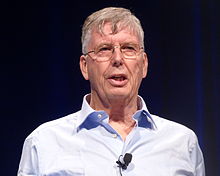
Michael Stonebraker, Co-Founder & CTO, at TAMR joins theCUBE hosts Dave Vellante (@dvellante) and Paul Gillin (@pgillin) live from MIT CDOIQ in Cambridge MA
#theCUBE #MITCDOIQ
https://siliconangle.com/2019/08/09/real-big-data-problem-machine-learning-can-fix-mitcdoiq-startupoftheweek/
Machine learning tips the scale
The market is not exactly lacking proposed solutions to the data-swamp problem. Plenty of tech companies are bringing them out or updating their original offerings. The main technologies typically used in these systems, however, have a key deficiency, Stonebraker pointed out. These traditional technologies include extract, transform, load systems and master data management systems.
“A dirty, little secret is that technology does not scale,” Stonebraker said.
ETL is based on the premise that someone really bright will come up with a global data model for all data sources a user wants. Then a human interviews each business unit to see what data they’ve got, how to get it in the global data model, load it into the data warehouse and so on. Processes that are that human intensive tend to not scale, according to Stonebraker. They typically wind up with 10 or 20 sources integrated in the data warehouse, he added.
Is that a sufficient number? Let’s look at a real-world company. Tamr customer Toyota Motor Europe has distributors in different countries (sometimes cantons). If someone buys a Toyota in Spain and then moves to France, the French company knows nothing about the car owner.
In total, TME has 250 separate customer databases with 40 million total records in 50 languages. The company is in the process of integrating them into a single customer database to solve this customer-servicing issue. Machine learning provides a plausible means to do this. “I’ve never seen an ETL system capable of dealing with that kind of scale,” Stonebraker said.
The reason MDM doesn’t scale is basically because it’s rules-based, Stonebraker explained. Another Tamr customer, General Electric Co., wants to do spend analytics. It had 20 million spend transactions from the year before last. It tried to classify all of those into a rules-based hierarchy.
“So GE wrote 500 rules, which is about the most any single human can get their arms around,” he said. “That classified 2 million of the 20 million transactions. You’ve now got 18 to go. And another 500 rules is not going to give you 2 million more.
That, he noted, is the law of diminishing returns. “You’re going to have to write a huge number of rules that no one can possibly understand,” Stonebraker said. “If you don’t use machine learning, you’re absolutely toast.”
Forgot Password
Almost there!
We just sent you a verification email. Please verify your account to gain access to
MIT Chief Data Officer and Information Quality Symposium (CDOIQ) 2019 | Boston. If you don’t think you received an email check your
spam folder.
Sign in to MIT Chief Data Officer and Information Quality Symposium (CDOIQ) 2019 | Boston.
In order to sign in, enter the email address you used to registered for the event. Once completed, you will receive an email with a verification link. Open this link to automatically sign into the site.
Register For MIT Chief Data Officer and Information Quality Symposium (CDOIQ) 2019 | Boston
Please fill out the information below. You will recieve an email with a verification link confirming your registration. Click the link to automatically sign into the site.
You’re almost there!
We just sent you a verification email. Please click the verification button in the email. Once your email address is verified, you will have full access to all event content for MIT Chief Data Officer and Information Quality Symposium (CDOIQ) 2019 | Boston.
Thanks for confirming your account. Now you can access MIT Chief Data Officer and Information Quality Symposium (CDOIQ) 2019 | Boston with this email address.
I want my badge and interests to be visible to all attendees.
Checking this box will display your presense on the attendees list, view your profile and allow other attendees to contact you via 1-1 chat. Read the Privacy Policy. At any time, you can choose to disable this preference.
Select your Interests!
add
Upload your photo
Uploading..
OR
Connect via Twitter
Connect via Linkedin
EDIT PASSWORD
Share
Forgot Password
Almost there!
We just sent you a verification email. Please verify your account to gain access to
MIT Chief Data Officer and Information Quality Symposium (CDOIQ) 2019 | Boston. If you don’t think you received an email check your
spam folder.
Sign in to MIT Chief Data Officer and Information Quality Symposium (CDOIQ) 2019 | Boston.
In order to sign in, enter the email address you used to registered for the event. Once completed, you will receive an email with a verification link. Open this link to automatically sign into the site.
Sign in to gain access to MIT Chief Data Officer and Information Quality Symposium (CDOIQ) 2019 | Boston
Please sign in with LinkedIn to continue to MIT Chief Data Officer and Information Quality Symposium (CDOIQ) 2019 | Boston. Signing in with LinkedIn ensures a professional environment.
Are you sure you want to remove access rights for this user?
Details
Manage Access
email address
Community Invitation
Michael Stonebraker, TAMR | MIT CDOIQ 2019
Michael Stonebraker, Co-Founder & CTO, at TAMR joins theCUBE hosts Dave Vellante (@dvellante) and Paul Gillin (@pgillin) live from MIT CDOIQ in Cambridge MA
#theCUBE #MITCDOIQ
https://siliconangle.com/2019/08/09/real-big-data-problem-machine-learning-can-fix-mitcdoiq-startupoftheweek/
Machine learning tips the scale
The market is not exactly lacking proposed solutions to the data-swamp problem. Plenty of tech companies are bringing them out or updating their original offerings. The main technologies typically used in these systems, however, have a key deficiency, Stonebraker pointed out. These traditional technologies include extract, transform, load systems and master data management systems.
“A dirty, little secret is that technology does not scale,” Stonebraker said.
ETL is based on the premise that someone really bright will come up with a global data model for all data sources a user wants. Then a human interviews each business unit to see what data they’ve got, how to get it in the global data model, load it into the data warehouse and so on. Processes that are that human intensive tend to not scale, according to Stonebraker. They typically wind up with 10 or 20 sources integrated in the data warehouse, he added.
Is that a sufficient number? Let’s look at a real-world company. Tamr customer Toyota Motor Europe has distributors in different countries (sometimes cantons). If someone buys a Toyota in Spain and then moves to France, the French company knows nothing about the car owner.
In total, TME has 250 separate customer databases with 40 million total records in 50 languages. The company is in the process of integrating them into a single customer database to solve this customer-servicing issue. Machine learning provides a plausible means to do this. “I’ve never seen an ETL system capable of dealing with that kind of scale,” Stonebraker said.
The reason MDM doesn’t scale is basically because it’s rules-based, Stonebraker explained. Another Tamr customer, General Electric Co., wants to do spend analytics. It had 20 million spend transactions from the year before last. It tried to classify all of those into a rules-based hierarchy.
“So GE wrote 500 rules, which is about the most any single human can get their arms around,” he said. “That classified 2 million of the 20 million transactions. You’ve now got 18 to go. And another 500 rules is not going to give you 2 million more.
That, he noted, is the law of diminishing returns. “You’re going to have to write a huge number of rules that no one can possibly understand,” Stonebraker said. “If you don’t use machine learning, you’re absolutely toast.”